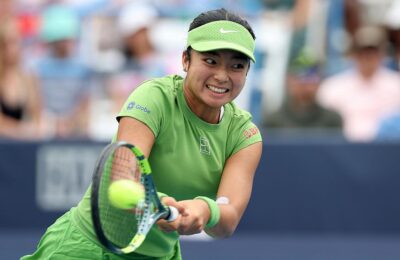
Alex Eala’s incredible North American hard-court run continues.
Just days after making Philippine tennis history by winning her first WTA Tour singles title in Washington, the Filipina tennis star has delivered another hard-fought victory—this time at one of the biggest tournaments on the WTA calendar.
Alex defeated American Caty McNally, 6–3, 5–7, 6–4, in the third round of the 2026 Canadian Open, officially known as the National Bank Open presented by Rogers, in Toronto.
The three-set victory sends Alex into the Round of 16 of the WTA 1000 tournament, where another difficult challenge awaits: former world No. 4 and 2015 Canadian Open champion Belinda Bencic of Switzerland.
For Filipino fans following Alex’s remarkable rise, this is another important result.
She has now won seven consecutive singles matches across Washington and Toronto, and instead of slowing down after winning the biggest title of her career, she continues to find ways to win.
Let’s take a closer look at Alex Eala’s victory over Caty McNally, how she reached the Canadian Open Round of 16, what the result means for her ranking and prize money, and what to expect from her next match against Belinda Bencic.
Content
Alex Eala defeats Caty McNally in three sets
The final score:
Alex Eala def. Caty McNally, 6–3, 5–7, 6–4
It was another long and challenging match for Alex.
She won the opening set 6–3 and appeared to be moving toward another important victory, but McNally refused to disappear.
The American fought back in the second set, eventually taking it 7–5 and forcing the match into a deciding third set.
At that point, the pressure increased considerably.
Alex had already played a lot of tennis over the previous week. She had just completed a five-match title run in Washington, traveled to Toronto, beaten Alycia Parks in three sets in her opening singles match, and also competed in doubles with Venus Williams.
Another deciding set was probably the last thing she needed physically.
But Alex kept fighting.
She eventually edged McNally 6–4 in the third set to secure the victory and move into the fourth round.
It was not an easy win, and that is exactly what makes it impressive.
At this level of professional tennis, players are rarely going to dominate every match. Sometimes the biggest difference between winning and losing is simply finding a way to survive when your best tennis is not available for every point.
Alex did exactly that.
Another example of Alex Eala’s fighting mentality
One of the most noticeable developments in Alex’s game has been her ability to remain composed in difficult matches.
She has always had the technical ability.
She is left-handed, moves well around the baseline, takes the ball early, and can create difficult angles with her forehand. Her return of serve has also developed into one of the strongest parts of her game.
But what has become increasingly impressive is her mentality.
Against McNally, Alex won the first set but lost a tight second. For many players, that shift in momentum can become dangerous.
Instead of allowing the disappointment of losing the second set to carry into the third, Alex reset and competed for every game.
That ability to recover mentally is one of the reasons she has been winning so many close matches.
It also explains why her current run feels different from simply producing an occasional upset.
Alex is now consistently finding ways to win.
Who is Caty McNally?
McNally was never going to be an easy opponent despite entering the tournament ranked below Alex.
The American is known for having an all-court game. She is comfortable at the baseline, but unlike many modern singles players, she is also willing to attack the net.
Her doubles experience has helped develop excellent volleys, anticipation, and court awareness.
Before facing Alex, McNally had already produced one of the biggest surprises of the Canadian Open.
She defeated No. 6 seed and reigning Wimbledon champion Linda Noskova, 7–6(5), 6–1.
That result was even more impressive because McNally had fallen behind 1–5 in the opening set before turning the match around.
The National Bank Open described McNally as world No. 70 heading into her meeting with Eala, while Alex had climbed to world No. 20 following her Washington championship.
Rankings can sometimes make a matchup look easier than it actually is.
McNally clearly arrived in Toronto playing very good tennis, and her victory over Noskova proved she had the ability to trouble highly ranked opponents.
That is why Alex’s three-set win deserves plenty of credit.
Alex and McNally had never played before
Another interesting aspect of the matchup was that it was their first career singles meeting.
There was no previous head-to-head record.
Alex could study video and prepare for McNally’s style, but there is always a difference between watching someone play and actually experiencing their shots, timing, movement, and patterns from across the net.
McNally’s willingness to move forward also creates a different type of challenge.
Alex generally likes to control rallies from the baseline. Against an opponent who attacks the net, she must make quick decisions—whether to hit a passing shot, attempt a lob, attack the body, or force the opponent into a difficult volley.
Over three sets, Alex found enough answers.
Alex Eala is now in the Canadian Open Round of 16
The victory puts Alex among the final 16 players in Toronto.
That is particularly significant because the Canadian Open is a WTA 1000 tournament.
These events are among the most prestigious competitions in women’s professional tennis outside the four Grand Slams and the season-ending WTA Finals.
Toronto features a 96-player singles field, with the top 32 seeds receiving first-round byes. Alex entered as the No. 25 seed and therefore began her campaign directly in the second round.
Her Toronto singles journey so far has been:
- First round: Bye
- Second round: Defeated Alycia Parks, 6–1, 4–6, 6–2
- Third round: Defeated Caty McNally, 6–3, 5–7, 6–4
- Round of 16: Belinda Bencic
Two matches.
Two deciding sets.
Two victories.
And Alex is still standing.
Seven consecutive singles victories
Perhaps the most impressive statistic surrounding Alex right now is her winning streak.
After defeating McNally, she has won seven consecutive singles matches.
The streak began during her championship run at the Mubadala DC Open in Washington.
Alex won five matches there, defeating a difficult group of opponents before beating Jessica Pegula in the final.
She then traveled to Toronto and defeated Parks.
Now McNally becomes victory No. 7.
After the Parks match, the WTA noted that Alex had extended her winning streak to six matches. The McNally victory adds another one to that total.
Winning seven consecutive matches on the WTA Tour is difficult under any circumstances.
Doing it across two tournaments, with travel in between and several three-set matches, makes the run even more impressive.
Remember what happened only days ago in Washington
It is easy to forget just how quickly everything has happened.
Alex entered Washington ranked outside the Top 20.
She then went on the best main-tour run of her professional career.
In the final, she faced Jessica Pegula, one of the world’s leading hard-court players.
Pegula won the opening set, and rain interrupted the match.
When play resumed, Alex turned everything around.
She eventually defeated Pegula 4–6, 6–4, 6–0 to win her first WTA Tour singles title.
The championship made her the first player representing the Philippines to win a WTA Tour-level singles title and pushed her to a career-high world No. 20.
There was barely enough time to celebrate.
Alex had to leave Washington, travel to Toronto, recover, practice, and begin another tournament almost immediately.
That makes her Toronto performance even more remarkable.
Alex Eala is now a Top 20 player
Alex entered Toronto with a new status.
She was no longer merely the rising Filipina who had produced surprising victories against established stars.
She arrived as a WTA champion and world No. 20.
The National Bank Open currently lists her at No. 20, although she is officially the No. 25 seed in Toronto because the tournament seeding was based on an earlier ranking before her Washington title.
This creates a different kind of pressure.
When Alex was ranked outside the Top 100 or even outside the Top 50, she often entered matches as the underdog.
Now players are preparing specifically to beat her.
Opponents know about her forehand.
They know about her left-handed patterns.
They know how dangerous she is on return.
They also know she has beaten some of the best players in the world.
That changes expectations.
The fact that Alex continues winning under these new circumstances is encouraging.
Her victory over McNally is different from beating a Top 10 player
There is an interesting psychological challenge that comes with climbing the rankings.
When Alex plays someone ranked No. 5 or No. 10, she can enter knowing that most people expect her opponent to win.
There is freedom in being the underdog.
Against McNally, the situation was reversed.
Alex was ranked No. 20.
McNally was around No. 70.
Suddenly, Alex was the higher-ranked player expected to advance.
That pressure can sometimes be more difficult.
There is less room for error because fans begin treating every lower-ranked opponent as someone Alex “should” beat.
But professional tennis does not work that way.
McNally had just eliminated the reigning Wimbledon champion.
She was clearly dangerous.
Alex still found a way to win.
That type of victory may not attract the same headlines as defeating a world No. 1, but it is extremely important for building a sustainable career near the top of the rankings.
Alex has now won two three-set matches in Toronto
Another encouraging statistic is Alex’s ability to handle deciding sets.
Against Parks:
6–1, 4–6, 6–2
Against McNally:
6–3, 5–7, 6–4
In both matches, Alex won the opening set, lost the second, and then recovered to take the third.
That pattern tells us something important.
Alex is not panicking when an opponent changes the momentum.
She is learning how to reset.
At WTA 1000 tournaments and Grand Slams, that skill becomes extremely valuable because the competition becomes more difficult with every round.
Her doubles campaign with Venus Williams is over
Alex was also competing in Toronto doubles alongside tennis legend Venus Williams.
The pair faced Miyu Kato and Liudmila Samsonova in the first round.
Their doubles campaign ended with a straight-sets defeat, allowing Alex to concentrate completely on singles going forward. The National Bank Open confirmed that Eala and Williams were eliminated in the opening round.
From a fan’s perspective, it would have been exciting to see Alex and Venus make a deep doubles run.
From a physical perspective, however, the singles-only schedule may actually help.
Alex has played a tremendous amount of tennis over a short period.
She needs every possible opportunity to rest.
Alex Eala earns more ranking points and prize money
Reaching the Canadian Open Round of 16 also comes with significant ranking points and prize money.
According to the WTA’s official Toronto tournament breakdown, a player reaching the fourth round receives:
120 WTA ranking points
and
US$81,800 in prize money
A quarterfinal appearance would increase those totals to 215 ranking points and US$154,354.
However, the ranking impact is not as simple as adding 120 points directly to Alex’s current total.
WTA rankings consider results from a rolling period, and certain previous results may be replaced or dropped.
Still, every deep WTA 1000 run strengthens Alex’s position and gives her valuable points as she tries to establish herself permanently inside the Top 20.
Next opponent: Belinda Bencic
Alex’s next challenge will be significantly tougher.
She will face Switzerland’s Belinda Bencic, the No. 12 seed.
Bencic defeated American Taylor Townsend in a marathon three-set match to earn her place in the Round of 16.
The Swiss star brings a completely different level of experience.
She has been ranked as high as world No. 4, won Olympic singles gold at the Tokyo Games, and has been one of the most accomplished players of her generation.
Most importantly for this tournament, Bencic knows exactly what it takes to win in Toronto.
She captured the Canadian Open title in 2015. The WTA lists her among the former champions competing in the 2026 tournament.
So Alex is not simply facing another highly ranked opponent.
She is facing a former champion on a court where that opponent has already experienced one of the biggest victories of her career.
Why Belinda Bencic is dangerous
Bencic does not need overwhelming power to control a match.
Her greatest strength is timing.
She likes to stand close to the baseline and take the ball early. By doing this, she removes time from her opponent and redirects pace exceptionally well.
That can be difficult for Alex.
Alex likes to build points using her forehand and create angles with her left-handed patterns.
Bencic may try to prevent those patterns from developing by striking early and forcing Alex to react instead of dictate.
Bencic is also an excellent returner.
Serving consistently will therefore become especially important for Alex.
If Alex leaves too many second serves in the middle of the box, Bencic is capable of immediately taking control of the rally.
The Eala-Bencic matchup should be fascinating
Stylistically, this could be one of Alex’s most interesting matches in Toronto.
Both players like to take time away from their opponents.
Both are comfortable redirecting the ball.
Both have strong returns.
The key difference may be how effectively Alex uses her left-handed forehand.
A lefty forehand naturally creates different angles against a right-handed player. If Alex can consistently push Bencic away from the court, she may create opportunities to attack the open space.
Alex will also need to remain patient.
Bencic is experienced enough to absorb early pressure and wait for an opponent to become impatient.
This is unlikely to be a match where Alex can simply overpower her opponent from start to finish.
She will need variety, discipline, and another strong mental performance.
Bencic also had to survive a difficult third round
One positive for Alex is that she is not the only player coming from a demanding match.
Bencic needed three sets to overcome Taylor Townsend.
That match featured two close tiebreak sets before Bencic eventually completed the victory in the third.
This means both players arrive in the Round of 16 having spent significant time on court.
Recovery could therefore become important.
At this stage of a tournament, physical conditioning becomes almost as important as shot-making.
What Alex needs to do against Bencic
Alex’s return game will likely be one of the biggest keys.
She has become one of the WTA Tour’s most dangerous second-serve returners. WTA statistics earlier in the 2026 season placed her among the leaders in second-serve return points won.
If Alex can consistently pressure Bencic’s second serve, she may create enough break opportunities to control important games.
She will also need to protect her own second serve.
Bencic will attack anything short.
Alex should look to vary placement, move Bencic around, and avoid falling into predictable patterns.
Most importantly, she needs to remain mentally patient.
Bencic will probably create stretches where Alex feels rushed.
That is normal against a player who takes the ball early.
The challenge will be avoiding frustration and continuing to trust her game.
Filipino support remains a major part of Alex’s Toronto run
One of the biggest stories surrounding Alex in Canada has been the crowd.
Toronto has a large Filipino community, and thousands have shown up to support her.
During her opening singles match against Parks, Philippine flags were everywhere inside Sobeys Stadium.
The tournament itself has repeatedly referred to the growing phenomenon as “Eala-mania.”
For Alex, that support creates something close to a home-court advantage.
That is unusual in professional tennis.
The Philippines does not currently host a regular WTA Tour event, meaning Alex rarely has the opportunity to compete professionally in front of thousands of Filipino supporters.
Cities with large Filipino communities—Toronto, New York, Washington, Melbourne, and others—have increasingly become unofficial home crowds.
Against Bencic, the atmosphere could once again be intense.
Alex Eala’s Canadian Open run so far
Alex’s Toronto campaign has already become another successful chapter in her breakthrough 2026 season.
She arrived as a newly crowned WTA champion.
She defeated Alycia Parks despite being pushed to three sets.
She then survived another three-set battle against a confident Caty McNally.
Now she is in the final 16 of a WTA 1000 tournament.
And remember—she had barely finished celebrating Washington before all of this started.
Why this run matters even if Alex does not win the tournament
Winning titles is obviously the ultimate goal.
But Alex does not need to win Toronto for this tournament to be considered successful.
The bigger picture is consistency.
Young players often produce one spectacular tournament and then struggle to reproduce that level.
Alex’s challenge after winning Washington was to prove that she could immediately compete well again.
So far, she has done exactly that.
She has followed a WTA 500 championship with consecutive victories at a WTA 1000 event.
That tells us her Washington title was not simply the result of one extraordinary week.
Her overall level is rising.
That is probably the most encouraging part of her recent results.

Frequently asked questions about Alex Eala at the Canadian Open
Did Alex Eala beat Caty McNally?
Yes. Alex defeated Caty McNally 6–3, 5–7, 6–4 in the Canadian Open third round on August 8, Philippine time.
What round is Alex Eala in now?
Alex has advanced to the Round of 16, also referred to as the fourth round.
Who will Alex Eala play next?
She will face Belinda Bencic of Switzerland, the No. 12 seed and 2015 Canadian Open champion.
What is Alex Eala’s current ranking?
Alex entered the latest stage of the tournament ranked world No. 20, the highest ranking of her career and a record for a Filipino singles player.
How many consecutive matches has Alex Eala won?
She has now won seven consecutive singles matches—five in Washington followed by victories over Alycia Parks and Caty McNally in Toronto.
Is Alex still playing doubles with Venus Williams?
No. Eala and Venus Williams were eliminated in the first round of the Toronto doubles tournament by Miyu Kato and Liudmila Samsonova.
How much prize money has Alex earned by reaching the Round of 16?
The official WTA prize-money schedule awards US$81,800 to players reaching the fourth round of the Canadian Open.
How many ranking points are awarded for reaching the Round of 16?
The fourth round is worth 120 WTA ranking points. The net effect on Alex’s ranking will depend on the WTA’s rolling ranking system and any points being replaced.
What happens if Alex beats Bencic?
If Alex defeats Bencic, she will advance to the Canadian Open quarterfinals.
That would increase her tournament haul to 215 ranking points and US$154,354 in prize money.
More importantly, it would give Alex another deep run at a WTA 1000 event and keep alive the possibility of winning back-to-back major titles in Washington and Toronto.
Considering how difficult the WTA Tour is, winning consecutive tournaments at WTA 500 and WTA 1000 level would be an extraordinary achievement.
But that is still several steps away.
For now, the focus is Bencic.
Final thoughts
Alex Eala keeps finding ways to make Philippine tennis history more exciting.
Her victory over Caty McNally was not a comfortable straight-sets win.
It was a battle.
Alex won the opening set, watched McNally fight back to take the second, and then had to dig deep in the deciding set.
She could have been tired.
She probably was.
She could have allowed the momentum to shift completely after losing the second set.
She did not.
Instead, Alex kept competing and eventually won 6–4 in the third.
That is what makes this victory important.
The best players do not always win because they play perfectly. Sometimes they win because they remain composed long enough to figure out a solution.
Alex is starting to demonstrate that quality more frequently.
Seven straight singles victories.
A first WTA Tour championship.
A career-high world No. 20 ranking.
And now a place in the Canadian Open Round of 16.
Next comes Belinda Bencic—a former world No. 4, Olympic champion, and former winner of this very tournament.
It will be another difficult test.
But considering everything Alex Eala has accomplished over the past few weeks, Filipino tennis fans have plenty of reasons to believe that this remarkable run may not be over yet.