Some Philippine festivals celebrate a harvest. Others revolve around a local product, a religious devotion or an important moment in history.
Lawag Festival in Laoang, Northern Samar is a little different because it brings several of those ideas together—but at the center of everything is one simple image:
Light.
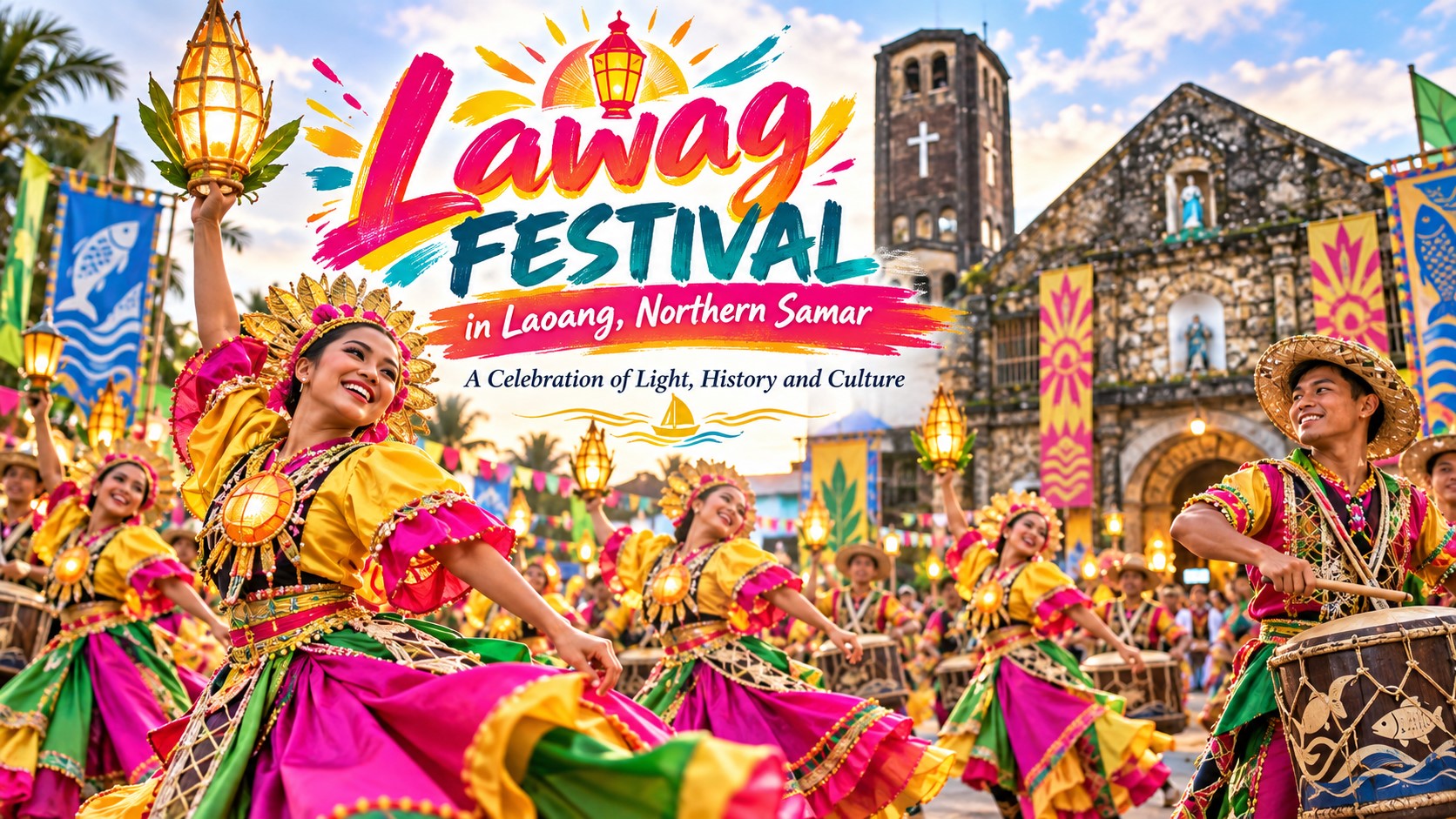
Every September, Laoang celebrates its history and local identity through Lawag Festival, a cultural celebration filled with street dancing, colorful costumes, storytelling and imagery connected with the town’s old fishing traditions.
But Lawag isn’t simply about putting dancers on the street.
The festival tells the story of Laoang itself.
Northern Samar’s official tourism portal describes Lawag Festival as a celebration depicting the founding and legends of Laoang, including the traditional story of how the island received its name and the arrival of three brothers identified as Surahan, Anud-anod and Kahundit.
And once you understand what “Lawag” represents, the festival becomes much more interesting.
Content
What Is Lawag Festival?
Lawag Festival is a cultural festival celebrated in the municipality of Laoang in Northern Samar.
It forms part of Laoang’s September celebration season, which eventually leads into the town fiesta honoring St. Michael the Archangel on September 28 and 29.
Unlike the patronal fiesta itself, Lawag focuses heavily on Laoang’s history, legends, fishing heritage and community identity.
Official Northern Samar tourism information describes the festival as a depiction of the founding of Laoang and local traditions surrounding the arrival of Surahan, Anud-anod and Kahundit.
Through dance and dramatic presentation, performers turn those stories into something people can actually see.
That is one of the things I like about festivals such as Lawag.
Instead of reading local history from a plaque or museum display, you’re watching communities interpret it through movement, costumes, music and props.
Lawag Festival Quick Facts
| Detail | Information |
|---|---|
| Festival | Lawag Festival |
| Location | Laoang, Northern Samar |
| Usual Month | September |
| Current Northern Samar Tourism Listing | September 23 |
| Main Theme | History, legends, fishing heritage and light |
| Town Fiesta | September 28–29 |
| Patron Saint | St. Michael the Archangel |
| Main Fiesta Day | September 29 |
| Main Cultural Features | Street dancing, storytelling, costumes, lights and historical themes |
Northern Samar Tourism currently lists September 23 as the Lawag Festival date and September 28–29 as Laoang’s town fiesta.
However, you’ll sometimes encounter September 20 in older or separate references to the town’s founding anniversary. I’ll explain that difference later because it is useful if you’re actually planning a trip.
What Does “Lawag” Mean?
This is where the festival gets its identity.
Municipal promotional material explains that the name Laoang is traditionally connected with the word “Lawag,” meaning light. The same local narrative describes lawag as a light once used by fishermen to attract fish and help with their nighttime catch.
Think about that for a moment.
Before modern electric lights, fishermen heading out at night depended on a source of illumination.
That light was practical.
It helped them work.
It helped them navigate darkness.
And in the festival, that simple fishing light becomes something larger.
It represents hope.
Guidance.
Livelihood.
And the ability of a community to keep moving even when things around it are uncertain.
Recent promotional descriptions of Lawag explicitly use light as a symbol of hope for Laoanganons facing life’s difficulties.
So the “festival of lights” idea isn’t just about making the streets look pretty.
The light has meaning.
From Lawag to Laoang
There is also an interesting historical detail worth clarifying.
Festival narratives commonly connect the word Laoang with “Lawag” and the traditional lamps used by fishermen.
A local historical study likewise recorded oral accounts saying Laoang derived from Lawag, a term associated with night fishing.
But local history is not completely uniform on this point.
Other historical interpretations have suggested that an older form of the name may have been “Lawang,” with a different linguistic origin.
That distinction is important.
Festivals often preserve oral traditions and community legends. Those traditions are meaningful even when historians debate exactly how a place name developed centuries ago.
So the best way to understand Lawag Festival is not to treat every scene as a literal historical documentary.
It is Laoang telling its own story.
Through memory.
Legend.
Livelihood.
And tradition.
The Story of Surahan, Anud-anod and Kahundit
One of the most recognizable narratives presented during Lawag Festival involves three brothers: Surahan, Anud-anod and Kahundit.
Northern Samar Tourism specifically identifies them in its description of the festival, saying Lawag portrays their arrival as part of Laoang’s founding legend.
Local accounts associate the three with Palapag and the early settlement of Laoang.
Festival performances may interpret these stories through dramatic choreography, characters, symbolic props and scenes representing arrival, settlement and the development of community life.
Again, these are best understood as part of Laoang’s local historical tradition.
And this storytelling element is exactly what gives Lawag a different personality from a festival centered on, say, one agricultural crop.
You’re watching a narrative unfold.
Why Fishing Is Important to Lawag Festival
If light is one half of Lawag’s identity, fishing is the other.
The traditional lawag was associated with fishermen.
Municipal descriptions say the light helped attract fish and facilitate the catch.
That is why costumes and props used in Lawag presentations can incorporate elements inspired by fishing, the sea and the everyday life of Laoanganons.
It makes sense geographically too.
Laoang is an island and coastal municipality whose history has always been closely connected with surrounding waters.
For earlier generations, the sea wasn’t simply scenery.
It was transportation.
Food.
Livelihood.
And survival.
So when festival performers recreate nighttime fishing or carry light-inspired props, those aren’t random decorations.
They’re representing part of the way people lived.
Lawag Festival as a Festival of Lights
Calling Lawag a festival of lights sounds modern, but its concept actually reaches back to something very traditional.
A flame or lamp carried by a fisherman at night.
Today, that idea becomes much bigger.
Festival presentations have used torches, lantern-like props, illuminated displays and other visual interpretations of light. Recent Laoang festival promotions have continued emphasizing lanterns, torches and the idea of the town “lighting up.”
And visually, this works really well.
Imagine groups of performers carrying glowing or light-inspired objects while telling a story about fishermen finding their way through the darkness.
That’s a very simple image.
But it’s powerful.
Light becomes both literal and symbolic at the same time.
Street Dancing
Of course, this is still a Philippine festival.
So yes, expect dancing.
Educational materials documenting Northern Samar’s festivals describe Lawag as including street dancing and field presentations where performers demonstrate aspects of local life through choreographed movement.
The performances are not necessarily just dance for the sake of dance.
They can function almost like moving theater.
A contingent can begin by representing fishermen.
Then another scene might depict the arrival of early settlers.
Another may symbolize hardship.
Then light appears.
The community grows.
The dancers celebrate.
When done well, you can understand the basic story even without someone explaining every movement.
Costumes and Props
This is another area where Lawag becomes especially photogenic.
Festival costumes tend to reflect the themes being presented rather than following only one permanent design.
Depending on the concept, you may see colors and patterns representing the sea, fishermen, indigenous or historical imagery, light, local livelihoods or the town’s legends.
Large props can become an important part of the storytelling too.
Lanterns.
Fishing-related objects.
Decorative lights.
Historical characters.
Elements representing waves or the sea.
And because each contingent can interpret the theme creatively, one performance may look very different from another.
That’s one of the best things about watching Philippine festival competitions.
You already know the general story.
But you don’t know how each group is going to tell it.
Music and Drums
Street dancing wouldn’t feel the same without the percussion.
Like many cultural festivals in the Philippines, Lawag uses rhythm to push the story forward.
The drums create energy for the dancers, but they also help turn an ordinary municipal street into a festival route.
Even before you see the next group approaching, you’ll probably hear them.
Then the crowd begins moving.
Phones come out.
Children start looking over people’s shoulders.
And suddenly another entire production is coming down the street.
That’s part of the experience you don’t really get from photos.
Lawag Festival and Laoang’s Founding Anniversary
Lawag is also closely associated with Laoang’s foundation celebrations.
This is where festival dates can become a little confusing.
A Philippine Senate legislative record shows that House Bill No. 8111 was filed in 2023 proposing that September 20 of every year be declared a special non-working holiday in Laoang to commemorate the municipality’s foundation day. The bill remained pending in committee according to the Senate legislative record.
Some promotional descriptions therefore associate Lawag directly with September 20 and the founding anniversary.
Northern Samar’s official tourism portal, however, currently lists the Lawag Festival date as September 23.
So don’t be surprised when you find different dates online.
The safest timeless description is this:
Lawag Festival is held during Laoang’s September founding and fiesta season, usually before the September 28–29 patronal fiesta.
For a specific year, always follow the final municipal program.
Lawag Festival and the Laoang Town Fiesta
Lawag Festival and Laoang Fiesta are closely connected.
But they aren’t exactly the same celebration.
Lawag is primarily cultural.
It focuses on local history, legends, heritage and identity.
The Laoang Town Fiesta is the religious and community celebration honoring St. Michael the Archangel.
Northern Samar Tourism lists the fiesta on September 28 and 29, with St. Michael identified as Laoang’s patron saint.
So September in Laoang develops almost like one long celebration.
First, there are founding-related and Lawag activities.
Then attention gradually shifts toward the patronal fiesta.
The cultural and religious sides eventually meet.
St. Michael the Archangel
St. Michael the Archangel is central to Laoang’s late-September celebrations.
His feast falls on September 29, the main fiesta date.
Festival materials also connect Lawag’s fishing story with gratitude for guidance, protection and blessings associated with St. Michael.
That gives the festival another layer.
Light guides fishermen.
St. Michael protects the community.
And the town celebrates both heritage and faith as September progresses.
St. Michael the Archangel Parish Church
If you’re visiting Laoang during festival season, the historic St. Michael the Archangel Parish Church helps put everything into context.
Catholic missionary activity in the area goes back to the Spanish colonial period, and historical accounts trace Laoang’s development as a parish and pueblo into the 18th century.
The church has undergone rebuilding and repairs over the centuries, so what you see today reflects several different periods rather than one untouched original structure.
During fiesta season, however, it remains more than a heritage attraction.
It’s an active center of devotion.
That distinction matters.
Visitors may be thinking about photography and festival schedules, while local residents are also preparing for Masses, religious observances and the feast of their patron.
Lawag Festival vs. Arangkada Festival
Here’s another useful distinction.
Laoang actually has another festival called Arangkada Festival.
They are not the same.
Northern Samar Tourism lists Arangkada Festival on January 29 and connects it with Laoang’s Santo Niño celebration and a reenactment of Christian conversion. Lawag, meanwhile, is listed in September and focuses on Laoang’s founding and legends.
So if you encounter both names while researching Laoang, remember:
Arangkada is the January celebration.
Lawag belongs to the September festival season.
Why Lawag Festival Matters
It’s easy to look at street festivals mainly through the lens of tourism.
Which one has the best costumes?
Which one has the biggest parade?
Which one looks best on camera?
But festivals like Lawag serve another purpose.
They keep local stories circulating.
A child who joins a dance group may first learn about Surahan, Anud-anod and Kahundit because those characters appear in a performance.
A visitor may learn why fishing matters to Laoang because dancers carry lamp-inspired props.
A younger Laoanganon may suddenly understand why the word “Lawag” keeps appearing in the town’s cultural identity.
That’s heritage preservation in a very accessible form.
Nobody needs to sit through a history lecture.
The story comes to the street.
What Visitors Can Expect
The exact program changes from year to year, but Lawag celebrations have traditionally revolved around cultural performances, street dancing, dramatic interpretations of Laoang’s history and visual elements built around light and fishing. Documentation of the festival also describes field competitions and performances highlighting the local way of life.
Beyond the formal festival itself, September is also fiesta season.
That usually means the municipality becomes busier as residents prepare for community activities and the September 28–29 patronal celebration.
The overall atmosphere is bigger than any single competition.
Families come home.
Communities prepare.
Performers rehearse.
The streets become more active.
And by the time the St. Michael fiesta arrives, Laoang has already been celebrating for days.
Tips for Watching Lawag Festival
Arrive earlier than the announced performance time. Street events can attract crowds quickly, and standing behind several rows of people isn’t ideal if you’ve traveled far just to see the dancers.
Wear comfortable footwear because festival days usually involve plenty of walking and waiting.
Bring water and some rain protection. Northern Samar’s weather can change quickly, and street events don’t always happen under perfect blue skies.
If you’re photographing dancers, remember to look beyond the lead performer. Costumes often make more sense when you can see the full contingent, props and formation together.
And give yourself time after the festival.
Lawag becomes much more meaningful when you’ve also seen Laoang outside the parade route—the fishing communities, the church and the everyday town that inspired the celebration in the first place.
Lawag Festival 2026 Update
For anyone planning specifically for 2026, there is one important scheduling detail.
Northern Samar Tourism currently lists September 23 as the date of Lawag Festival and September 28–29 as the Laoang Town Fiesta in honor of St. Michael the Archangel.
At the same time, September 20 is associated with Laoang’s foundation day in legislative records and has also been used in previous Lawag promotional materials.
Because those dates are not identical, travelers shouldn’t assume that every Lawag activity happens on only one day.
As of September 18, I have not found a complete official 2026 day-by-day festival program in an accessible municipal source that I would rely on for exact parade times, competition schedules and venues.
So if Lawag is your main reason for traveling, use September 23 as the current provincial tourism listing but check the Municipality of Laoang’s final announcements before booking transportation around one specific event.
The main town fiesta dates are much clearer: September 28 and 29, with September 29 associated with the feast of St. Michael the Archangel.
Lawag Festival FAQ
Where is Lawag Festival celebrated?
Lawag Festival is celebrated in Laoang, Northern Samar.
When is Lawag Festival?
It is celebrated during September as part of Laoang’s founding and fiesta season. Northern Samar Tourism currently lists September 23 as the festival date.
What does Lawag mean?
Laoang municipal festival materials describe “Lawag” as meaning light and connect it with a traditional light used by fishermen during nighttime fishing.
Why is Lawag Festival celebrated?
The festival commemorates Laoang’s history and founding traditions while highlighting local culture, fishing heritage and stories about the town’s origins.
Why is it called a festival of lights?
Light is central to the traditional story behind Lawag. Local promotional accounts connect it with fishermen using light at night and interpret that light today as a symbol of hope, guidance and resilience.
Who are Surahan, Anud-anod and Kahundit?
They are three figures named in Laoang’s local founding tradition. Northern Samar Tourism says the Lawag Festival portrays their arrival as part of the story of Laoang’s origins.
Is Lawag Festival the same as Laoang Fiesta?
No. Lawag is the cultural festival centered on local history and heritage. Laoang’s patronal fiesta takes place on September 28–29 in honor of St. Michael the Archangel.
Is Lawag Festival the same as Arangkada Festival?
No. Arangkada is a separate Laoang festival associated with the Santo Niño and is listed by Northern Samar Tourism on January 29.
Final Thoughts
What makes Lawag Festival interesting isn’t simply the dancing.
It’s the idea behind it.
A small light once associated with fishermen becomes a symbol for an entire community.
Around that light, Laoang tells stories about the sea, livelihood, early settlers, faith, hardship and hope.
Then those stories become costumes.
The costumes become dances.
The dances fill the streets.
And suddenly something that could have remained an old local story is being performed again for another generation.
That’s what makes festivals like Lawag worth documenting.
Yes, the colors are beautiful.
Yes, the street dancing makes great photos.
But underneath all of that is something much more meaningful.
It’s Laoang remembering where it came from—and keeping the light on for the people who come next.