If you’re riding a motorcycle around Metro Manila, there’s one traffic enforcement system you should definitely know about: the No Contact Apprehension Policy, or NCAP.
Whether you’re using your motorcycle for your daily commute, food deliveries, ride-hailing services, or weekend trips, you could receive a traffic violation even without being stopped by a traffic enforcer.
And yes, NCAP applies to motorcycles, too.
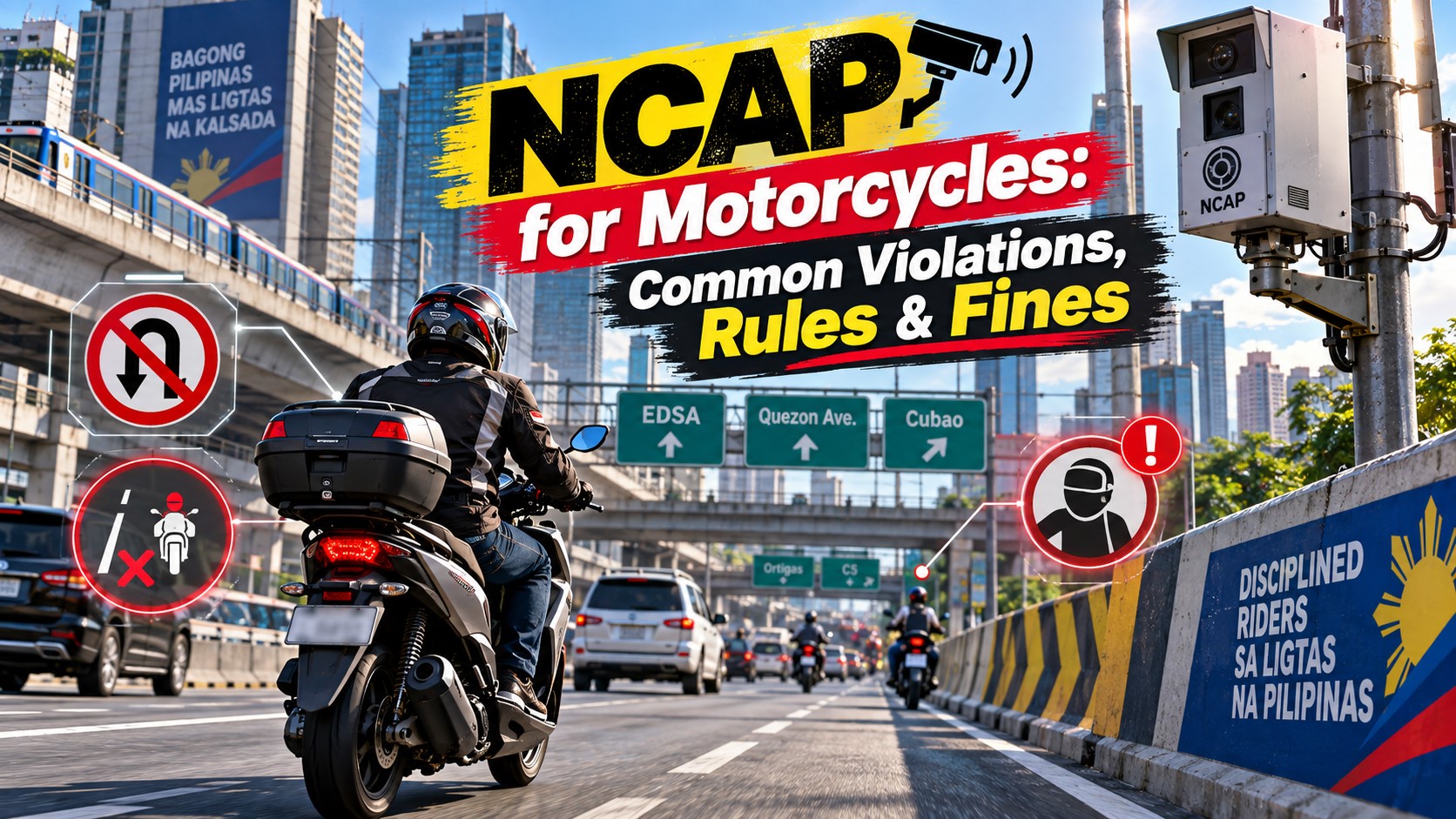
With cameras monitoring major roads such as EDSA, Commonwealth Avenue, and C5, motorcycle riders need to be particularly careful about following traffic signs, observing designated lanes, and avoiding dangerous maneuvers.
One wrong turn, an unauthorized entry into a bus lane, or an illegal counterflow could result in a Notice of Violation arriving at your registered address.
The tricky part is that you might not even realize you’ve been recorded.
That’s exactly how NCAP works.
But here’s something important to remember: not every motorcycle-related traffic offense is automatically detected by NCAP cameras, and not all violations carry the same fine.
For example, entering the EDSA Busway without authorization can result in a much higher penalty than a regular motorcycle lane violation.
In this guide, we’ll explain how NCAP works for motorcycles, the most common violations riders should avoid, current traffic fines, rules for motorcycle lanes, how to check your plate number online, and what to do if you receive a violation notice.
Content
Does NCAP Apply to Motorcycles?
Yes. Motorcycles are covered by the No Contact Apprehension Policy.
The NCAP system is designed to detect traffic violations through closed-circuit television cameras and other authorized recording technologies.
Instead of requiring a traffic enforcer to physically stop a motorist, the system allows authorities to document possible violations using photographic and video evidence.
This applies to various motor vehicles, including motorcycles.
For example, if a motorcycle rider enters a prohibited lane, disregards a traffic sign, or commits another detectable violation along an NCAP-covered road, the incident may be recorded.
The authorized personnel then review the footage to determine whether a traffic violation occurred.
If the violation is confirmed, a Notice of Violation may be issued using the vehicle’s registration information.
NCAP for Motorcycles: Quick Facts
| Details | Information |
|---|---|
| Policy | No Contact Apprehension Policy |
| Applies to motorcycles? | Yes |
| Main Enforcement Agency | MMDA and participating local governments |
| Coverage | Designated roads and enforcement areas |
| Detection Method | CCTV cameras and other authorized recording devices |
| Notice Recipient | Registered vehicle owner |
| Online Checking | MMDA May Huli Ka portal and eGovPH app |
| Usual Protest Period | 10 working days from receipt of notice |
| Motorcycle Lane Fine | Commonly ₱500 on specified MMDA routes; varies by regulation |
| Unauthorized EDSA Busway Use | ₱5,000 for the first offense |
| Disregarding Traffic Signs | ₱1,000 |
| Overspeeding | ₱1,000 under the Metro Manila Traffic Code |
These are reference figures for selected offenses. Other regulations may impose different fines, and the table should not be interpreted as a guarantee that every listed violation is detected through NCAP at every location.
How Does NCAP Work for Motorcycle Riders?
NCAP works in much the same way for motorcycles as it does for cars and other vehicles.
The difference is that motorcycles have additional traffic rules involving designated lanes, safety equipment, passenger restrictions, and riding behavior.
Here’s the general process.
Step 1: A Camera Records a Possible Violation
An NCAP camera captures a motorcycle allegedly violating a traffic rule.
For example, the camera might record the motorcycle crossing a prohibited lane marking or entering a restricted section of road.
Step 2: Traffic Personnel Review the Evidence
The recorded footage is reviewed by authorized traffic personnel.
This is an important part of the process because the presence of a motorcycle in a camera image doesn’t automatically establish that a violation occurred.
The evidence must support the alleged offense.
Step 3: The Registered Owner Is Identified
Once the violation is established, authorities identify the motorcycle through its plate number and available LTO registration information.
The Notice of Violation is ordinarily addressed to the registered owner.
Step 4: A Notice of Violation Is Issued
The notice should contain relevant information such as the date, time, location, violation, assessed penalty, and supporting photographic evidence.
It should also explain how to settle or contest the violation.
Step 5: The Owner May Pay or Contest the Violation
If the violation is valid, it can be settled through the issuing authority’s authorized payment channels.
If the owner believes the citation is incorrect, the applicable protest procedure may be used.
Remember that NCAP is not simply a camera automatically collecting fines.
Evidence review and the opportunity to challenge a citation are important parts of the enforcement process.
Common NCAP Violations for Motorcycles
Now, let’s discuss the traffic rules that motorcycle riders should pay particular attention to.
Some of these violations are commonly associated with camera-based enforcement, while others are separate motorcycle safety offenses that authorities may enforce when sufficient evidence is available.
1. Disregarding Traffic Signs
This is one of the most common traffic violations recorded in Metro Manila.
It happens when a motorist fails to follow a traffic sign, signal, or instruction that applies to the road.
For motorcycle riders, examples include:
- Entering a road marked No Entry
- Ignoring a No Left Turn or No U-Turn sign
- Disregarding a mandatory directional sign
- Entering a prohibited lane
- Failing to obey a Stop sign
Let’s say you’re riding along a busy road and notice a No U-Turn sign.
Traffic is relatively light, and you decide to make the turn anyway.
Even if no traffic enforcer is present, an authorized camera may record the maneuver.
Under the Metro Manila Traffic Code of 2023, disregarding traffic signs carries a fine of ₱1,000.
The exact citation depends on the sign, road markings, evidence, and rule violated.
2. Motorcycle Lane Violations
This is probably one of the biggest concerns among riders traveling along Metro Manila’s major roads.
The MMDA has established designated motorcycle lanes along several important thoroughfares.
These include sections of EDSA, Commonwealth Avenue, C5, and other roads covered by relevant motorcycle lane regulations.
However, it’s important to understand that not all motorcycle lanes follow exactly the same rules.
Some are designated for motorcycle use, while others are non-exclusive lanes that may also be used by other types of vehicles.
On certain roads, motorcycle riders are generally required to use the designated motorcycle lane except when an authorized maneuver or other exception applies.
For example, turning at an intersection may require riders to leave the motorcycle lane and move gradually toward the appropriate turning lane.
The specific rules depend on the applicable MMDA regulation.
How Much Is the Motorcycle Lane Fine?
MMDA’s published fine schedules have listed a ₱500 penalty for motorcycle lane violations on specified routes such as EDSA, Commonwealth Avenue, and C5.
However, another MMDA regulation governing certain non-exclusive motorcycle lanes prescribes a ₱1,000 penalty.
That’s why riders shouldn’t assume that every motorcycle lane violation costs exactly ₱500.
The amount depends on the regulation cited in the Notice of Violation.
3. Illegal Entry Into the EDSA Busway
This is one traffic violation that can become particularly expensive.
The EDSA Busway, also known as the EDSA Carousel lane, is reserved for authorized vehicles.
Ordinary private motorcycles are not permitted to use the exclusive busway simply to avoid traffic congestion.
Some riders may be tempted to enter the bus lane when other lanes are heavily congested.
However, doing so can result in substantial fines.
Under MMDA Regulation No. 23-002, the penalties for unauthorized use of the EDSA Busway are:
| Offense | Fine and Additional Penalties |
|---|---|
| First offense | ₱5,000 |
| Second offense | ₱10,000, one-month license suspension, and road safety seminar |
| Third offense | ₱20,000 and one-year license suspension |
| Fourth offense | ₱30,000 and recommendation for license revocation |
These penalties are separate from ordinary motorcycle lane violations.
In other words, entering a motorcycle-restricted lane and entering the exclusive EDSA Busway are not necessarily the same offense.
That’s an important distinction, especially considering how much higher the Busway penalties can be.
4. Overspeeding
Motorcycles can also be cited for exceeding applicable speed limits.
Some riders assume that because motorcycles are smaller and more maneuverable, they can travel faster through traffic.
But speed limits still apply.
For example, the MMDA’s Commonwealth Avenue regulation specifies a maximum speed limit of 60 kilometers per hour for vehicles using that road, including motorcycles.
Other roads may have different posted limits.
Under the Metro Manila Traffic Code of 2023, the fine for overspeeding is ₱1,000.
Can NCAP Detect Motorcycle Speeding?
Speed-related violations may be documented where authorized monitoring technology can establish the motorcycle’s speed and the applicable limit.
However, ordinary surveillance footage alone doesn’t necessarily prove how fast a motorcycle was traveling.
The issuing authority must have sufficient evidence to support an overspeeding citation.
The safest approach is to follow the applicable speed limit, particularly when entering sections of road with new signage or changing traffic conditions.
5. Illegal Counterflow
Counterflow happens when a motorcycle travels against the legally designated direction of traffic.
This is especially dangerous on busy roads.
Imagine riding through heavy congestion and seeing an apparently empty lane on the opposite side.
Using that lane to get ahead might save a few minutes, but it creates a serious risk of head-on collisions.
NCAP cameras may record illegal counterflow when the road direction and prohibited maneuver are visible.
Under the Metro Manila Traffic Code, illegal counterflow generally carries a ₱2,000 fine.
A higher penalty may apply in circumstances involving physical injury.
Riders should avoid using opposing lanes unless traffic authorities have expressly established and authorized a temporary counterflow arrangement.
6. Reckless Driving
Reckless driving is another traffic offense that motorcycle riders should take seriously.
It generally involves operating a vehicle in a manner that endangers people or property without due regard for prevailing road conditions.
For motorcycles, potentially reckless behavior may include dangerous weaving between vehicles, aggressive overtaking, unsafe lane changes, and other hazardous maneuvers.
Not every lane change is reckless driving, of course.
The actual conduct and surrounding circumstances matter.
Reckless Driving Fines
| Offense | Fine |
|---|---|
| First offense | ₱1,000 |
| Second offense | ₱1,000 plus required seminar |
| Third and subsequent offenses | ₱2,000 plus required seminar |
These are the harmonized penalties under the Metro Manila Traffic Code.
Depending on the circumstances, dangerous conduct may also involve other violations or more serious legal consequences.
7. Lane Splitting and Lane Filtering
This is one of the more confusing topics for motorcycle riders.
Lane splitting generally refers to riding between vehicles occupying adjacent traffic lanes, while lane filtering commonly refers to moving between stopped or very slow-moving vehicles.
The distinction can matter under traffic enforcement policies.
In June 2025, public reporting on MMDA guidance showed that the agency clarified its earlier statements about lane splitting and motorcycle lane requirements.
The clarification identified lane splitting as prohibited, while treating lane filtering differently.
However, riders shouldn’t interpret this as blanket permission to travel between vehicles under all circumstances.
You still need to consider road markings, prohibited lane changes, designated motorcycle lanes, intersections, and safe riding behavior.
For example, crossing a solid lane marking to pass between vehicles could raise an issue different from cautiously moving through a lawful opening in slow traffic.
Because enforcement guidance and local traffic conditions may change, it’s best to follow the current road-specific rules and written MMDA advisories.
And if you’re uncertain about a maneuver, the safest option is to remain in your designated lane and avoid squeezing between vehicles.
8. Illegal Parking and Obstruction
Motorcycles are not exempt from parking restrictions.
For example, parking your motorcycle along a prohibited portion of a major road may obstruct traffic or violate posted restrictions.
Motorcycles should not be parked in places where stopping or parking is prohibited, including designated travel lanes, blocked driveways, pedestrian access areas, or other restricted locations.
MMDA’s harmonized fine schedule includes:
| Violation | Fine |
|---|---|
| Attended illegal parking | ₱1,000 |
| Unattended illegal parking | ₱2,000, with impoundment provision |
| Obstruction | ₱1,000 |
| Loading or unloading in a prohibited zone | ₱1,000 |
Some parking and obstruction offenses may be documented through camera evidence, but enforcement methods and actual sanctions depend on the nature of the incident.
9. Failure to Wear a Motorcycle Helmet
Wearing a helmet is a legal requirement for motorcycle riders and passengers in the Philippines.
Republic Act No. 10054, or the Motorcycle Helmet Act of 2009, requires the use of standard protective motorcycle helmets.
Under the applicable penalty schedule:
| Offense | Fine |
|---|---|
| First offense | ₱1,500 |
| Second offense | ₱3,000 |
| Third offense | ₱5,000 |
| Fourth and subsequent offenses | ₱10,000, with confiscation of driver’s license under the statutory schedule |
Now, does that mean every NCAP camera automatically identifies riders without helmets?
Not necessarily.
Helmet violations are separate motorcycle safety offenses, and the ability to establish them through camera enforcement depends on the available evidence and the authority’s actual enforcement procedures.
Regardless of whether a camera is present, both riders and passengers should wear compliant and properly secured helmets.
10. Improper Motorcycle Rider Attire
Motorcycle riders are also subject to dress code regulations.
Under the Metro Manila Traffic Code of 2023, the motorcycle dress code carries these penalties:
| Offense | Fine |
|---|---|
| First offense | ₱500 |
| Second offense | ₱750 |
| Third and subsequent offenses | ₱1,000 |
The rules include requirements concerning appropriate footwear.
As a practical matter, riders should wear secure, protective, closed-toe footwear rather than slippers or footwear that could interfere with motorcycle controls.
Just remember that a dress code violation and a helmet violation are separate offenses.
They have different legal bases and penalty schedules.
11. Distracted Driving
Motorcycle riders are also covered by the Anti-Distracted Driving Act, Republic Act No. 10913.
The law restricts the use of mobile electronic devices while operating a motor vehicle, subject to applicable exceptions.
For example, holding a mobile phone to text or browse while riding can violate the law.
The prescribed penalties begin at ₱5,000 for the first offense and increase for repeat violations.
However, distracted driving is not automatically established simply because a motorcycle passes an NCAP camera.
The authority must have adequate evidence of conduct prohibited by the law.
If you use navigation while riding, follow the rules on permitted hands-free arrangements and avoid manipulating your phone while the motorcycle is moving.
12. Unsafe Motorcycle Passengers and Child Back Riders
The Philippines also has specific safety rules concerning motorcycle passengers.
Republic Act No. 10666, the Children’s Safety on Motorcycles Act of 2015, restricts the transport of children on motorcycles in covered circumstances.
Among the important considerations are whether the child can reach the foot pegs, hold onto the rider properly, and wear the required protective helmet.
The law also imposes substantial penalties for violations.
Under the Metro Manila Traffic Code’s adopted schedule, the first offense carries a ₱3,000 fine.
However, as with helmet and distracted-driving violations, this should not be interpreted to mean every NCAP camera automatically checks passenger eligibility.
These requirements apply independently of whether a violation is detected by a camera or a roadside officer.
NCAP Motorcycle Violations and Fines: Summary
Here’s a convenient reference table showing some of the traffic offenses relevant to motorcycle riders.
| Violation | Fine or Starting Penalty |
|---|---|
| Disregarding traffic signs | ₱1,000 |
| Specified MMDA motorcycle lane violation | ₱500 |
| Certain non-exclusive motorcycle lane violations | ₱1,000 |
| Unauthorized EDSA Busway use | ₱5,000 |
| Overspeeding | ₱1,000 |
| Illegal counterflow | ₱2,000 |
| Reckless driving | ₱1,000 |
| Attended illegal parking | ₱1,000 |
| Unattended illegal parking | ₱2,000 |
| Obstruction | ₱1,000 |
| Motorcycle dress code violation | ₱500 |
| No standard protective helmet | ₱1,500 |
| Distracted driving | ₱5,000 |
| Violation of child motorcycle passenger safety law | ₱3,000 |
These figures are based on the applicable Metro Manila traffic framework, selected MMDA regulations, and national laws. Repeat-offense penalties may be higher.
The list combines offenses enforceable through different methods. It is not a verified list of offenses automatically detected by every NCAP camera.
For an actual citation, follow the specific violation code and governing rule stated in the official Notice of Violation.
Are Motorcycles Exempt From Number Coding?
Generally, motorcycles are exempt from the MMDA’s Unified Vehicle Volume Reduction Program, commonly called the number coding scheme.
This is an important distinction because some motorists assume that any motorcycle traveling during restricted hours can receive an NCAP violation.
Under the Metro Manila Traffic Code framework, motorcycles are among the vehicle categories exempted from the regular number coding program.
However, this does not exempt motorcycles from other applicable traffic restrictions.
Motorcycle riders still need to follow motorcycle lane regulations, road signs, speed limits, and other traffic rules.
Local traffic restrictions outside the MMDA’s general coding system should also be checked separately.
Where Are Motorcycle NCAP Violations Enforced?
NCAP coverage depends on the agency operating the cameras and the roads included in its enforcement program.
The MMDA resumed camera-based enforcement on major Metro Manila thoroughfares on May 26, 2025.
Among the important road corridors associated with NCAP and motorcycle lane enforcement are EDSA, Commonwealth Avenue, and C5.
Other roads and local government areas may also have operating NCAP systems.
However, that doesn’t mean every road or intersection in Metro Manila has a working NCAP camera.
Likewise, the presence of a CCTV camera doesn’t automatically mean it is authorized or configured to issue NCAP citations.
The exact enforcement coverage can change as government agencies add equipment, adjust road markings, or introduce new arrangements.
Riders should follow traffic rules regardless of whether a camera is visible.
Motorcycle Lane Rules on EDSA, Commonwealth and C5
Let’s take a closer look at the major roads where motorcycle riders commonly have questions about lane restrictions.
NCAP Motorcycle Rules on EDSA
EDSA has designated motorcycle lane arrangements and an exclusive Busway used by authorized vehicles.
The motorcycle lane and EDSA Busway are separate facilities.
Motorcycle riders must observe the applicable lane markings and restrictions.
Ordinary motorcycles should not enter the exclusive Busway without authorization.
This is particularly important because the Busway fine is much higher than the usual motorcycle lane fine.
NCAP Motorcycle Rules on Commonwealth Avenue
Commonwealth Avenue has specific MMDA regulations concerning motorcycle lanes, public utility vehicle lanes, and traffic movement.
The road also has a documented 60-kilometer-per-hour maximum speed regulation.
Riders should pay attention to lane markings, intersections, turn restrictions, and directional signs.
If you’re changing lanes to make a permitted turn, do so gradually and according to the applicable rules.
Avoid suddenly crossing multiple lanes.
NCAP Motorcycle Rules on C5
C5 is another major route where motorcycle lane rules have generated questions.
Some sections have designated motorcycle lanes, while physical road conditions and markings may differ by location.
MMDA regulations have established motorcycle lane arrangements along C5, including rules on when riders may leave the designated lane to make authorized turns.
When using C5, pay close attention to signs and the actual markings on your stretch of road.
Do not assume that every part of C5 has an identical lane configuration.
Are Big Bikes Exempt From Motorcycle Lane Rules?
Some riders ask whether motorcycles with engines of 400cc or higher must follow the same designated lane arrangements as smaller motorcycles.
This question became particularly prominent after NCAP enforcement resumed in 2025.
MMDA clarifications reported that year indicated an exemption for big bikes on certain designated motorcycle lane arrangements, including Commonwealth Avenue.
However, this should not be interpreted as a universal exemption from all motorcycle lane regulations.
Rules can differ by road and regulation.
Large-displacement motorcycles are also not automatically exempt from restrictions on the EDSA Busway, traffic signs, speed limits, or other traffic offenses.
If you ride a big bike, follow the latest MMDA guidance applicable to your particular route rather than relying on a blanket assumption based on engine displacement.
How to Check Your Motorcycle NCAP Violation Online
One of the most useful developments for motorcycle owners is the MMDA’s online violation-checking system.
The agency operates a service called May Huli Ka, which allows motorists to check eligible violation records using their vehicle registration details.
Step 1: Visit the Official May Huli Ka Website
Open your browser and manually enter:
mayhulika.mmda.gov.ph
Make sure the website belongs to the MMDA.
Avoid clicking unfamiliar links sent through text messages or social media.
Step 2: Enter Your Motorcycle Plate Number
Type the plate number of your motorcycle.
Make sure the letters and numbers match the registration records.
Step 3: Enter the MV File Number
The portal allows registered owners to check records using their plate number and Motor Vehicle File Number.
You can find the MV File Number on your motorcycle’s Official Receipt or Certificate of Registration.
The system also supports other verification options, including searching with an applicable ticket number.
Step 4: Review the Results
If the portal displays a violation, review the details carefully.
Check the date, time, location, and specific offense.
Where available, examine the corresponding evidence.
Make sure the cited motorcycle matches your registration.
Step 5: Decide Whether to Pay or Contest
If the citation is valid, follow the authorized payment instructions.
If you believe it was issued incorrectly, review the protest procedure.
For example, if the image shows a different motorcycle or the plate number appears to have been misread, you may have grounds for a protest.
Remember that MMDA’s May Huli Ka portal is not necessarily a consolidated database for every NCAP program operated by an independent local government.
For an LGU-issued notice, check the issuing city’s official system.
Can You Check Motorcycle NCAP Violations Through the eGovPH App?
Yes.
In July 2026, the MMDA and the Department of Information and Communications Technology expanded access to NCAP records through the eGovPH Super App.
This provides another way for motorists to check relevant records through their mobile phones.
The app supports government digital services and includes access to participating traffic enforcement systems.
Motorcycle owners should use the official eGovPH application and follow the available vehicle-verification instructions.
The exact menu options and features may change as the system is updated.
What Does “No Record Found” Mean for Motorcycle NCAP?
If the May Huli Ka portal displays “No Record Found,” it generally means no matching violation record was returned for the information entered at that time.
However, this doesn’t necessarily guarantee that your motorcycle has never committed a traffic violation.
There are several possible explanations.
For example, your plate number or MV File Number may have been entered incorrectly.
A recently recorded violation may also still be undergoing review or processing.
Another possibility is that the violation belongs to a city-operated system that is not included in the particular MMDA search.
If you received an official Notice of Violation but the portal shows no record, verify the details directly with the issuing authority.
How to Pay an NCAP Violation for a Motorcycle
If you’ve confirmed that a violation is legitimate and you don’t intend to contest it, you can follow the issuing authority’s official payment procedure.
For MMDA violations, authorized digital payment channels may be available through the May Huli Ka system or supported government services.
The agency has also introduced improvements to its online payment arrangements, including GCash-related integration.
However, the available payment options can differ based on the transaction and issuing authority.
Here’s the general process.
- Verify the motorcycle’s violation record through the official portal.
- Review the violation details and assessed amount.
- Select an available authorized payment option.
- Follow the payment instructions shown by the issuing authority.
- Save your official payment confirmation or receipt.
- Check whether the violation’s settlement status has been updated.
Don’t send money directly to a personal GCash or Maya account claiming to represent NCAP.
And never rely on a payment link from an unverified text message.
How to Contest an NCAP Violation for a Motorcycle
What if you believe the notice is wrong?
For example, maybe the motorcycle in the image isn’t yours.
Or perhaps you were making a permitted turn but the camera recorded the maneuver as a motorcycle lane violation.
In these situations, you may contest the citation through the appropriate administrative process.
Step 1: Review the Notice
Check the alleged violation and available evidence.
Look at the date, time, location, and vehicle details.
Step 2: Identify the Issuing Authority
Determine whether the notice came from the MMDA or a city-operated NCAP program.
This matters because protests must be filed with the appropriate adjudication office.
Step 3: Prepare Supporting Evidence
Depending on your circumstances, supporting documents might include your motorcycle’s OR/CR, valid identification, available camera or dashcam footage, photographs of relevant road signs, or other documents supporting your explanation.
You may also need a written explanation stating the grounds for your protest.
Step 4: File Within the Deadline
Under the Metro Manila Traffic Code NCAP framework, a protest generally must be filed within 10 working days from receipt of the Notice of Violation.
Do not confuse this deadline with the date the camera recorded the incident.
Step 5: Follow the Adjudication Instructions
Once you’ve filed a protest, monitor your case.
The issuing authority may review the documents or schedule a hearing.
Attend when required and provide additional evidence if requested.
If the protest is denied, an administrative appeal may be available under the applicable rules.
What If Someone Else Was Riding Your Motorcycle?
This can happen when you lend your motorcycle to a family member, friend, employee, or another authorized rider.
Under NCAP, the Notice of Violation is ordinarily addressed to the registered owner because the enforcement system uses LTO vehicle records.
However, the owner may be able to identify the actual driver during the protest process.
For example, San Juan City’s official NCAP guidelines allow a registered owner to file a protest and submit information identifying the person who was driving the vehicle.
The authority may require additional documents or declarations.
Don’t automatically assume that the fine can be transferred simply by naming another person.
Follow the official procedure and provide truthful information.
What If You Sold Your Motorcycle but Still Receive NCAP Violations?
This is another common problem.
Let’s say you sold your motorcycle several months ago, but the buyer never transferred the registration.
The motorcycle is then caught committing an NCAP violation.
Because the vehicle remains registered under your name, you may receive the notice.
If that happens, check the date of the alleged offense and compare it with the date you sold and delivered the motorcycle.
Prepare your notarized Deed of Sale and other relevant documents.
San Juan City’s official NCAP rules specifically recognize the use of a notarized Deed of Sale when a previous owner contests a notice involving a vehicle that was already sold.
However, the actual resolution depends on the issuing authority.
The best long-term solution is to ensure that the motorcycle’s registration is properly transferred through the LTO.
What Happens If You Don’t Pay Your Motorcycle NCAP Fine?
Ignoring a legitimate NCAP violation can create problems.
Under the applicable Metro Manila NCAP framework, a violation that remains unresolved after the protest or settlement period may result in the motorcycle’s plate number being included in an LTO-related alarm list.
For example, San Juan City’s official NCAP guidance states that an unpaid violation that has not been protested within the prescribed period may be included in the alarm list.
This can affect vehicle registration renewal.
It’s worth emphasizing that MMDA officials have stated that NCAP fines do not accrue interest or ordinary late-payment penalties under their system.
However, this does not mean you can ignore unresolved violations without consequences.
The key problem is that the record may remain unsettled and create registration difficulties.
Can You Receive Multiple NCAP Violations in One Day?
Yes, it’s possible to receive more than one citation when separate traffic violations are committed and properly documented.
For example, a rider could be recorded entering a restricted lane on one occasion and disregarding a traffic sign later in the day.
These may constitute separate incidents.
However, authorities must follow the applicable rules on evidence and duplicate apprehensions.
Under the Metro Manila NCAP framework, when the same offense is recorded through both roadside apprehension and NCAP in the circumstances addressed by the rules, the physical apprehension takes precedence.
Motorists should review multiple citations carefully, particularly where the dates, times, locations, and offenses appear identical.
A rider should not automatically assume that every recorded incident represents a separate valid offense without checking the supporting evidence.
Is NCAP Legal in the Philippines?
NCAP has been the subject of several legal challenges.
In August 2022, the Supreme Court issued a temporary restraining order affecting certain NCAP implementations.
The MMDA later resumed enforcement on major Metro Manila roads in May 2025 following a partial lifting of the injunction.
On July 9, 2026, the Supreme Court announced that it had dismissed consolidated petitions challenging earlier NCAP ordinances.
The Court explained that the petitions had been overtaken by the adoption of the Metro Manila Traffic Code of 2023.
Importantly, the dismissal was not a blanket declaration that every earlier NCAP ordinance was constitutionally valid.
The current enforcement framework and the specific rules being applied remain relevant.
For motorcycle owners, the practical point is that NCAP enforcement continues in participating areas, and valid notices should be taken seriously.
Latest NCAP Updates for Motorcycle Riders
Several developments have made NCAP more relevant to motorcycle owners.
NCAP Enforcement Resumed in 2025
The MMDA resumed NCAP operations on major Metro Manila roads on May 26, 2025.
Motorcycle lane violations, disregarding traffic signs, and unauthorized use of restricted lanes were among the concerns highlighted when enforcement resumed.
Online Violation Checking Improved
The May Huli Ka portal has been upgraded to provide improved access to vehicle violation records.
In August 2026, the MMDA introduced an additional search option allowing vehicle owners to use their plate number and MV File Number to check violation records.
eGovPH Integration Expanded in 2026
The MMDA’s collaboration with DICT made NCAP record checking more accessible through the eGovPH Super App.
This gives motorcycle owners another convenient way to review their records.
Supreme Court Issued an Important Decision
The Supreme Court’s July 2026 announcement clarified the status of legal petitions involving earlier NCAP ordinances.
The decision recognized the significance of the newer Metro Manila traffic enforcement framework.
NCAP Scam Warnings Continue
The MMDA also warned motorists about fraudulent text messages impersonating NCAP.
According to the agency, legitimate MMDA text alerts do not contain payment links.
Riders should verify notices through the official May Huli Ka portal rather than clicking suspicious SMS links.
Tips to Avoid NCAP Violations When Riding a Motorcycle
The simplest way to avoid NCAP fines is to follow traffic rules consistently.
But there are a few practical habits that are particularly important for motorcycle riders.
Follow the Motorcycle Lane Rules
Pay attention to designated motorcycle lanes and road signs.
Don’t suddenly move into another lane simply because traffic is slow.
Never Enter the EDSA Busway Without Authorization
Remember that the first-offense penalty is ₱5,000.
This is considerably higher than ordinary motorcycle lane penalties.
Observe Speed Limits
Don’t assume that lighter traffic means you can exceed the posted speed limit.
Motorcycle riders are subject to the same applicable speed restrictions as other vehicles.
Avoid Illegal Counterflow
Never enter an opposing traffic lane just to overtake stopped vehicles.
Apart from the possibility of a fine, the maneuver is dangerous.
Signal Before Changing Lanes
Use your signal lights properly when preparing to turn or change lanes.
Move gradually and check surrounding traffic.
Wear Proper Protective Equipment
Always wear a compliant motorcycle helmet and appropriate footwear.
Your passenger should also follow the applicable safety requirements.
Check Your NCAP Record Periodically
Even if you haven’t received a notice, checking the official portal occasionally can help you identify records that may require attention.
Keep Your LTO Registration Information Updated
Make sure your motorcycle registration and contact details are accurate.
If you change your address or transfer ownership, follow the appropriate LTO procedures.
Frequently Asked Questions About NCAP for Motorcycles
Are Motorcycles Included in NCAP?
Yes. Motorcycles are covered by NCAP on roads and within jurisdictions where the policy is implemented.
Can an NCAP Camera Detect a Motorcycle Plate Number?
Yes. Authorized cameras may record motorcycle plate numbers and other identifying information.
However, whether a particular image is sufficient for a citation depends on its clarity and the supporting evidence.
How Much Is an NCAP Violation for Motorcycles?
There is no single universal NCAP fine.
For example, disregarding traffic signs carries a ₱1,000 penalty under the Metro Manila Traffic Code, while unauthorized use of the EDSA Busway starts at ₱5,000.
Other violations have different penalty schedules.
How Much Is the Motorcycle Lane Violation Fine?
Certain MMDA motorcycle lane violations carry a ₱500 fine, while other regulations prescribe ₱1,000.
The exact amount depends on the applicable route and rule.
Can Motorcycles Use the EDSA Busway?
Ordinary private motorcycles are not authorized to use the EDSA Busway.
Unauthorized entry carries a ₱5,000 first-offense penalty.
Are Motorcycles Exempt From Number Coding?
Yes. Motorcycles are generally exempt from the MMDA’s regular number coding scheme.
However, other traffic rules and local restrictions still apply.
Can Motorcycle Riders Be Fined for Lane Splitting?
Potentially, yes.
MMDA has clarified that lane splitting is prohibited in the context of its enforcement guidance.
The actual citation depends on the circumstances and applicable rule.
Is Lane Filtering Allowed?
Lane filtering has been discussed separately from lane splitting in MMDA clarifications.
However, riders should not assume every filtering maneuver is automatically permitted.
Road markings, lane restrictions, and safe riding requirements still apply.
Are Big Bikes Exempt From NCAP?
No. Large-displacement motorcycles are not generally exempt from NCAP.
Certain motorcycle lane exemptions may apply under specific MMDA guidance, but other traffic laws remain enforceable.
Can NCAP Detect Riders Without Helmets?
A camera may capture visual evidence of helmet noncompliance, but that does not mean every NCAP installation automatically issues helmet citations.
Helmet requirements apply regardless of the enforcement method.
How Do I Check My Motorcycle NCAP Violation?
Visit the official MMDA May Huli Ka portal and enter the required motorcycle registration details.
You may also check relevant MMDA records through supported eGovPH services.
What If I Don’t Receive an NCAP Notice?
Keep your registration information updated and use authorized channels to verify available records.
If a notice is delivered late or you dispute its service, raise that issue through the appropriate adjudication process.
Can I Appeal an NCAP Violation?
Yes. The Metro Manila NCAP framework provides administrative protest procedures.
The usual filing period is 10 working days from receipt of the Notice of Violation.
Does NCAP Apply Outside Metro Manila?
Other local governments may operate camera-based or no-contact traffic enforcement programs.
However, their coverage, rules, and administrative procedures must be checked individually.
Do not assume that MMDA rules automatically apply throughout the Philippines.
Final Thoughts
NCAP has become an important part of traffic enforcement in Metro Manila, and motorcycle riders are definitely included.
Whether you’re using a small scooter for your daily commute or a larger motorcycle for longer trips, the same basic principle applies: traffic rules must be followed even when no enforcer is standing nearby.
And for motorcycle riders, the rules concerning designated lanes are particularly important.
Entering the wrong lane, disregarding a traffic sign, or using the EDSA Busway without authorization could lead to penalties.
Some violations may cost a few hundred pesos, while others can result in fines worth thousands.
But beyond the financial penalties, these rules are also intended to reduce dangerous maneuvers and improve road safety.
If you’re unsure whether your motorcycle has an outstanding violation, you can check through the MMDA’s May Huli Ka system or supported digital government services.
And if you receive a notice that you believe is incorrect, don’t ignore it.
Review the evidence, gather your documents, and use the official protest procedure within the applicable deadline.
At the end of the day, avoiding NCAP violations shouldn’t be about constantly looking for cameras.
It’s about developing safer riding habits, respecting lane restrictions, and being more aware of other people sharing the road.
Because whether you’re riding a motorcycle, driving a car, or commuting on public transportation, everyone benefits from safer and more organized traffic.
So the next time you’re riding along EDSA, C5, Commonwealth Avenue, or another busy Metro Manila road, pay attention to the signs, observe the speed limit, and follow the designated lanes.
A little extra discipline can help you avoid unnecessary fines and, more importantly, prevent accidents.
Ride safely, follow the rules, and ingat sa biyahe!
Editor’s Note: This guide reflects traffic rules and NCAP developments reviewed as of October 19, 2026. Fines can vary by offense, enforcement authority, road-specific regulation, and repeat-offense status. Not every traffic offense described here is necessarily enforced through NCAP cameras. For an actual violation, refer to the official Notice of Violation and the issuing authority’s current rules.