If you regularly drive around Manila, there’s now another thing worth checking from time to time: whether your vehicle has been recorded for a traffic violation under the city’s No Contact Apprehension Program.
The City of Manila resumed NCAP on October 5, 2026, using high-resolution cameras to monitor roads and record possible violations without requiring a traffic enforcer to physically stop the vehicle. Camera footage is still reviewed and validated by authorized personnel before a Notice of Violation is issued.
That means you could drive through Manila, reach your destination normally and only find out later that your plate was recorded.
Fortunately, you don’t have to simply wait for a notice to arrive in the mail.
Manila now provides an online way to check NCAP records using your vehicle information.
But there’s one very important detail to understand first:
Manila’s NCAP system is separate from MMDA’s NCAP system.
So if you’re trying to check whether your plate has a violation, you first need to know which authority you’re checking.
Here’s a complete guide.
Content
Is NCAP Active in Manila in 2026?
Yes.
The City of Manila officially restarted its enhanced NCAP—or what city officials have referred to as NCAP 2.0—on October 5, 2026.
The system uses traffic cameras capable of recording vehicles and plate numbers when possible traffic violations occur.
Examples of violations camera systems can detect include:
- Beating the red light
- Disregarding traffic signs
- Crossing prohibited lane markings
- Illegal lane changes
- Counterflow
- Yellow-box violations
- Obstruction of pedestrian lanes
- Number-coding violations
- Certain motorcycle violations
- Other visible traffic offenses
The Supreme Court’s 2026 NCAP decision discussed camera technology capable of recognizing license plates and detecting traffic behavior such as red-light violations, counterflow, yellow-box violations, speeding, disregarding lane markings and traffic signs, pedestrian-crossing violations and number coding.
How Does Manila NCAP Work?
The process is relatively straightforward.
Traffic cameras monitor selected roads and intersections.
If the system detects something that may be a traffic violation, the incident is recorded.
The system captures information such as:
- Plate number
- Date
- Time
- Location
- Vehicle movement
- Relevant traffic signal
- Lane markings
- Images or video of the incident
But the camera isn’t supposed to be the final judge.
Authorized personnel review and validate the footage before a Notice of Violation—or NOV—is issued.
This distinction is important.
A camera may detect an unusual movement, but there could be circumstances that need human review.
Maybe road construction forced you to change lanes.
Maybe a traffic enforcer directed you to proceed despite the normal signal.
Maybe an emergency vehicle required you to move.
That’s why validation and a process for contesting violations are part of the system.
How to Check Your Plate Number for NCAP Manila
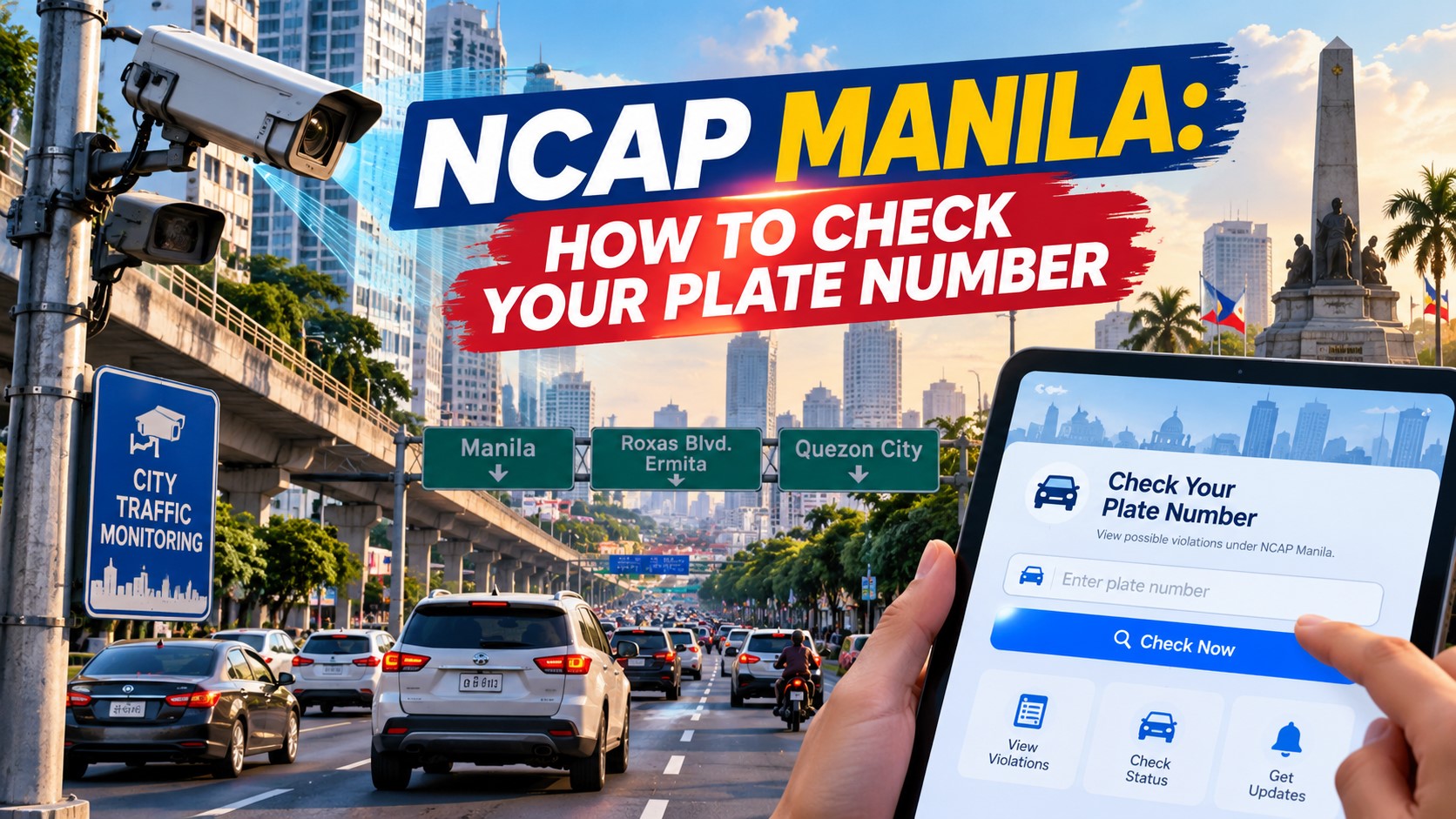
For a City of Manila-issued NCAP violation, use Manila’s official GO Manila NCAP service.
The current Manila NCAP checker is connected with the city’s GO Manila platform rather than MMDA’s May Huli Ka system. Current 2026 guidance identifies GO Manila as the City of Manila portal for checking and settling its city-level NCAP records.
Here is the basic process.
Step 1: Prepare Your Plate Number
You’ll need your vehicle’s plate number.
Make sure you’re checking the exact plate registered with LTO.
Don’t accidentally enter:
- Another family vehicle’s plate
- An old vehicle you’ve already sold
- A temporary plate when the system requires the registered information
- An incorrectly typed plate
Even one wrong character can obviously produce the wrong result.
Step 2: Prepare Your MV File Number
Under the newer NCAP checking system, plate number alone may not be enough.
Current Metro Manila NCAP portals generally require the plate number together with either:
MV File Number
or, if you already received a citation,
Ticket/Notice of Violation number
The MV File Number provides an additional layer of verification instead of allowing anyone to search vehicle records using only a visible plate number.
Where Do You Find the MV File Number?
Look at your vehicle’s Certificate of Registration or CR issued by the Land Transportation Office.
The MV File Number is printed on the registration document.
This isn’t necessarily the same thing as your plate number.
Think of it as another identifier associated with your vehicle’s LTO registration record.
It’s worth having a photo or digital copy of your CR stored securely because this number is increasingly useful for government vehicle services.
Step 3: Open the GO Manila NCAP Service
Use the official GO Manila platform and go to the NCAP or No Contact Apprehension section.
Be careful here.
Because NCAP involves traffic fines, scammers have a strong incentive to create fake pages that look like government websites.
Rather than opening a random link sent through a text message, access GO Manila yourself through the city’s official service.
Step 4: Enter Your Vehicle Information
Depending on the inquiry option presented, enter the requested information such as:
- Plate number
- MV File Number
or, if you’ve already received a Notice of Violation:
- Plate number
- Ticket or violation number
Current 2026 Metro Manila NCAP guidance says the system can use plate number together with an MV File Number to search vehicle records, while motorists who already have a notice can use the applicable ticket information.
Step 5: Check the Result
Submit the inquiry.
The system should then indicate whether a matching traffic-violation record is available for the vehicle information you provided.
If no Manila NCAP violation appears, you’ll generally receive a result indicating that the system found no applicable record.
If a violation does appear, review the details carefully.
Don’t immediately pay without first checking what you’re being accused of.
If You Have a Violation, Check These Details
Look for:
- Plate number
- Date of violation
- Time
- Location
- Offense
- Fine
- Photograph
- Video or supporting evidence
- Notice or reference number
Make sure the vehicle in the evidence is actually yours.
Then look at the road situation.
Can you see the traffic light?
Can you see the lane marking?
Is the plate readable?
Does the footage actually show the alleged offense?
If everything is correct, you can proceed with settlement.
If something doesn’t look right, you have the option to contest the violation rather than simply paying it.
What If You Already Received a Notice of Violation?
If you received an official Manila NCAP Notice of Violation, checking becomes easier because the document should contain reference information connected with the case.
Current LGU NCAP guidance says Notices of Violation may also contain a QR code that directs motorists toward the appropriate online service for checking or payment.
Still, I’d recommend verifying that the notice is legitimate before paying anything.
Compare the details with the official GO Manila record.
Do You Need a GO Manila Account?
For checking basic violation information, follow the options presented by the current NCAP portal.
For online payment through Manila, current 2026 guidance says motorists need to create or use a GO Manila account before settling the fine electronically.
GO Manila is the City Government of Manila’s official digital-service platform and is operated by the city’s Electronic Data Processing Services office.
Can You Check Manila NCAP Using the GO Manila App?
GO Manila also has an official mobile app.
The app provides digital government and payment services administered by the City Government of Manila.
If you’re already using GO Manila for other city transactions, it can be useful to have an account ready.
However, NCAP services and interfaces can change, so use the current web or app option specifically identified by Manila for your traffic case.
Important: Manila NCAP Is Not the Same as MMDA May Huli Ka
This is probably the most important part of this entire guide.
There are now multiple NCAP systems operating in Metro Manila.
If Manila City issued your violation, check through GO Manila.
If MMDA issued your violation, check through MMDA’s May Huli Ka system or the MMDA service inside the eGovPH app.
These databases shouldn’t automatically be treated as the same thing.
Current Metro Manila NCAP guidance specifically advises motorists to check LGU-issued violations through the concerned city’s portal because city NCAP systems operate separately from MMDA’s platform.
Manila NCAP vs MMDA NCAP
Here’s the easiest way to understand it:
| Violation Issued By | Where to Check |
|---|---|
| City of Manila / Manila NCAP | GO Manila NCAP service |
| MMDA | May Huli Ka |
| MMDA via mobile | eGovPH app → MMDA NCAP |
| Other LGU | Concerned city’s NCAP portal |
So if you check May Huli Ka and see:
No Record Found
that does not necessarily mean Manila City has no separate record involving your vehicle.
And the reverse is also true.
Checking GO Manila doesn’t necessarily tell you whether MMDA has recorded another violation elsewhere.
Can You Get an MMDA NCAP Violation While Driving in Manila?
Potentially, yes.
The City of Manila and MMDA are separate enforcement authorities.
MMDA operates on roads and traffic matters within its jurisdiction, including major Metro Manila thoroughfares.
That’s why motorists shouldn’t think:
“I already checked Manila’s website, so I’m clear everywhere.”
You’re checking a specific enforcement authority’s database.
How to Check MMDA NCAP Instead
If you think the violation was issued by MMDA, use May Huli Ka.
The current MMDA system allows searches using either:
Plate number + MV File Number
or:
Plate number + ticket number
The plate-plus-MV-file option allows a vehicle owner to check NCAP records even without already having a ticket. The ticket option is useful if a Notice of Violation has already been received.
The MV File Number is again available on the vehicle’s Certificate of Registration.
Check MMDA NCAP Using eGovPH
There’s another option if you’d rather use your phone.
MMDA’s NCAP service is now integrated into the eGovPH Super App.
The integration allows motorists to access NCAP records and related traffic services through the government app.
Inside eGovPH, look for the MMDA NCAP service.
Remember:
That’s for MMDA.
For a City of Manila NCAP record, follow Manila’s GO Manila process.
What Does “No Record Found” Mean?
It sounds simple, but this result can be misunderstood.
If Manila’s portal returns no record, it means the information entered didn’t produce a corresponding Manila NCAP record in the system at that time.
It doesn’t automatically prove that:
- You have no MMDA violation
- You have no manually issued ticket
- You have no LTO violation
- Another LGU has no record
- A very recent incident has already been processed
NCAP isn’t necessarily instantaneous from camera detection to searchable case.
There is still footage validation and processing before a Notice of Violation is created.
So if you think you committed a violation this morning and check five minutes later, don’t assume that a blank result means the incident was ignored.
How Quickly Does an NCAP Violation Appear?
There isn’t one guaranteed public processing time for every incident.
Remember that camera footage has to be reviewed and validated.
That means the sequence is more like:
Possible violation detected → evidence reviewed → violation validated → record/NOV generated
rather than:
Camera flashes → online ticket appears instantly
For that reason, motorists concerned about a recent incident can check again later.
Will Manila Send You a Notice?
Yes, validated violations can result in a Notice of Violation being issued to the registered owner.
NCAP ties the vehicle plate to information available through LTO registration records.
Historically, Manila’s system sends the notice to the registered vehicle owner rather than stopping the driver at the scene, which is the basic principle of no-contact apprehension.
This makes it very important to keep your vehicle ownership and address information updated with LTO.
What If Your LTO Address Is Outdated?
This is where people can get into trouble.
Imagine you moved two years ago.
The old address is still recorded for your vehicle.
Manila sends the Notice of Violation there.
You never see it.
Meanwhile, the case continues through the traffic-adjudication process.
That’s why vehicle-registration records shouldn’t be treated as something you update only when convenient.
If you’ve moved, changed ownership or sold the vehicle, deal with the LTO paperwork properly.
How Long Do You Have to Pay or Contest?
Under the standardized Metro Manila NCAP framework, motorists generally have 10 working days from receipt of the Notice of Violation to settle the citation or file a protest.
Current 2026 guidance for participating LGUs follows that 10-working-day period.
The deadline on your actual Notice of Violation is still the one you should follow.
Don’t wait until the tenth day if you’re planning to contest.
How to Pay a Valid Manila NCAP Violation
If you’ve checked the evidence and agree that the violation is valid, Manila provides online and in-person settlement options.
Current 2026 information says valid NCAP penalties in Manila can be paid electronically or through authorized physical payment channels.
For GO Manila electronic settlement, you’ll generally need your GO Manila account and the violation information.
Follow the payment option attached to your actual record rather than sending money through an unsolicited link.
Don’t Pay Through Random Text-Message Links
This needs to be emphasized.
NCAP is a perfect topic for phishing.
A scammer only needs to send something like:
“Your vehicle has an unpaid traffic violation. Pay ₱1,000 within 24 hours to avoid suspension.”
Then provide a fake payment page.
People panic.
They click.
That’s exactly what you should not do.
For MMDA, authorities have specifically warned the public about fraudulent NCAP messages. MMDA says its official SMS sender ID is MMDA_NCAP, and legitimate MMDA notifications do not include payment links.
For Manila-issued citations, independently open the official GO Manila service instead of trusting a suspicious link.
Can You Contest a Manila NCAP Violation?
Yes.
If you think the citation is wrong, you’re entitled to challenge it through the appropriate adjudication process.
Manila’s Traffic Adjudication Board has jurisdiction over traffic cases captured by the city’s traffic-enforcement cameras.
Current NCAP implementation also allows motorists to contest violations through online procedures identified by the LGUs.
When Should You Consider Contesting?
You may want to challenge the citation if:
- The plate number is wrong
- The vehicle shown isn’t yours
- You already sold the vehicle
- Your vehicle was stolen
- The image doesn’t clearly show a violation
- The alleged road sign wasn’t visible
- Construction forced you to change lanes
- A traffic officer told you to proceed
- You moved for an ambulance or emergency vehicle
- The time or location is incorrect
- You were charged twice for the same incident
Don’t file a protest just because you don’t want to pay.
A strong protest is supported by facts and evidence.
Evidence That Can Help Your Appeal
Keep anything that helps explain what actually happened.
That can include:
- Dashcam footage
- Photos
- Videos
- LTO registration documents
- Deed of sale
- Police report
- Proof the vehicle was somewhere else
- Roadwork notices
- Parking receipts
- Toll records
- Time-stamped documents
- Copy of the NOV
- Screenshots of the online record
Dashcams are especially useful because a fixed traffic camera may show your movement but not the circumstances immediately around your vehicle.
What If Someone Else Was Driving?
NCAP begins with the vehicle because that’s what the camera identifies.
That means the Notice of Violation normally goes to the vehicle’s registered owner.
The newer standardized framework provides procedures for situations where the registered owner wasn’t the actual driver.
If that applies to you, follow the authorization or driver-identification instructions included with the notice and provide the required supporting documents.
What If You Sold the Vehicle Already?
This is one of the strongest reasons to complete a proper transfer of ownership after selling a vehicle.
If the car remains registered under your name, NCAP records can still initially point toward you as the registered owner.
A deed of sale can help demonstrate what happened, but the better solution is to make sure the LTO ownership records are properly transferred in the first place.
What If the Car Was Stolen?
If a stolen vehicle is recorded committing an offense, don’t simply pay the ticket.
Contest the violation and provide documentation such as the police report and other proof showing that the vehicle was stolen at the time.
Can Unpaid NCAP Violations Affect Registration?
Yes, unresolved NCAP violations can eventually become a problem for vehicle transactions.
The standardized NCAP framework provides mechanisms allowing unresolved violations to be endorsed for action through LTO systems after the applicable process has been followed.
Current 2026 guidance warns that unresolved violations can result in an alarm that can interfere with vehicle-registration renewal, transfer of ownership or other LTO transactions until the issue is resolved.
So ignoring an official notice isn’t a good strategy.
Common Manila NCAP Violations
Camera systems are particularly effective at identifying visible traffic behavior.
Some violations motorists should watch carefully include:
Beating the Red Light
If the light is already red, stop before the designated line.
Don’t speed up because you think you’ll make it.
Disregarding Traffic Signs
This can include:
- No Left Turn
- No Right Turn
- No U-Turn
- No Entry
- One Way
- Stop signs
- Lane-use restrictions
Crossing Solid Lines
If the marking is solid, don’t cut across simply because your lane is moving slowly.
Improper Lane Changing
Choose your lane early.
Last-second movements across several lanes near an intersection are exactly the kind of behavior cameras can document clearly.
Blocking Pedestrian Crossings
Stopping on the crosswalk doesn’t become legal just because traffic ahead suddenly stopped.
Leave the pedestrian area clear.
Yellow Box Violation
Don’t enter a yellow box unless there’s enough room for the entire vehicle to clear it.
Counterflow
Don’t drive against the intended traffic direction just to skip a queue.
Number Coding
NCAP technology can also identify plates for applicable coding enforcement.
Check current Metro Manila and local rules before traveling.
How Much Are Manila NCAP Fines?
Manila’s renewed NCAP is tied to the standardized Metro Manila Traffic Code of 2023, rather than simply reviving all the old Manila NCAP fine schedules.
Common standardized penalties include:
| Violation | Typical Fine |
|---|---|
| Number coding | ₱500 |
| Disregarding traffic signs | ₱1,000 |
| Obstruction | ₱1,000 |
| Overspeeding | ₱1,000 |
| Illegal parking – attended | ₱1,000 |
| Illegal parking – unattended | ₱2,000 |
| Illegal counterflow | ₱2,000 |
| Truck ban | ₱3,000 |
Violations under special national laws—such as distracted driving or motorcycle helmet rules—can carry significantly higher penalties.
The exact amount on your validated Notice of Violation is what matters.
Don’t Rely on Old Manila NCAP Fine Tables
This deserves its own section because older articles remain searchable.
The Manila NCAP system before the 2022 TRO had its own city-specific penalty schedule.
The 2026 framework is different.
The Supreme Court noted that subsequent adoption of the Metro Manila Traffic Code of 2023 created a newer, uniform framework involving common traffic rules, fines, adjudication procedures, payments and privacy protections.
So if an old Facebook graphic says a certain Manila NCAP violation costs a particular amount, don’t assume that is still the correct 2026 figure.
Check the current notice.
Is Plate-Number Checking Safe?
One of the criticisms of the old Manila system was that people could potentially search traffic records simply by knowing someone else’s plate number.
The issue even became part of the Supreme Court litigation surrounding NCAP.
The newer approach adds additional identifying information such as the MV File Number or ticket details, making the process more restrictive than simply typing a plate visible on the street.
That’s why you should keep your MV File Number private rather than posting your full Certificate of Registration publicly.
Should You Check Your Plate Regularly?
If you frequently drive around Manila, I’d say yes.
You don’t have to obsessively check every day.
But checking occasionally can be useful, particularly:
- After driving through unfamiliar Manila roads
- After accidentally entering the wrong lane
- If you’re unsure whether you crossed an intersection legally
- Before renewing your vehicle registration
- After receiving a suspicious NCAP notification
- Before selling or transferring a vehicle
The goal isn’t to spend your entire life worrying about cameras.
It’s simply to avoid being surprised by an unresolved legitimate citation later.
Quick Guide: How to Check NCAP Manila
Here’s the simple version:
For a City of Manila NCAP violation:
- Prepare your plate number.
- Get your MV File Number from your Certificate of Registration.
- Open the official GO Manila NCAP service.
- Enter the requested vehicle information.
- Review the result.
- If there’s a violation, check the photo/video, location, date, offense and fine.
- Pay it if it’s correct.
- Contest it within the allowed period if you believe it’s wrong.
For an MMDA violation:
Use May Huli Ka or the MMDA NCAP service inside eGovPH instead.
Frequently Asked Questions
How do I check if my plate has an NCAP violation in Manila?
Use Manila’s official GO Manila NCAP service and enter the vehicle information requested, generally including the plate number and another identifier such as the MV File Number.
Can I check with just my plate number?
Current 2026 NCAP systems generally require additional vehicle information, such as the MV File Number or ticket details, to provide better privacy and security.
Where do I find my MV File Number?
It is printed on your LTO Certificate of Registration.
Is GO Manila the same as May Huli Ka?
No.
GO Manila is used for City of Manila services.
May Huli Ka is operated by MMDA.
If May Huli Ka says no violation, am I clear in Manila?
Not necessarily.
A City of Manila-issued violation may need to be checked through GO Manila rather than MMDA’s system.
Can I use eGovPH to check Manila NCAP?
The NCAP service integrated into eGovPH is an MMDA service.
For a City of Manila-issued NCAP record, use Manila’s official system.
When did Manila NCAP restart?
The City of Manila resumed its enhanced NCAP implementation on October 5, 2026.
Will I get stopped if a camera catches me?
Not necessarily.
That’s the entire point of no-contact apprehension.
The possible violation is recorded and reviewed, and an NOV may later be issued.
Can I see the evidence?
The NCAP process provides motorists access to the images and relevant evidence supporting the citation so they can review the alleged offense and determine whether to pay or contest it.
Can I contest a violation?
Yes.
Manila provides an adjudication process for disputed traffic violations.
How long do I have?
The current standardized framework generally gives motorists 10 working days from receipt of the Notice of Violation to settle or contest it.
Check your actual NOV for the applicable deadline.
Can I pay online?
Yes.
Manila provides an online payment option for valid NCAP penalties, although GO Manila account registration may be required for electronic settlement.
What happens if I ignore the violation?
An unresolved valid citation can eventually create problems with LTO vehicle transactions, including registration renewal, after the prescribed process has been followed.
Final Thoughts
Checking your NCAP record in Manila isn’t complicated once you understand one very important distinction:
City of Manila NCAP and MMDA NCAP are different systems.
If Manila City recorded the violation, check through GO Manila.
If MMDA recorded it, use May Huli Ka or eGovPH.
Prepare your plate number and MV File Number, verify the evidence carefully and don’t trust random payment links sent through text messages.
And if the system shows a legitimate violation, deal with it promptly.
If the citation is wrong, use the appeal process rather than simply ignoring it.
Personally, I think the easiest habit for motorists is to check their vehicle record occasionally and keep LTO registration information updated.
But the even easier way to avoid an NCAP problem is still the obvious one:
Follow the traffic lights.
Stay inside the proper lanes.
Respect road markings.
Don’t block intersections or pedestrian crossings.
And drive as though there could be a camera at every major intersection.
Because with Manila’s NCAP back in operation, there very well might be.