There are Philippine festivals that celebrate flowers, harvests, saints, food, and even giant fish.
Then there is the Parau Festival of Pilar, Sorsogon—a celebration whose identity is closely tied to the sea.
Held every October in the municipality of Pilar, Parau Festival brings together history, faith, maritime traditions, colorful street dancing, community events, and the annual feast of Our Lady of the Pillar.
And if you’re wondering what “Parau” means, that’s actually one of the most interesting parts of the festival.
The name refers to a traditional sailboat associated with the coastal and shipbuilding history of Pilar.
That alone tells you a lot about what makes this festival different.
Parau Festival is not simply an excuse to hold a parade.
Behind the costumes and celebrations is a story about shipbuilders, sailors, faith, colonial history, community resilience, and Pilar’s long relationship with the sea.
So if you’re planning to visit Sorsogon in October—or you simply want to understand one of the province’s local festivals better—here is a complete guide to the Parau Festival.
Content
What Is the Parau Festival?
Parau Festival is an annual cultural and religious celebration held in Pilar, Sorsogon.
The Tourism Promotions Board of the Philippines lists the celebration from October 1 to 12, culminating around the Feast of Our Lady of the Pillar. It describes the festival as a celebration showcasing Pilar’s cultural heritage while bringing families, relatives, and friends together.
That combination is important.
Parau Festival is both:
a celebration of Pilar’s cultural and maritime heritage, and
a fiesta connected with the town’s devotion to Our Lady of the Pillar.
This is something you’ll notice in many festivals around the Philippines.
The celebrations may be filled with dancing, competitions, concerts, food stalls, and parades, but underneath all of that is often a centuries-old religious tradition.
In Pilar, the two identities come together.
You have the sea and the sailboat.
You have the shipbuilding history.
You have the story of the town.
And you have the annual religious celebration honoring its patroness.
That is essentially the heart of Parau Festival.
Where Is Parau Festival Celebrated?
Parau Festival is celebrated in Pilar, a municipality in the province of Sorsogon in the Bicol Region.
Pilar sits in the northwestern part of Sorsogon and borders Albay to the north, Castilla to the east, Donsol to the west, and Pilar Bay to the south.
The local government places Pilar about 47 kilometers from Legazpi City and around 57 kilometers by road from Sorsogon City.
If the name Pilar sounds familiar to travelers, there is a good reason.
The municipality is also an important coastal transportation point. Pilar’s port serves routes connecting parts of Luzon with Masbate and nearby islands.
So even today, the sea continues to play an important part in the identity and economy of the town.
That makes a maritime-themed festival here feel very natural.
When Is Parau Festival Celebrated?
Parau Festival is traditionally celebrated during the first part of October.
The Tourism Promotions Board lists the festival from:
October 1 to October 12
with the celebration taking place alongside the Feast of Our Lady of the Pillar.
The exact lineup of activities can change from year to year.
Some events may happen during the first week, while the biggest cultural and religious activities are usually scheduled closer to the fiesta.
If you’re planning to visit specifically for street dancing or another major competition, don’t assume that it happens on exactly the same date every year.
Check the latest calendar released by the Municipality of Pilar or Pilar Tourism Center before traveling.
What Does “Parau” Mean?
The name of the festival comes from the word “parau,” also written in other Philippine contexts as “paraw.”
It refers to a traditional sailboat, generally associated with vessels using sails and outriggers.
Festival histories connect the name directly to Pilar’s maritime and shipbuilding past.
And this isn’t just a random name chosen because Pilar happens to be beside the sea.
The boat represents an important part of the town’s identity.
For generations, coastal communities depended on boats for transportation, trade, fishing, communication, and livelihood.
But Pilar’s connection with boats goes even deeper because of its historical association with shipbuilding.
That is where the story of Parau Festival becomes much more interesting.
The Shipbuilding History Behind Parau Festival
To understand Parau Festival, you need to go back several centuries.
During the Spanish colonial period, Sorsogon became important to maritime activity connected with the Manila-Acapulco galleon trade.
According to the Municipality of Pilar’s historical account, one of the important Spanish shipbuilding sites in the area was established on Bagatao Island in what is now Magallanes.
However, attacks on the site eventually pushed colonial authorities and shipbuilders to look for safer locations.
Pilar offered an alternative.
Panlatuan Bay provided a protected harbor, while the surrounding area had access to materials and labor needed for shipbuilding.
Panlatuan consequently developed into an important shipbuilding location.
This history is one reason boats appear so prominently in the identity of the Parau Festival.
The festival becomes a way of remembering that Pilar was not simply a quiet coastal town.
It was part of a much larger maritime story.
The Story Wasn’t Always a Happy One
History becomes uncomfortable when we only remember the colorful parts.
Pilar’s shipbuilding past also involved forced labor, colonial control, conflict, and violence.
Local historical accounts describe exploitation of workers connected with the Panlatuan shipyard and unrest during the final years of Spanish rule.
One incident remembered in local accounts involved the killing of shipyard administrator Ramon Gonzales in August 1898, followed by violent Spanish retaliation against residents.
That darker history adds another layer to the festival.
The sailboat can symbolize craftsmanship and maritime skill.
But the cultural performances can also remember struggle, resistance, endurance, and the experiences of earlier generations.
So when you see street dancers performing during Parau Festival, the story behind those dances is much bigger than simply creating something colorful for spectators.
They are performing pieces of Pilar’s history.
When Did Parau Festival Start?
The modern Parau Festival is commonly traced to 2002.
Festival histories identify that year as the beginning of the organized celebration using the Parau Festival name.
Compared with religious fiestas that have existed for centuries, that makes Parau Festival relatively young.
But the history it celebrates is much older.
And I actually like that distinction.
Not every festival has to claim that its exact modern form existed hundreds of years ago.
Sometimes communities create contemporary festivals specifically to preserve stories that are in danger of being forgotten.
Parau Festival does exactly that.
It takes history that could otherwise stay inside old records and turns it into something people can see.
You have boats.
You have costumes.
You have floats.
You have dancing.
You have music.
You have young people participating.
Suddenly, local history becomes alive again.
Parau Festival and Our Lady of the Pillar
Parau Festival is also closely tied to the Catholic faith of Pilar.
The town celebrates the feast of Our Lady of the Pillar, or Nuestra Señora del Pilar, on October 12.
The religious connection is important because Pilar itself developed partly from early Christian settlements established during the Spanish colonial period.
The Municipality of Pilar traces the community’s roots to the Abucay-Catamlangan Mission, which later became part of the town that would eventually be called Pilar.
Today, the fiesta is a combination of religious observance and civic celebration.
For residents, that can mean attending Mass or joining religious activities while also enjoying the cultural events happening around town.
It is a very Filipino combination.
Faith in the church.
Music on the streets.
Families coming home.
Food on the table.
Visitors everywhere.
And suddenly the whole town feels different for a few days.
What Happens During Parau Festival?
The exact program changes from one edition to another, but several activities have become closely associated with the celebration.
Past festival programs have included street dancing, parades, decorated floats, boat races, beauty pageants, sports events, concerts, trade fairs, community programs, and religious activities.
Here are some of the things you may encounter.
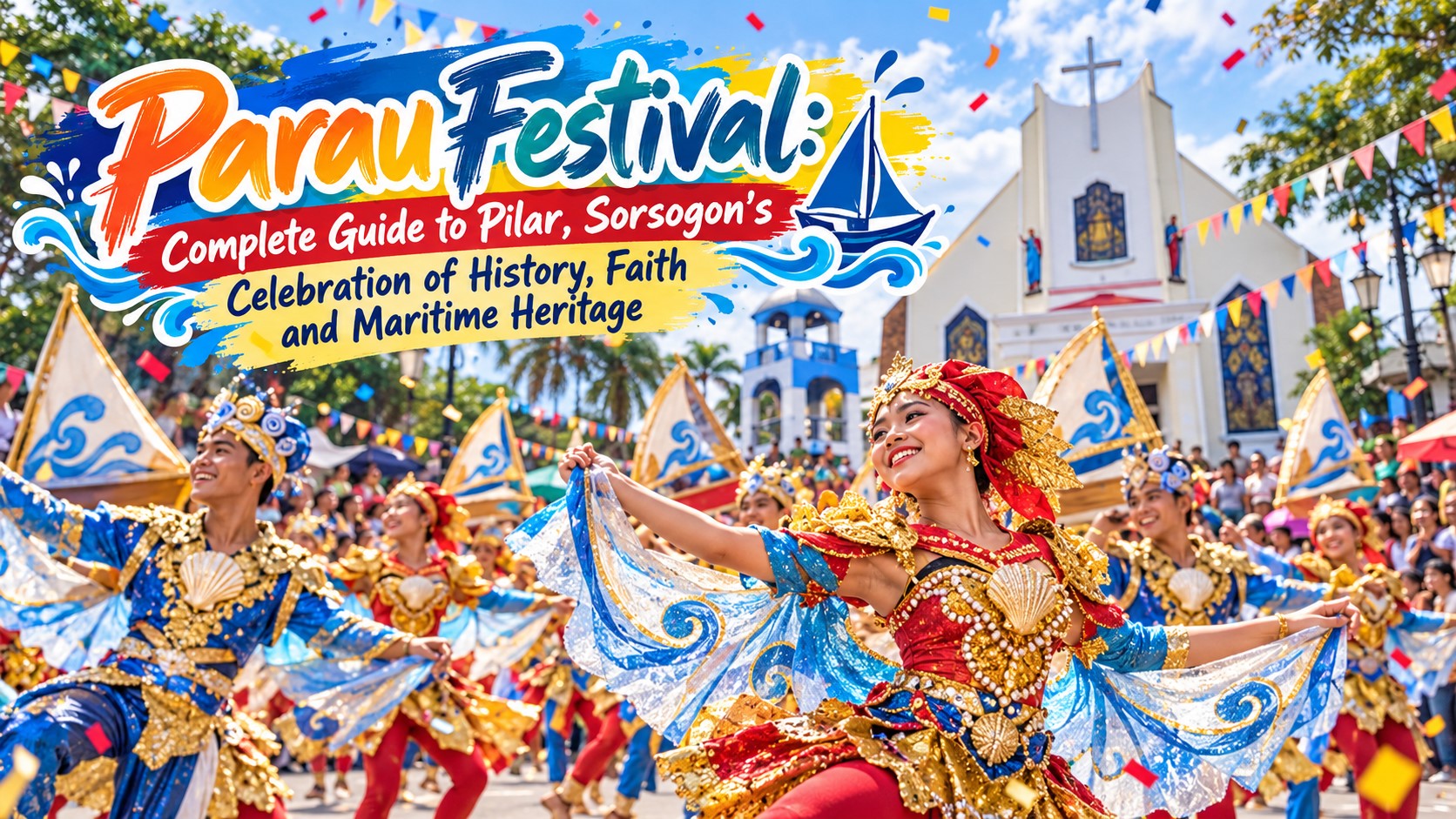
Parau Street Dancing
For many visitors, street dancing is one of the most visually exciting parts of any Philippine festival.
Parau Festival is no exception.
Performers take to the streets wearing colorful costumes while choreography, props, and music help tell stories connected with Pilar.
The performances can draw inspiration from maritime life, shipbuilding, local history, faith, and the experiences of Pilareños.
This is where the festival’s historical theme becomes especially visible.
Instead of reading about the community’s past, you see young performers interpreting it through movement.
And like other street dancing festivals in the Philippines, there is plenty of energy.
Expect bright costumes.
Expect drums.
Expect large formations.
Expect dancers performing under the October sun.
And expect plenty of spectators holding up their phones whenever the contingents pass.
Parau Float Competition
Another activity strongly associated with the festival is the Parau Float Competition.
The floats reflect the craftsmanship and creativity of participating communities.
Local historical materials specifically connect the float competition with the shipbuilding skills associated with earlier generations of Pilareños.
This makes the floats more than decoration.
They become symbolic representations of Pilar’s identity.
You may see maritime imagery, traditional boats, local products, religious symbols, historical scenes, and other designs inspired by life in the municipality.
For photographers, this is one of the events worth watching.
The combination of large decorated structures, performers, spectators, and festival colors can create some of the best scenes of the celebration.
Boat Races and Maritime Events
Of course, a festival called Parau would feel incomplete without activities happening on the water.
Past programs have featured boat racing events, including competitions identified as Parau Layagan and Sibidan races.
These activities strengthen the connection between the festival and Pilar’s coastal character.
And this is one of the things that sets Parau apart from many land-based festivals.
The celebration isn’t simply using a boat as its logo.
The sea remains part of everyday life in the community.
Fishing boats, passenger vessels, coastal livelihoods, and maritime transportation continue to shape the area.
Mutya ng Parau
Beauty pageants remain a familiar part of Philippine fiestas, and Parau Festival has also featured the Mutya ng Parau competition.
Like many municipal pageants, it usually becomes one of the festival’s major evening events.
But beyond gowns and stage production, local festival queens often serve as representatives of community culture and tourism.
Expect contestants representing different areas or groups, cultural attire, interviews, and a grand coronation event.
Agri-Trade and Local Product Fairs
Festival season is also a good opportunity to discover what people actually produce in the area.
Trade fairs and community exhibits have been included in previous Parau Festival programs.
Pilar’s economy has traditionally been strongly connected with agriculture, particularly coconut production, alongside fishing and maritime activities. The municipal government describes coconut as one of the town’s major agricultural crops.
During local fairs, visitors may encounter food products, agricultural goods, handicrafts, and small businesses from the municipality and surrounding communities.
I always recommend checking these parts of a festival.
The street dancing gets most of the photos.
But the trade fair is sometimes where you discover the things you actually want to bring home.
Sports and Community Competitions
Another thing I like about smaller-town festivals is that they aren’t designed only for tourists.
A large part of the celebration is really for the residents themselves.
Sports tournaments, fun runs, competitions, community nights, and similar activities have all formed part of previous Parau Festival programs.
These may not receive as much attention as the grand parade, but they are important.
Festivals are also reunions.
Former classmates see each other again.
Relatives come home.
Barangays compete.
Friends gather after work.
Students join performances.
Families go out at night.
That community atmosphere is really one of the best parts of a provincial fiesta.
Music, Concerts and Evening Events
Once the sun goes down, the festival usually continues.
Concerts and entertainment programs have appeared in past Parau Festival schedules, giving residents and visitors another reason to stay around after daytime activities.
Depending on the year, programs may feature local performers, bands, invited artists, cultural presentations, and other entertainment.
The exact lineup changes, so this is definitely one of those things you’ll want to check once the official schedule is released.
Why the Parau Festival Matters
It would be easy to describe Parau Festival as another colorful Philippine fiesta.
But that would miss the point.
At its core, the festival is about identity.
Pilar has changed.
People no longer live in the same world as the shipbuilders of Panlatuan centuries ago.
Transportation has changed.
Technology has changed.
The economy has changed.
The boats have changed.
But the town still has a maritime identity.
The festival provides a way to connect the Pilar of today with the Pilar of the past.
And that matters because local history can disappear surprisingly quickly.
Ask younger generations about an old shipyard, a historical uprising, an ancestral livelihood, or a centuries-old coastal community and the stories may slowly become less familiar.
A festival gives those stories another chance to survive.
Not inside a textbook.
But in music.
In dancing.
In boats.
In costumes.
In floats.
And in stories that parents can explain to their children while watching a parade.
Parau Festival Is Also About Coming Home
The Tourism Promotions Board’s description of Parau Festival mentions something that I think deserves more attention.
It says the celebration is a time when families, relatives, and friends gather and renew their relationships.
Anyone who grew up around Filipino fiestas understands this.
Sometimes the festival itself is only part of the story.
Fiesta means relatives arriving from Manila.
It means someone coming home from overseas.
It means cousins sleeping in every available room.
It means tables filled with food.
It means visiting houses.
It means people you haven’t seen for years suddenly appearing again.
That’s why local festivals matter even when they aren’t nationally famous.
For residents, they become markers of time.
Another year.
Another fiesta.
Another homecoming.
What Makes Parau Festival Different?
There are hundreds of festivals across the Philippines.
So what makes this one worth knowing?
For me, it’s the maritime history.
Pilar’s festival identity isn’t built around something generic.
The parau immediately connects the celebration with the geography and history of the town.
Pilar faces the sea.
Its history includes shipbuilding.
Its communities have long depended on the water.
Its port remains important.
And then the festival turns all of those things into a cultural celebration.
That’s a very strong sense of place.
If you took Parau Festival out of Pilar and moved it somewhere else, the story wouldn’t work the same way.
And that’s usually the sign of a meaningful local festival.
Best Time to Visit Parau Festival
If you’re visiting primarily for the festival, plan your trip during the first half of October.
The traditional festival period is October 1 to 12.
However, don’t assume every day will have a major event.
The biggest programs may be concentrated on specific dates.
Once the official calendar is released, look for:
- street dancing
- grand parade
- Parau float competition
- boat races
- Mutya ng Parau
- religious activities
- concerts
- trade fairs
- major evening programs
If you only have one or two days available, schedule your visit around the cultural highlight rather than simply arriving anytime between October 1 and 12.
How to Get to Pilar, Sorsogon
Pilar is accessible by road from Metro Manila and other parts of Bicol.
From Manila
Long-distance buses travel from Metro Manila toward Sorsogon and the Bicol Region.
The Municipality of Pilar estimates the Manila-to-Pilar land journey at roughly nine to ten hours under normal conditions, although actual travel time can be longer depending on traffic, stops, weather, and road conditions.
For a festival trip, give yourself extra time.
October weather can be unpredictable, and Bicol road journeys can take longer than expected.
From Legazpi
Legazpi City is one of the most convenient major gateways for travelers coming from outside the region.
Pilar is around 47 kilometers from Legazpi according to the local government, with the trip taking roughly an hour by road depending on your exact starting point and transportation.
Buses, vans, or hired vehicles can be used depending on availability.
From Sorsogon City
Pilar is roughly 56 to 57 kilometers from the provincial capital according to provincial and municipal sources.
Public transportation options are available within the province, although schedules and routes should always be checked locally.
Travel Tips for Parau Festival
If this is your first time attending Parau Festival, a little preparation helps.
First, check the official schedule before leaving.
Festival dates may be consistent, but individual activities can move.
Second, arrive early for street dancing and parades.
Good viewing areas fill up quickly, especially near judging areas and major intersections.
Third, bring sun protection.
October may be within the rainy season, but when the sun comes out, standing along a parade route can get hot very quickly.
Bring an umbrella, hat, water, and sunscreen.
And yes, that umbrella can also save you if it suddenly rains.
Fourth, carry some cash.
Small food stalls, local transportation, and community vendors may not always accept digital payments.
Fifth, support local businesses.
Eat at local restaurants.
Buy local products.
Visit the trade fair.
Book locally when possible.
A festival becomes more meaningful when tourism actually benefits the community hosting it.
What Else Can You Visit Around Pilar?
A Parau Festival trip can also be combined with other destinations around northwestern Sorsogon.
Pilar sits close to Donsol, one of the Philippines’ best-known destinations for whale shark encounters during the appropriate season.
The municipality itself also has coastal areas and serves as an important jumping-off point for sea travel toward Masbate and nearby islands.
If you have more time, you can continue exploring other parts of Sorsogon.
The province offers everything from beaches and coastal scenery to historical towns, lakes, hot springs, and views of Bulusan Volcano.
That makes Parau Festival a good excuse to explore a part of Bicol that travelers sometimes rush through on the way somewhere else.
Parau Festival 2026 Schedule
For 2026, Parau Festival is scheduled for October 1 to 12 in Pilar, Sorsogon, consistent with the traditional festival period listed by the Tourism Promotions Board.
The Municipality of Pilar and Pilar Tourism Center have also released the 2026 festival calendar under the theme:
“Liwanag, Pag-asa, Pagkakaisa.”
The local government announced the calendar on September 23, 2026.
Because individual event times and venues may still be adjusted, visitors should check the latest announcements from LGU Pilar and the Pilar Tourism Center before traveling.
I’ll keep this article focused on the festival itself rather than turning it into a yearly schedule post.
That way, you can return to this guide every year.
Frequently Asked Questions About Parau Festival
Where is Parau Festival celebrated?
Parau Festival is celebrated in the municipality of Pilar in Sorsogon province, Bicol Region.
When is Parau Festival celebrated?
It is traditionally held from October 1 to 12, culminating around the Feast of Our Lady of the Pillar on October 12.
What does Parau mean?
Parau refers to a traditional sailboat associated with Pilar’s maritime heritage.
What is Parau Festival known for?
The festival is known for celebrating Pilar’s maritime and shipbuilding history through cultural activities such as street dancing, floats, parades, boat-related events, community competitions, and religious festivities.
Who is the patron saint of Pilar, Sorsogon?
The town fiesta honors Our Lady of the Pillar, whose feast is celebrated on October 12.
When did Parau Festival begin?
The modern festival is commonly dated to 2002.
How long does Parau Festival last?
The traditional festival calendar spans around 12 days, from October 1 to October 12.
Is Parau Festival a religious festival?
It has both cultural and religious elements. The cultural festival celebrates Pilar’s maritime history and local heritage, while the celebration takes place alongside the town’s feast honoring Our Lady of the Pillar.
Final Thoughts
What I like about Parau Festival is that once you understand the story behind it, the sailboat suddenly means much more.
It’s not just something placed on a festival logo.
It represents Pilar’s relationship with the sea.
It connects today’s Pilareños with generations of shipbuilders, sailors, workers, fishermen, and coastal families who came before them.
Then you add another layer: faith.
Every October, the celebration coincides with the Feast of Our Lady of the Pillar.
And then another layer: community.
Families come home.
Barangays participate.
Students dance.
Boats race.
Floats fill the streets.
Food stalls open.
Old friends meet again.
For a few days, local history moves out of books and onto the streets.
That’s what makes festivals like Parau worth preserving.
You can come for the street dancing and colorful celebrations.
But hopefully, you leave knowing a little more about the town that created them.
Because Parau Festival isn’t simply a festival about a boat.
It is Pilar telling the story of where it came from—and celebrating where its people are going next.