When people think of La Union, the first things that usually come to mind are the surfing beaches of San Juan, beautiful sunsets, and the province’s growing food and café scene.
But travel farther north, and you’ll discover a coastal town where an annual festival celebrates something Filipinos have always valued: sharing food and welcoming visitors.
This is the Pinnakan Festival, a cultural and religious celebration held every November in Luna, La Union.
Unlike many Philippine festivals that are primarily known for elaborate street dancing and colorful costumes, Pinnakan Festival has a different tradition at its center.
It’s about feeding people.
During the celebration, members of the community gather around tables filled with traditional Ilocano dishes. Residents, visitors, and devotees come together to share meals, celebrate their heritage, and express gratitude for the blessings they have received.
The festival is also closely connected to the town’s fascinating history.
Long before it became known as Luna, the municipality was called Namacpacan, an Ilocano name associated with the generosity of residents who provided food and shelter to travelers during the Spanish colonial period.
Today, that tradition lives on through Pinnakan Festival.
If you’re planning to experience this celebration, here’s everything you need to know about Pinnakan Festival, including its meaning, history, traditions, schedule, religious significance, and the best things to see and do in Luna, La Union.
Content
What Is Pinnakan Festival?
Pinnakan Festival is an annual cultural festival celebrated in the municipality of Luna, La Union, traditionally during the town fiesta celebrations in November.
The festival highlights the Ilocano tradition of hospitality, particularly the practice of preparing food and sharing meals with neighbors, visitors, and members of the community.
Its name comes from the Ilocano word pinnakan, associated with feeding people or sharing food.
The celebration is rooted in the history of Luna, which was formerly known as Namacpacan.
According to local historical accounts, the town earned this name because of the hospitality of residents who welcomed travelers passing through the area during the Spanish colonial period.
Pinnakan Festival preserves this tradition by bringing the community together through shared meals and cultural activities.
The celebration is also held in connection with the Feast of Saint Catherine of Alexandria, Luna’s patron saint, and religious observances honoring Our Lady of Namacpacan.
Apart from the communal feast, festival activities have included cultural dances, drum-and-lyre performances, parades, pageants, musical presentations, and other community programs.
Pinnakan Festival Quick Facts
| Details | Information |
|---|---|
| Festival name | Pinnakan Festival |
| Location | Luna, La Union |
| Region | Ilocos Region (Region I) |
| Festival season | November |
| Traditional dates | November 20–25 |
| Patronal feast | November 25 |
| Patron saint | Saint Catherine of Alexandria |
| Important religious celebration | Our Lady of Namacpacan |
| First celebrated | 2018 |
| Festival theme | Hospitality, unity, faith, and sharing food |
| Main tradition | Communal feast featuring Ilocano dishes |
| Local language | Ilocano |
When Is Pinnakan Festival Celebrated?
Pinnakan Festival is traditionally celebrated during the latter part of November, particularly from November 20 to 25.
These dates coincide with the annual town fiesta of Luna and the Feast of Saint Catherine of Alexandria on November 25.
However, individual activities do not necessarily take place throughout the entire period.
Some celebrations begin earlier in the month, while the main Pinnakan communal feast has been held on November 24 in recent years.
For example, the 2025 Pinnakan Festival’s communal celebration took place on November 24 at the Saint Catherine of Alexandria Parish grounds.
Meanwhile, November 25 is the traditional patronal feast day of the municipality.
The festivities may include several days of religious services, cultural presentations, competitions, and community activities.
If you’re planning to visit, remember that the most important dates are generally November 24 and 25, although the exact program can vary each year.
What Does Pinnakan Mean?
The word pinnakan comes from Ilocano, the language widely spoken in La Union and other parts of Northern Luzon.
According to the Provincial Government of La Union, Pinnakan refers to feeding people or sharing food.
The festival uses this concept to represent generosity, hospitality, and community unity.
These values have a special connection to Luna’s history.
Before the town received its present name, it was called Namacpacan, an Ilocano term commonly translated as “one who feeds” or “one who has given food.”
The name was associated with the practice of residents offering meals and shelter to travelers passing through their community.
Instead of simply remembering this tradition through historical accounts, the people of Luna celebrate it by preparing food and sharing it with others.
This is what makes Pinnakan Festival different from many other local festivals in the Philippines.
Food is not just something visitors purchase or enjoy during the celebration.
Sharing food is the central tradition.
History of Pinnakan Festival
Although Pinnakan Festival was first celebrated in 2018, the cultural tradition behind it is much older.
Its origins are closely connected to the early history of Luna and the town’s former name, Namacpacan.
Luna Was Originally Called Namacpacan
Long before modern highways and public transportation connected the communities of Northern Luzon, travelers relied on established routes between towns.
One of these routes was the camino real, or royal road, which connected settlements during the Spanish colonial period.
The settlement that eventually became Luna was located along an important travel route.
According to the municipality’s historical accounts, travelers passing through the area would stop to rest, eat, and find shelter.
During that period, commercial restaurants and modern roadside facilities did not exist in the same form we know today.
Residents would welcome travelers into their homes and provide food and accommodation.
This generosity became associated with the settlement’s name.
It came to be known as Namacpacan, meaning someone who provides food.
The name reflected the hospitality of the community.
Over time, this tradition became an important part of the town’s historical identity.
The Establishment of Namacpacan
Historical accounts identify Namacpacan as a settlement connected to Purao, now Balaoan, as early as the late 16th century.
It was originally a visita, or a community served by clergy based in another parish.
On November 25, 1690, Namacpacan was established as a town and parish under the patronage of Saint Catherine of Alexandria.
This date became significant in the town’s religious and community calendar.
November 25 continues to be associated with Luna’s annual patronal fiesta.
Why Was Namacpacan Renamed Luna?
The municipality was officially renamed Luna on October 18, 1906, through Philippine Commission Act No. 1543.
The change honored Doña Laureana Novicio Luna, who came from the town and was the mother of two prominent figures in Philippine history.
Her sons were General Antonio Luna, a military leader during the Philippine-American War, and Juan Luna, one of the Philippines’ most celebrated painters.
Although the municipality adopted the name Luna, its earlier identity as Namacpacan remained important.
The name continues to be associated with the town’s religious heritage, particularly the devotion to Our Lady of Namacpacan.
It also became the inspiration for the Pinnakan Festival.
When Did Pinnakan Festival Start?
The modern Pinnakan Festival was first celebrated in 2018.
This date was confirmed in reporting by the Philippine Information Agency and the Provincial Government of La Union.
The festival was developed to commemorate the hospitality of the town’s early residents and promote the community’s cultural identity.
Its celebrations also recognize the importance of fishing and other traditional livelihoods in Luna.
Through cultural performances, the community portrays the story of residents who welcomed travelers and shared the blessings of the sea.
The festival also serves as an expression of thanksgiving.
Over the years, Pinnakan has become part of Luna’s annual town fiesta celebrations, combining local history, Ilocano culture, community meals, and religious traditions.
Pinnakan Festival and the Namacpacan Streetdancers
One notable achievement connected to the festival came in March 2022.
The Namacpacan Streetdancers, representing Luna, participated in the Festival Dance Competition during the Panagbenga Festival in Baguio City.
The contingent finished as first runner-up.
Their presentation featured colorful Ilocano-inspired costumes and choreography depicting Luna’s traditions.
The performance highlighted fishing, thanksgiving for a bountiful harvest, and the practice of feeding travelers.
This achievement helped introduce Luna’s cultural festival to audiences beyond La Union.
It also demonstrated how Pinnakan’s traditions could be presented through dance and theatrical storytelling.
Highlights of Pinnakan Festival
What can visitors expect during Pinnakan Festival?
The activities may differ each year, but several traditions have become associated with the celebration.
1. Pinnakan Communal Feast
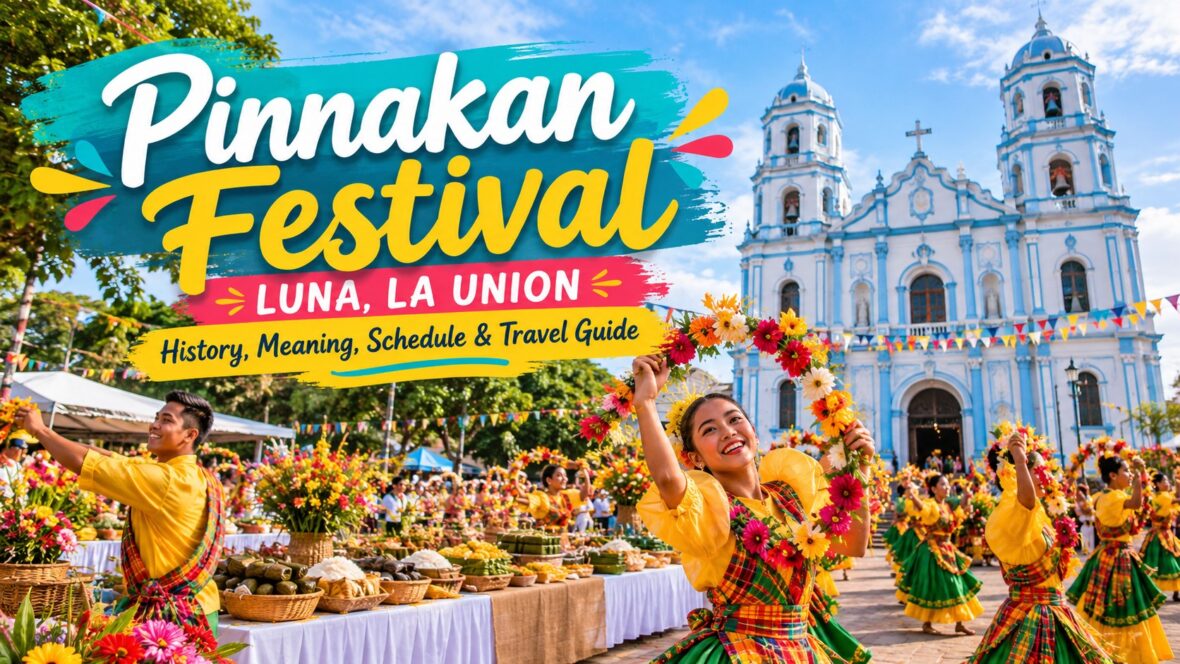
The communal feast is the most distinctive part of Pinnakan Festival.
During the celebration, long tables are prepared with traditional Ilocano food and other dishes contributed or organized for the occasion.
Residents, visitors, and members of the community gather to share a meal.
This tradition reflects the historical generosity associated with the town’s former name, Namacpacan.
For example, during the November 24, 2025 celebration, the Municipal Government of Luna and Saint Catherine of Alexandria Parish organized a communal meal at the parish grounds.
Long tables were filled with native delicacies, and residents were invited to join the gathering.
The event demonstrated the festival’s central message: food becomes a way of bringing people together.
Unlike food festivals where the main attraction is a cooking competition or commercial food stalls, Pinnakan places particular emphasis on sharing.
For visitors, the communal meal is one of the best opportunities to understand the meaning behind the festival.
2. Cultural Dance Presentations
Cultural dancing is another important element of Pinnakan Festival.
Performances by students and local cultural groups highlight Ilocano traditions and different aspects of Luna’s history.
Some dances portray the town’s connection to fishing and its coastal environment.
Others focus on thanksgiving, community life, and the generosity of residents toward travelers.
Colorful costumes, coordinated movements, and traditional cultural themes help bring these stories to life.
The presentations also provide an opportunity for younger generations to participate in preserving local traditions.
3. Drum-and-Lyre Performances
School drum-and-lyre corps have also been featured during Pinnakan Festival celebrations.
These performances bring together students from different educational institutions.
With coordinated formations, percussion instruments, and musical arrangements, the performers add energy to the town’s festivities.
In previous celebrations, drum-and-lyre performances were held alongside cultural dances and other school presentations.
These activities help encourage participation among students while providing entertainment for residents and visitors.
4. Grand Civic Parade
Another important activity associated with Luna’s town fiesta is the Grand Civic Parade.
The event brings together representatives from local government offices, schools, barangays, and community organizations.
Participants may include marching bands, decorated contingents, and representatives of different sectors of the municipality.
The parade celebrates community participation and highlights the shared identity of Luna’s residents.
For visitors, it provides another opportunity to experience the festive atmosphere of the town.
5. Religious Celebrations
Faith is an important part of Pinnakan Festival.
The celebration coincides with religious observances honoring Saint Catherine of Alexandria and Our Lady of Namacpacan.
These include Masses, devotional activities, and other parish programs.
The local church is an important gathering place during the festival.
For Catholic pilgrims, Pinnakan Festival offers an opportunity to participate in the town’s religious traditions while learning about its cultural heritage.
6. Mutia ti Luna and Other Pageants
Beauty pageants and community competitions have also been part of Luna’s fiesta celebrations.
One of the events featured in previous programs is the Mutia ti Luna Coronation Night.
Other celebrations have included Mrs. Luna and programs involving representatives of different barangays.
These activities provide opportunities for participants to represent their communities and take part in the annual festivities.
Specific pageant formats and schedules depend on the organizers.
7. Musical and Community Programs
Pinnakan Festival celebrations have also included events such as Balikbayan Night, Educator’s Night, cultural folk-dance competitions, and musical presentations.
Other activities featured in past programs include kundiman singing competitions, community gatherings, and special celebrations for different sectors.
These events help make the town fiesta a broader celebration involving residents, students, workers, families, and returning members of the community.
The Feast of Saint Catherine of Alexandria
One of the most important religious events associated with Pinnakan Festival is the Feast of Saint Catherine of Alexandria.
Saint Catherine is the patron saint of Luna, La Union.
Her feast day is celebrated on November 25.
The association dates back to the establishment of Namacpacan as a town and parish in 1690.
During the annual fiesta, Catholic devotees participate in religious activities organized by the parish.
The church, formally known as Saint Catherine of Alexandria Parish, is one of Luna’s most important historical and religious landmarks.
It is also closely associated with the devotion to Our Lady of Namacpacan.
Although Pinnakan Festival highlights the town’s culture of hospitality, the patronal celebration provides the religious foundation of the annual fiesta.
Our Lady of Namacpacan and Pinnakan Festival
Another important aspect of Luna’s religious heritage is Our Lady of Namacpacan.
The Marian image is enshrined at Saint Catherine of Alexandria Parish and is affectionately called Apo Baket by devotees.
The name is an Ilocano term of endearment and respect for an elderly woman.
According to local religious tradition, the image of the Virgin Mary arrived in the area during the Spanish colonial period.
The story tells of a vessel carrying the image that sought shelter near Darigayos because of unfavorable weather.
The image eventually became associated with Namacpacan, where it developed a strong following among Catholic devotees.
The account forms part of the town’s religious tradition rather than a fully independently verified historical narrative.
Today, the church remains a pilgrimage destination in Northern Luzon.
The Pontifical Coronation of Our Lady of Namacpacan
An important date in the history of the devotion is November 24, 1959.
This marked the pontifical coronation of the image of Our Lady of Namacpacan.
The anniversary is commemorated through religious celebrations.
For example, on November 24, 2023, the parish celebrated the 64th anniversary of the coronation.
The celebration included a Eucharistic service, cultural presentations, and the traditional communal meal associated with Pinnakan Festival.
This connection between religious devotion and food sharing is one of the festival’s defining characteristics.
It brings together two important aspects of Luna’s identity: faith and hospitality.
What Food Is Served During Pinnakan Festival?
Food is at the center of Pinnakan Festival, so naturally, one of the most interesting parts of the celebration is discovering Ilocano cuisine.
The dishes served during the communal feast depend on the participating groups and organizers.
However, previous celebrations have featured traditional Ilocano food, including dinengdeng and lechon.
Luna is also known for local delicacies such as bibingka and tupig.
Dinengdeng
Dinengdeng is a traditional Ilocano vegetable dish commonly prepared with bagoong and locally available vegetables.
Depending on the recipe, it may include ingredients such as squash, eggplant, okra, string beans, and bitter gourd.
Fish may also be added.
The dish is widely associated with home cooking in the Ilocos Region.
Dinengdeng was among the foods reported during the communal celebration in 2023.
Lechon
Lechon is another dish that has appeared during past Pinnakan communal feasts.
It is often served during major celebrations, fiestas, and family gatherings across the Philippines.
At Pinnakan Festival, dishes such as lechon may be shared alongside traditional Ilocano food.
Bibingka
Luna is known for its local bibingka.
This rice cake is a popular snack and pasalubong for travelers passing through the municipality.
Some versions are generously topped with egg and cheese.
If you’re exploring Luna during the festival, local bakeries and food stalls are good places to look for bibingka.
Tupig
Tupig is another traditional delicacy associated with Northern Luzon.
It is made from glutinous rice, coconut, and sweeteners, wrapped in banana leaves and grilled.
The result is a fragrant, chewy rice snack.
It is commonly sold as pasalubong in parts of La Union and neighboring provinces.
Although not every one of these foods is necessarily served at the official communal feast each year, they are examples of the local and regional cuisine visitors can discover during a trip to Luna.
Why Pinnakan Festival Is Important to Luna
Pinnakan Festival plays an important role in preserving the town’s identity.
First, it reminds residents of the history behind the name Namacpacan.
The story of people feeding travelers might seem like a simple detail, but it became important enough to define how the community was known.
Second, the festival encourages generosity and cooperation.
Preparing a community feast requires contributions and coordination among organizers, residents, institutions, and volunteers.
Third, Pinnakan helps preserve local cultural traditions.
Students and performers participate in activities that highlight Ilocano music, dance, food, and storytelling.
Finally, the festival connects cultural heritage with religious devotion.
The shared celebration of the town fiesta and Our Lady of Namacpacan brings together residents and pilgrims.
For Luna, Pinnakan is therefore more than an annual event.
It is a celebration of the values that the community has associated with its history for generations.
Where Is Pinnakan Festival Held?
Pinnakan Festival is celebrated in Luna, La Union, a coastal municipality located in the northern part of the province.
Many important festival activities take place around the town proper.
The communal feast has been held at the Saint Catherine of Alexandria Parish grounds, which also houses the Shrine of Our Lady of Namacpacan.
Other events may take place at designated public spaces, school grounds, and community venues.
The locations vary depending on the activities prepared for each edition.
If you’re planning to watch a particular performance or participate in the communal feast, check the official venue announcements before traveling.
How to Get to Luna, La Union
Luna is accessible by road from Metro Manila, San Fernando City, and other municipalities in La Union.
Whether you’re traveling by private car or public transportation, the route generally passes through the main highways connecting La Union with the rest of Northern Luzon.
From Manila to Luna, La Union
If you’re traveling from Metro Manila, you can take a northbound bus headed toward La Union or Ilocos.
Depending on the bus route, you may be able to get off at Balaoan.
From Balaoan, local tricycles provide transportation to Luna.
Another option is to travel to San Fernando City, La Union, and transfer to local transportation going toward Luna.
For those traveling by private vehicle, the journey from Metro Manila is approximately 300 kilometers, depending on the starting point.
Travel time commonly takes around six to seven hours in favorable conditions, although traffic and stops can extend the trip.
From San Fernando City, La Union
If you’re already in San Fernando City, Luna can be reached by local public transportation or private vehicle.
According to the Provincial Government of La Union, jeepneys serving Luna operate from the area near the San Fernando City Public Market.
Confirm the current departure point and schedule before boarding, as routes and operating hours may change.
From San Juan, La Union
If you’re staying in San Juan, particularly around Urbiztondo Beach, visiting Luna is possible as a day trip.
Travelers with private vehicles can take the northern coastal route through nearby municipalities.
Those using public transportation may need to travel toward the main highway and transfer to vehicles bound for Luna or Balaoan.
If your main purpose is attending the Pinnakan communal feast, allow enough time to arrive before the scheduled activities.
Festival traffic and temporary road restrictions may affect transportation.
Tourist Spots to Visit in Luna, La Union
One advantage of visiting Pinnakan Festival is that Luna has several attractions worth exploring.
The town is known for its historical church, pebble beaches, coastal scenery, and stone-based artworks.
If you have extra time before or after the festival, consider visiting these destinations.
Shrine of Our Lady of Namacpacan
The Shrine of Our Lady of Namacpacan is one of Luna’s most important landmarks.
Also known as Saint Catherine of Alexandria Parish or Namacpacan Church, it is a major religious destination in La Union.
The church features a distinctive historic facade, with twin bell towers and architectural elements associated with the Spanish colonial period.
Inside, devotees visit the image of Our Lady of Namacpacan.
The church is also associated with a well that some devotees believe has special religious significance.
For visitors attending Pinnakan Festival, the shrine is particularly important because of its connection to the annual communal feast and religious celebrations.
Baluarte Watchtower
Baluarte Watchtower is another famous attraction in Luna.
Located near the pebble-covered shoreline of Barangay Victoria, the historical structure was originally used as a coastal observation and defensive post during the Spanish colonial period.
It helped communities watch for approaching vessels and potential threats from the sea.
Over time, the tower was damaged by coastal erosion and other natural forces.
Preservation efforts have helped protect the remaining structure.
Today, Baluarte Watchtower is one of the most recognizable photography spots in Luna.
The combination of historic brickwork, ocean views, and pebble-covered shores makes it a distinctive destination.
Bahay na Bato
Bahay na Bato is another popular attraction in Luna.
It is a privately developed art destination known for its use of stones and pebbles in architectural features and artistic displays.
Visitors can explore sculptures, decorated spaces, and other installations.
Its coastal setting also provides views of the sea.
Bahay na Bato is particularly interesting for travelers who enjoy photography, art, and unusual architectural attractions.
Since the property is privately managed, confirm its current admission fees and visiting hours before your trip.
Luna’s Pebble Beaches
Unlike the sandy shores often associated with La Union, Luna is known for its beaches covered with smooth stones and pebbles.
These pebble-covered coastlines are among the municipality’s most distinctive natural features.
They also support local livelihoods and artistic traditions associated with stone-based products.
Visitors can enjoy coastal scenery and photography.
However, the beaches may have strong waves and uneven surfaces.
Not every section is suitable for swimming, so observe local safety notices and avoid entering the water where conditions are dangerous.
Other Attractions Around Luna
Travelers with more time can also explore other sites promoted by La Union’s tourism office, including Bato de Luna and Darigayos Cove.
These destinations provide additional opportunities to experience the town’s coastal environment and local artistic attractions.
Where to Stay During Pinnakan Festival
Accommodation choices in Luna are more limited than in the major tourism centers of La Union.
However, visitors can look for local inns, homestays, guesthouses, and other lodging establishments in and around the municipality.
If you prefer a wider selection of hotels and restaurants, staying in San Fernando City or San Juan is another option.
Both locations provide access to other destinations in La Union.
For those who want to experience the religious celebrations and communal feast without making a long return trip on the same day, staying in or near Luna may be more convenient.
Because the town fiesta can attract additional visitors, it’s best to arrange your accommodation in advance.
Tips for Visiting Pinnakan Festival
If you’re planning your first visit, here are a few reminders to help you prepare.
- Plan your trip around November 24–25. These dates are especially important for the communal feast, Marian devotion, and patronal celebration, although exact schedules can vary.
- Check the official festival program. Cultural shows, parades, and other activities may take place on different dates.
- Arrive early for the communal feast. Public dining areas may become crowded, and food service arrangements depend on the organizers.
- Wear comfortable clothing. Expect outdoor activities, walking, and warm weather.
- Prepare for changing weather. November is part of the transition toward the northeast monsoon season, and rainfall remains possible.
- Bring cash. Small food vendors and local transportation providers may not always accept digital payments.
- Observe proper etiquette inside the church. Avoid disrupting Masses or devotional activities when taking photographs.
- Respect the tradition of sharing. Take reasonable portions during the communal feast and follow instructions from organizers and volunteers.
- Explore Luna’s historical landmarks. The church, watchtower, and pebble beaches can make your visit more memorable.
- Confirm transportation before your return trip. Local public transportation may be less frequent later in the evening.
Is November 25 a Holiday in Luna, La Union?
November 25 is the traditional town fiesta of Luna, celebrating Saint Catherine of Alexandria.
However, this does not automatically mean that the date is a permanent special non-working holiday every year.
For example, November 25, 2025, was declared a special non-working day in the municipality through Proclamation No. 1070, signed on October 27, 2025.
The declaration allowed residents to participate in their town fiesta celebrations.
That proclamation applied specifically to November 25, 2025.
Holiday status in future years must be verified through the appropriate official proclamations or other applicable laws.
Visitors should also remember that a local holiday declaration does not necessarily apply to the rest of La Union.
Pinnakan Festival 2026: Schedule and Latest Information
Pinnakan Festival is traditionally celebrated from November 20 to 25 in Luna, La Union.
For 2026, the customary festival period would fall on November 20–25, with the patronal feast of Saint Catherine of Alexandria on Wednesday, November 25.
However, these are traditional calendar dates and should not be treated as a confirmed program of activities for 2026.
As of October 26, 2026, a complete official schedule for Pinnakan Festival 2026 could not be verified from the available municipal and provincial sources.
Visitors should wait for official announcements concerning the communal feast, parade routes, cultural competitions, pageants, religious services, and other activities.
For reference, the 2025 celebration included a communal feast on November 24, with long tables prepared at the Saint Catherine of Alexandria Parish grounds.
It also featured cultural dances, school performances, religious activities, and community events.
The Municipal Government of Luna and the Provincial Government of La Union are among the official sources for festival updates.
Frequently Asked Questions About Pinnakan Festival
When is Pinnakan Festival celebrated?
Pinnakan Festival is traditionally celebrated from November 20 to 25 in Luna, La Union.
The celebration is associated with the town fiesta and the Feast of Saint Catherine of Alexandria on November 25.
Where is Pinnakan Festival held?
The festival is held in Luna, La Union, Philippines.
Its communal feast and religious celebrations have taken place at Saint Catherine of Alexandria Parish, which houses the Shrine of Our Lady of Namacpacan.
What is the meaning of Pinnakan Festival?
Pinnakan refers to feeding people or sharing food in Ilocano.
The festival celebrates the generosity and hospitality associated with Luna’s former name, Namacpacan.
Why is Luna called Namacpacan?
Namacpacan was the town’s former name.
According to local historical accounts, residents provided food and shelter to travelers passing through the settlement during the Spanish colonial period.
The Ilocano name is commonly translated as “one who feeds” or “one who has given food.”
When did Pinnakan Festival start?
The modern Pinnakan Festival was first celebrated in 2018.
It was established to highlight the town’s historical tradition of hospitality and sharing food.
What is Pinnakan Festival known for?
The festival is best known for its communal feast, during which residents and visitors gather to share traditional food.
Other activities include cultural dances, school performances, parades, pageants, and religious celebrations.
Is Pinnakan Festival a religious festival?
Pinnakan is primarily a cultural celebration of hospitality, but it is closely connected to Luna’s religious traditions.
It coincides with the Feast of Saint Catherine of Alexandria and devotion to Our Lady of Namacpacan.
Who is the patron saint of Luna, La Union?
Saint Catherine of Alexandria is the patron saint of Luna.
Her feast day is celebrated on November 25.
What is the connection between Pinnakan Festival and Our Lady of Namacpacan?
The festival is celebrated during the same period as important Marian observances in Luna.
Our Lady of Namacpacan is enshrined at Saint Catherine of Alexandria Parish, where the communal feast has also been held.
Is Pinnakan Festival the same as the Luna town fiesta?
They are closely connected, but the terms are not exactly interchangeable.
Pinnakan Festival is the cultural celebration highlighting the town’s history of feeding and welcoming visitors.
The town fiesta includes the broader religious, civic, and community celebrations associated with the feast of Saint Catherine of Alexandria.
Is Pinnakan Festival free to attend?
Many public cultural and religious activities are organized for community participation.
The communal feast has also been offered as a shared public celebration.
However, some separately organized activities may have their own admission requirements or arrangements.
Visitors should check announcements for the particular events they want to attend.
How do I get to Pinnakan Festival from Manila?
Travelers from Manila can take a northbound bus toward La Union or Ilocos and connect to Luna through Balaoan or San Fernando City.
Those traveling by private vehicle can follow the highway routes through La Union and continue to Luna.

Final Thoughts
Pinnakan Festival may not be as widely known as some of the Philippines’ biggest festivals, but it celebrates a tradition that remains deeply meaningful to the people of Luna, La Union.
It’s a festival centered on hospitality.
Instead of focusing only on parades and performances, Pinnakan brings people together through something simple: sharing a meal.
The celebration also keeps alive the history of Namacpacan, the former name of Luna, and the generosity of residents who welcomed travelers during the Spanish colonial period.
Today, that tradition continues alongside the town’s religious devotion to Saint Catherine of Alexandria and Our Lady of Namacpacan.
For travelers, Pinnakan Festival provides an opportunity to discover another side of La Union.
Beyond the popular surfing destinations, the province has coastal communities with historical landmarks, cultural traditions, and stories worth exploring.
If you’re planning a visit to La Union in November, consider including Luna in your itinerary during the festival.
It’s a chance to experience local hospitality, discover Ilocano food, and understand why sharing has become such an important part of the town’s identity.