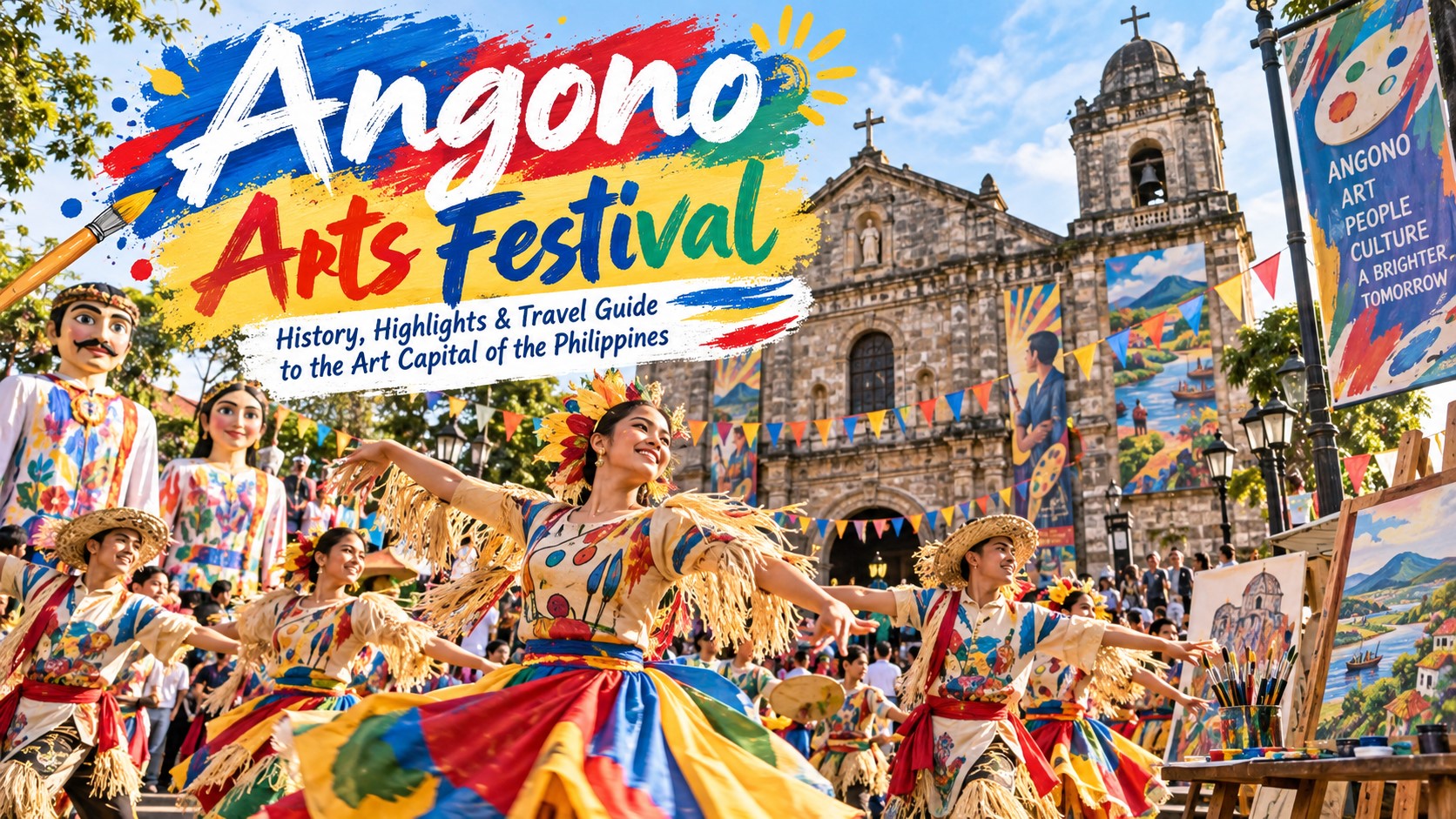
Every November, the town of Angono in Rizal becomes an even more colorful place as artists, musicians, students, and local communities come together to celebrate creativity.
Paintings fill galleries, public spaces become venues for artistic expression, and the streets come alive with cultural performances and celebrations.
This is the Angono Arts Festival, one of the cultural celebrations in the Philippines that showcases the country’s rich artistic heritage.
And if you’re familiar with Angono, you probably already know that this isn’t just any ordinary town.
Angono is widely recognized as the Art Capital of the Philippines, a title it has earned through generations of talented painters, sculptors, musicians, and other creative individuals who have made significant contributions to Filipino culture.
It is the hometown of two National Artists, Carlos “Botong” Francisco and Lucio San Pedro, whose achievements helped put Angono on the country’s artistic map.
But what makes the Angono Arts Festival particularly interesting is that it isn’t just a celebration of famous artists.
It’s also about giving aspiring painters, young musicians, students, and ordinary residents an opportunity to participate in the town’s artistic traditions.
And while the festival shares the November celebration season with the famous Higantes Festival, it has its own identity rooted in visual arts, music, creative expression, and cultural preservation.
If you’re interested in Philippine festivals, art museums, cultural heritage, or simply looking for a unique destination near Metro Manila, here’s everything you need to know about the Angono Arts Festival.
Content
What Is the Angono Arts Festival?
The Angono Arts Festival is an annual cultural celebration held in Angono, Rizal, highlighting the town’s artistic heritage and the creativity of its residents.
Traditionally associated with November and the commemoration of National Artist Carlos “Botong” Francisco’s birthday, the celebration provides opportunities for local artists to display their works and share their skills with the community.
Art exhibitions, painting competitions, workshops, and other creative activities have long been part of the festival.
Over the years, Angono has also developed a broader November celebration known as the Higantes and Arts Festival, which combines artistic activities with traditional street celebrations, cultural performances, and the town fiesta.
The distinction is worth remembering.
While the Angono Arts Festival primarily celebrates the town’s creative community, the Higantes Festival is particularly famous for its enormous papier-mâché figures paraded through the streets.
Both reflect Angono’s artistic identity, and their activities often form part of the same festive season.
Angono Arts Festival at a Glance
| Details | Information |
|---|---|
| Festival | Angono Arts Festival |
| Location | Angono, Rizal, Philippines |
| Region | CALABARZON |
| Traditional celebration month | November |
| Cultural significance | Celebration of Filipino art, heritage, and local creativity |
| Key historical connection | Birth anniversary of Carlos “Botong” Francisco |
| Traditional activities | Art exhibitions, painting competitions, workshops, and community art |
| Related celebration | Higantes and Arts Festival |
| Nearby major occasion | Feast of St. Clement, November 23 |
| Popular attractions | Art galleries, museums, street murals, and the Higantes parade |
The exact events and dates can vary each year, depending on the programs organized by the municipal government, local artists’ associations, and participating cultural institutions.
History of the Angono Arts Festival
To understand how the Angono Arts Festival began, it’s important to appreciate the town’s long relationship with the arts.
Angono has been home to artists for generations.
Even during the Spanish colonial period, local painters and craftsmen were already contributing to the town’s artistic traditions.
Historical accounts from the Municipal Government of Angono identify artists such as Juan Senson and Pedro Piñon among the early creative figures who influenced later generations.
Eventually, Angono would produce some of the most distinguished artists in Philippine history.
Among them was Carlos “Botong” Francisco, whose large-scale murals depicted Filipino history, legends, and everyday life.
Another was composer Lucio San Pedro, whose musical compositions became part of the country’s cultural heritage.
Their achievements helped inspire a growing community of painters, sculptors, musicians, and cultural workers.
The Formation of the Angono Ateliers Association
An important chapter in the festival’s history came with the establishment of the Angono Ateliers Association in 1975.
The organization was created to bring local artists together, promote artistic development, and continue the creative legacy of Botong Francisco.
Nemesio “Nemi” Miranda Jr., widely known as Nemiranda, was among the individuals who played an important role in establishing the association.
The group became a venue for artists to collaborate, display their works, and support younger generations interested in painting and other creative activities.
It also helped develop opportunities for students to learn through competitions, workshops, and exhibitions.
According to the Department of Tourism’s cultural heritage feature on Angono, the Angono Ateliers Association initiated the Angono Arts Festival.
The festival is traditionally celebrated in November in connection with Botong Francisco’s birthday.
Celebrating the Legacy of Botong Francisco
Carlos “Botong” Francisco was born on November 4, 1912.
His achievements as a painter, particularly in mural painting, helped establish Angono’s reputation as a center of Philippine art.
He was posthumously named National Artist for Visual Arts in 1973.
Remembering his birthday became an important occasion for local artists to celebrate his life and contributions.
Over the years, exhibitions, student competitions, and workshops have helped carry that legacy forward.
This is one of the things that makes the Angono Arts Festival meaningful.
It isn’t just about remembering the artistic achievements of the past.
It’s also about inspiring future artists to develop their own talents.
Why Is Angono Called the Art Capital of the Philippines?
If there’s one thing Angono is especially proud of, it’s the title “Art Capital of the Philippines.”
And the recognition isn’t simply a promotional slogan.
According to the Municipal Government of Angono, the town has nurtured hundreds of visual artists, alongside musicians, writers, theater performers, filmmakers, sculptors, and other creative professionals.
The municipality has also been home to several artists’ associations, private galleries, studios, and cultural institutions.
Art is an important part of daily life in Angono.
You can see this through the murals that decorate public spaces, the galleries established by local painters, and the creative traditions that continue within families.
But perhaps the strongest evidence of Angono’s artistic significance is its association with two National Artists.
Carlos “Botong” Francisco – National Artist for Visual Arts
Carlos “Botong” Francisco is one of the most important figures in Philippine painting.
He became especially known for murals that presented sweeping scenes of Philippine history, mythology, and culture.
His work helped revive the tradition of large-scale mural painting in the country.
Among his notable works are Bayanihan, Harana, and The First Mass at Limasawa.
His paintings often featured expressive figures, dramatic movement, and scenes inspired by Filipino identity.
Even after his death in 1969, his artistic influence remained strong in Angono.
His home and studio became a place where visitors could learn about his life and legacy, while reproductions and interpretations of his works became part of the town’s public art landscape.
Lucio D. San Pedro – National Artist for Music
Angono’s artistic heritage extends far beyond painting.
The town is also the birthplace of Lucio D. San Pedro, one of the country’s most celebrated composers.
He was named National Artist for Music in 1991.
San Pedro is best known for the beloved Filipino lullaby Sa Ugoy ng Duyan, composed with lyrics by Levi Celerio.
His music reflects the warmth, emotion, and expressive qualities of Filipino musical traditions.
His legacy helped establish Angono not only as a community of painters but also as a center for musical creativity.
Together, Botong Francisco and Lucio San Pedro represent two important artistic traditions that continue to influence the town.
When Is the Angono Arts Festival Celebrated?
The Angono Arts Festival is traditionally associated with November.
This timing is significant because November 4 marks the birth anniversary of Carlos “Botong” Francisco.
Art-related commemorations and activities may begin earlier in the month, while other cultural events continue throughout Angono’s November festival season.
However, the festival doesn’t necessarily have one fixed annual date or an identical schedule every year.
Some editions focus on art exhibitions and workshops, while the municipality’s broader Higantes and Arts Festival may include concerts, cultural competitions, community activities, and parades.
November is also an important month for Angono because of the Feast of St. Clement, the patron saint of fishermen, celebrated on November 23.
This means travelers may encounter several related celebrations happening around the same period.
| November occasion | Traditional timing |
|---|---|
| Botong Francisco’s birth anniversary | November 4 |
| Angono Arts Festival activities | November, dates vary |
| Higantes Festival grand parade | Traditionally the third Sunday of November |
| Feast of St. Clement | November 23 |
| Other cultural and community events | Dates vary annually |
If you’re planning to attend a particular exhibition, workshop, or performance, it’s best to check the official yearly calendar.
Highlights of the Angono Arts Festival
So, what can you expect when visiting Angono during its annual celebration of the arts?
Unlike festivals that focus mainly on street dancing or religious processions, Angono’s art celebrations highlight several forms of creative expression.
Here are some of the activities traditionally associated with the festival and the town’s wider arts scene.
1. Art Exhibitions and Gallery Shows
One of the highlights is the opportunity to appreciate artworks created by local artists.
Exhibitions may feature paintings, drawings, sculptures, mixed-media works, and other forms of visual art.
Some displays celebrate established painters, while others introduce emerging talents.
What makes these exhibitions interesting is the variety of artistic styles represented.
Some artists focus on realistic depictions of Filipino life, while others explore modern themes, imagination, abstract forms, and experimental techniques.
Visitors can discover how Angono’s creative community continues to evolve while remaining connected to its artistic history.
2. Painting Competitions for Students
One of the important purposes of the Angono Arts Festival is to encourage younger generations to become involved in the arts.
Student painting competitions have been among the festival’s established activities.
These contests give aspiring artists opportunities to demonstrate their creativity and develop their skills.
For some students, participating in an art competition can be their first opportunity to present their work outside the classroom.
It’s also a way for the community to recognize young talent.
And in a town like Angono, where painting traditions have been passed down through families, encouraging young artists has particular cultural significance.
3. Art Workshops and Creative Activities
Workshops are another important part of Angono’s artistic community.
Depending on the event program, participants may have opportunities to learn painting techniques, drawing, sculpture, and other creative skills.
These activities can be especially appealing to children, students, and visitors who want a more hands-on experience.
Instead of simply looking at finished artworks, participants can learn about the creative process.
For someone who has never tried painting before, attending a workshop can be a memorable introduction to the town’s artistic traditions.
4. Public Art and Street Murals
One of my favorite things about the idea of exploring Angono is that you don’t necessarily need to enter a museum to appreciate its art.
The town itself has become a showcase for public artistic expression.
Along parts of Doña Aurora Street, visitors can find relief artworks inspired by the creations of Carlos “Botong” Francisco.
These pieces bring scenes associated with his artistic legacy into spaces where residents and visitors can appreciate them.
Public art has also been part of other creative initiatives organized by Angono-based artist groups.
The result is a town where art isn’t confined to gallery walls.
It’s visible in everyday surroundings.
5. Music and Cultural Performances
Angono’s artistic identity also includes music, literature, and performance.
The municipality has a history of marching bands, orchestral ensembles, choirs, theater groups, and other cultural organizations.
During the November celebration season, musical performances and cultural programs may form part of the festivities.
These activities reflect the influence of Lucio San Pedro and the town’s broader musical heritage.
They also remind visitors that Angono’s reputation as the Art Capital of the Philippines extends beyond visual arts.
6. Community Art and Creative Collaboration
One of the most meaningful aspects of the festival is the participation of local artists and organizations.
Angono has been home to several creative associations, including the Angono Ateliers Association, Angono Artists Association, and Neo-Angono Artists Collective.
These groups have contributed to exhibitions, public art projects, and cultural activities over the years.
The broader artistic community has also explored poetry, photography, performance, installation art, and experimental forms of expression.
Through these initiatives, Angono continues to provide opportunities for established and emerging artists to connect with audiences.
Angono Arts Festival vs. Higantes Festival: What’s the Difference?
This is probably one of the most common sources of confusion.
Many people associate Angono with the famous Higantes Festival.
And because the municipality has organized events under the combined name Higantes and Arts Festival, it’s understandable that visitors sometimes treat the celebrations as one and the same.
However, their main cultural focuses are different.
Angono Arts Festival
The Arts Festival celebrates the town’s long-standing artistic traditions.
Its historical activities include art exhibitions, student painting competitions, and workshops.
It also commemorates the legacy of local artists, particularly Carlos “Botong” Francisco.
Higantes Festival
The Higantes Festival is particularly known for its giant papier-mâché figures.
These enormous creations, called higantes, are carried through the streets during the annual parade.
The figures often feature exaggerated facial expressions, colorful costumes, and humorous designs.
Local folklore traces the tradition to the Spanish colonial period, when giant figures were reportedly used to mock wealthy landowners.
In more recent decades, the figures have become symbols of Angono’s creativity and community identity.
The Higantes Festival is also closely connected with the Feast of St. Clement, Angono’s patron saint of fishermen.
How the Celebrations Come Together
Although they have different origins and emphases, the arts and Higantes traditions complement each other.
The craftsmanship involved in making the giant figures is itself an important form of artistic expression.
Painting, sculpting, costume design, and community participation all contribute to the parade.
This is why the combined Higantes and Arts Festival has become such a fitting celebration for Angono.
It brings together the town’s artistic talents, cultural identity, and festive traditions.
What Are the Higantes Made Of?
The giant figures of Angono are traditionally made using lightweight materials such as bamboo, papier-mâché, and fabric.
The basic structure provides support for the oversized figure, while the papier-mâché head gives it a distinctive expression.
Artists then paint and decorate the figure.
Some higantes represent ordinary people, while others feature humorous characters or themes inspired by contemporary society.
The figures are usually carried by a person positioned inside the structure.
When you see them moving through the streets, swaying and dancing above the crowd, it’s easy to understand why they’ve become one of Angono’s most recognizable cultural symbols.
But beyond their playful appearance, the figures also showcase the town’s creativity and craftsmanship.
Best Places to Visit in Angono During the Arts Festival
One of the advantages of visiting Angono is that you can explore its artistic attractions even when major festival activities aren’t taking place.
If you’re planning an art-themed day trip, these destinations are worth considering.
1. Blanco Family Museum
The Blanco Family Museum is one of Angono’s best-known art destinations.
The museum showcases works by the family of painter Jose “Pitok” Blanco.
What makes it particularly interesting is that several generations of the family have been involved in painting.
The collection includes artworks depicting Filipino everyday life, traditions, celebrations, nature, and family experiences.
Visitors can appreciate how different family members developed their own styles and artistic interests.
It’s a great stop if you’re interested in realistic paintings and the role of family traditions in the arts.
2. Nemiranda Art House and Museum
Another important destination is the Nemiranda Art House and Museum.
Established by artist Nemesio “Nemi” Miranda Jr., the museum showcases his works and contributions to Philippine art.
Nemiranda is associated with a style known as imaginative figurism, which combines recognizable subjects with expressive and imaginative interpretations.
His works often draw inspiration from Filipino culture, stories, history, and everyday experiences.
The museum is also connected to the development of Angono’s artistic community through exhibitions and other creative activities.
For visitors interested in learning more about local artists, this is one of the places worth exploring.
3. Carlos “Botong” Francisco Studio Gallery
If you want to understand why Angono became known as the Art Capital of the Philippines, visiting a place associated with Botong Francisco is a good starting point.
His former residence and artistic legacy are preserved through family-managed cultural spaces in Angono.
The Carlos “Botong” Francisco Studio Gallery, associated with his grandson Carlos “Totong” Francisco II, showcases artworks that continue the family’s artistic traditions.
Visitors may also encounter memorabilia, reproductions, and other materials related to the National Artist’s life and work at his family heritage spaces.
Before visiting, confirm the current access arrangements because galleries and private heritage properties may not always follow the same schedule as larger museums.
4. Balaw-Balaw Restaurant and Art Gallery
Balaw-Balaw is one of Angono’s most recognizable cultural dining destinations.
Founded by artist Perdigon Vocalan, the establishment combines local food with an art gallery atmosphere.
It’s the kind of place where you can enjoy a meal while surrounded by paintings, sculptures, and other creative works.
The restaurant is particularly known for showcasing regional dishes and unusual food specialties.
But beyond the food, Balaw-Balaw reflects something unique about Angono.
Art is not always separated from everyday activities.
Even dining can become part of a cultural experience.
5. St. Clement Parish Church
Located along Doña Aurora Street, St. Clement Parish Church is one of the important religious landmarks in Angono.
The parish was officially established in 1933, although the area’s religious history dates back much earlier.
The church is particularly significant during the annual town fiesta in honor of St. Clement.
The celebration includes religious traditions connected to the town’s fishing heritage and its relationship with Laguna de Bay.
For visitors exploring Angono’s cultural landscape, the church provides another perspective on how religion, history, and local traditions are connected.
6. Angono-Binangonan Petroglyphs
If you’re interested in the much older history of art in the Philippines, consider visiting the Angono-Binangonan Petroglyphs.
This archaeological site is located in Barangay Bilibiran, Binangonan, near Angono.
It contains ancient figures engraved into a rock shelter and is recognized as one of the country’s most important prehistoric art sites.
The National Museum identifies it as the site of the oldest known rock art in the Philippines.
The carvings were brought to national attention after Carlos “Botong” Francisco reported their discovery in 1965.
The exact age and original meanings of the engravings remain subjects of research.
Today, the site is protected as a National Cultural Treasure.
It’s a fascinating destination for anyone who wants to explore how artistic expression in the Philippines extends far beyond the modern era.
Where Is Angono, Rizal?
Angono is a municipality in the province of Rizal, located east of Metro Manila.
It lies near the shores of Laguna de Bay and is part of the CALABARZON region.
Because of its proximity to Metro Manila, Angono is an appealing destination for weekend travelers.
You don’t necessarily need several days to explore its main artistic attractions.
A well-planned day trip can already include visits to galleries, street murals, local eateries, and other cultural landmarks.
However, if you’re attending the festival’s major activities, you may want to allow extra time because crowds and road closures can affect your schedule.
How to Get to Angono, Rizal
Getting to Angono is relatively straightforward, especially if you’re traveling from Metro Manila.
From Metro Manila by Public Transportation
One common approach is to travel through the Ortigas Avenue corridor toward Taytay and Angono.
Depending on your starting point, you may find jeepneys or other public transportation services connecting to towns in eastern Rizal.
If you’re coming from Cubao, Pasig, Mandaluyong, or nearby areas, check the available routes and terminals heading toward Angono or Taytay.
Make sure to verify the latest routes because public transportation arrangements can change.
By Private Vehicle
If you’re bringing your own car, Angono is accessible through the road network connecting Metro Manila and Rizal.
Ortigas Avenue Extension and Manila East Road are among the important routes serving the area.
Use a current navigation app to check traffic conditions.
During major festival events, some roads may be closed to accommodate processions, performances, or parades.
Best Way to Explore Angono
For an art-focused visit, it’s practical to begin near the town center before moving to other galleries and attractions.
Walking can be enjoyable within certain areas, particularly when exploring murals and nearby cultural sites.
For destinations farther apart, local transportation or a private vehicle may be more convenient.
What to Eat During the Angono Arts Festival
You can’t really explore a Filipino festival without trying the local food.
And Angono has several culinary traditions worth discovering.
One of its most famous specialties is fried itik, or fried duck.
This dish has become closely associated with Angono’s food culture.
It was even featured in a cooking competition during the municipality’s 2024 Higantes and Arts Festival celebrations.
Another local specialty worth trying is minaluto.
Popularized by restaurants such as Balaw-Balaw, minaluto is a shared meal traditionally inspired by food brought by farmers and fishermen.
It commonly combines rice with fish and other accompaniments, served in a large woven tray.
You can also explore local delicacies and snacks available in markets and eateries around town.
For visitors who enjoy both culture and food, Angono provides plenty of opportunities to appreciate the town beyond its galleries.
Suggested Angono Arts Festival Day Trip Itinerary
If you’re visiting Angono for the first time, here’s a simple itinerary you can use as inspiration.
Morning: Explore Angono’s Artistic Heritage
Start your trip at the Blanco Family Museum.
Spend time appreciating the paintings and learning about the Blanco family’s contribution to Philippine art.
From there, visit the Nemiranda Art House and Museum, subject to its current visiting arrangements.
If time permits, explore the public artworks around Doña Aurora Street.
Lunch: Try Angono’s Local Specialties
For lunch, consider visiting a restaurant that serves traditional Angono dishes.
Balaw-Balaw is an option if you’re looking for a combination of food and art.
Try local specialties that interest you and take time to appreciate the creative atmosphere.
Afternoon: Discover Botong Francisco’s Legacy
Continue your trip by exploring the areas connected to Carlos “Botong” Francisco.
Visit his family studio gallery if it’s open to visitors.
You can also appreciate the street murals and relief artworks inspired by his paintings.
If the Arts Festival is underway, check whether exhibitions, workshops, or public performances are scheduled for the afternoon.
Evening: Experience the Festival Atmosphere
If your visit coincides with the November festivities, consider staying until the evening.
Depending on the annual program, the town may have performances, community activities, and other celebrations.
If your main goal is to witness the Higantes parade, plan your visit around its specific date rather than assuming it will happen every day of the festival.
Travel Tips for Visiting the Angono Arts Festival
Check the Annual Schedule
Festival programs change every year.
Art exhibitions may open on different dates from the Higantes parade or the town fiesta.
If there’s an activity you particularly want to see, verify its schedule through official announcements.
Arrive Early During Major Events
Popular activities, especially the Higantes parade, can attract large crowds.
Arriving early gives you more time to find a suitable viewing area and explore the town before the busiest periods.
Confirm Museum Opening Hours
Some galleries are privately operated or family-managed.
Opening hours, admission fees, and guided visit arrangements may vary.
Contact the establishments before your trip if you’re planning to visit several museums in one day.
Wear Comfortable Clothes
You’ll likely be walking through streets, galleries, and public spaces.
Comfortable footwear is particularly useful if you’re planning to photograph murals or watch performances.
Respect the Artwork
Avoid touching paintings, sculptures, and fragile objects unless visitors are specifically allowed to do so.
Some galleries may also have photography restrictions.
Always ask before taking photographs inside private exhibition spaces.
Support Local Artists
One of the best ways to support Angono’s creative community is to appreciate the works of local artists.
If you find a painting, print, souvenir, or other handmade item that you like, consider purchasing directly from its creator or authorized seller.
Your support helps sustain the artistic traditions that make Angono special.
Why the Angono Arts Festival Matters
There are plenty of festivals in the Philippines that celebrate history, religion, harvests, and local traditions.
But the Angono Arts Festival has a particularly meaningful focus.
It celebrates creativity as part of community identity.
In Angono, art isn’t something that belongs only to established painters or exclusive galleries.
It is part of the town’s everyday environment.
It’s visible on the streets, in family-run museums, in local restaurants, and through the work of artists who continue to share their skills with younger generations.
The festival gives this creative community an opportunity to come together.
It also reminds visitors that artistic heritage isn’t something preserved only in textbooks.
It’s something that can continue to grow and change.
And for a town that has produced National Artists and nurtured hundreds of creative individuals, that’s a legacy worth celebrating.
Frequently Asked Questions About the Angono Arts Festival
What is the Angono Arts Festival?
The Angono Arts Festival is an annual cultural celebration in Angono, Rizal, highlighting the town’s artistic heritage through exhibitions, competitions, workshops, and related creative activities.
Where is the Angono Arts Festival held?
The festival is held in Angono, Rizal, a municipality east of Metro Manila known as the Art Capital of the Philippines.
When is the Angono Arts Festival celebrated?
The Arts Festival is traditionally celebrated in November, particularly in connection with the birth anniversary of Carlos “Botong” Francisco on November 4.
Activities connected to the broader Higantes and Arts Festival can continue later in the month.
Why is Angono called the Art Capital of the Philippines?
Angono has produced numerous notable artists, including National Artists Carlos “Botong” Francisco and Lucio San Pedro.
It also has a long-standing community of painters, sculptors, musicians, and other creative individuals.
Who started the Angono Arts Festival?
The Angono Ateliers Association, established in 1975, is credited with initiating the festival.
Nemesio “Nemi” Miranda Jr. was among the important figures involved in developing the association and promoting the town’s artistic community.
Is the Angono Arts Festival the same as the Higantes Festival?
Not exactly.
The Arts Festival traditionally focuses on exhibitions, workshops, competitions, and artistic heritage.
The Higantes Festival is famous for its giant papier-mâché figures and annual parade.
However, the celebrations are closely connected and have been organized together under the Higantes and Arts Festival.
What month is the Higantes Festival?
The Higantes parade traditionally takes place in November, with the main parade usually held on the third Sunday of the month.
It is associated with the Feast of St. Clement on November 23.
What are the best places to visit in Angono?
Popular cultural attractions include the Blanco Family Museum, Nemiranda Art House and Museum, Carlos “Botong” Francisco Studio Gallery, Balaw-Balaw Restaurant and Art Gallery, and St. Clement Parish Church.
The nearby Angono-Binangonan Petroglyphs are also worth visiting.
Is Angono Arts Festival free?
Many public festivities and street activities can be viewed without an admission ticket.
However, specific workshops, exhibitions, museums, and other special activities may have separate fees or registration requirements.
Can I visit Angono even when there’s no festival?
Absolutely.
Angono’s galleries, museums, public artworks, and culinary attractions make it a worthwhile cultural destination throughout the year.
Angono Arts Festival 2026: Latest Schedule Information
For visitors planning to experience the upcoming celebration, Angono is preparing its annual Higantes and Arts Festival activities for November 2026.
As of October 18, 2026, publicly circulated announcements from Angono Tourism identify November 15, 2026, as the date of the Higantes grand parade.
This is the major street celebration associated with the town’s November festivities.
Meanwhile, November 4 remains the birth anniversary of Carlos “Botong” Francisco, which has historically been an important date for Angono’s arts community.
The town’s traditional fiesta in honor of St. Clement takes place on November 23.
However, a complete, verified schedule covering every 2026 art exhibition, workshop, performance, and competition is not yet available in the sources reviewed for this article.
Visitors should check announcements from Angono Tourism and the Municipal Government of Angono for the final calendar, venue information, and possible changes.
Final Thoughts
Some places are known for their beaches, mountains, or historical landmarks.
Angono is known for its artists.
And that’s what makes the Angono Arts Festival special.
The celebration highlights a community where painting, music, sculpture, and creativity have become important parts of local identity.
From the legacy of Carlos “Botong” Francisco and Lucio San Pedro to the younger artists who continue developing their talents, Angono’s artistic traditions remain alive.
The annual festival is an opportunity to recognize those contributions while encouraging more people to appreciate Philippine art.
And because Angono is located relatively close to Metro Manila, experiencing its galleries, street murals, local food, and cultural celebrations can be an enjoyable day trip.
If you’re looking for a destination that offers something beyond the usual tourist attractions, consider exploring Angono.
Visit its museums, walk through its art-filled streets, support local artists, and discover the stories behind the works they create.
Because in Angono, art isn’t simply something you see inside a museum.
It’s part of the community itself.