When we think about Benguet, the first things that usually come to mind are its beautiful mountain scenery, vegetable terraces, strawberry farms, and the cool weather that makes this part of the Cordillera such a popular destination.
But beyond its natural attractions, Benguet also has a rich history and cultural heritage that deserves to be celebrated.
Every November 23, the province commemorates Benguet Foundation Day, also known as Benguet Day, an important occasion marking the establishment of its civil provincial government in 1900.
And this isn’t just an ordinary anniversary celebration.
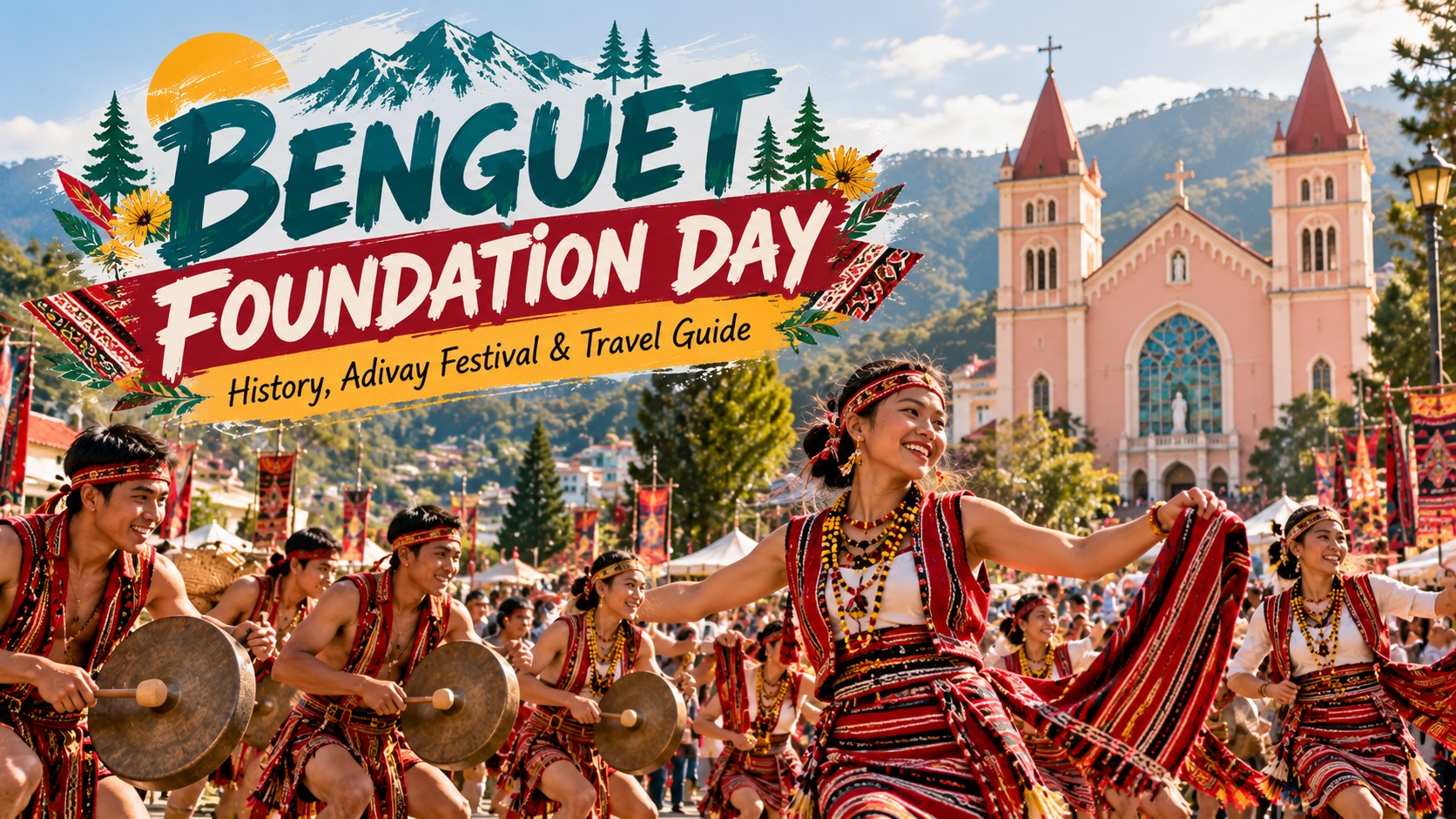
Throughout November, the province comes alive with cultural performances, traditional dances, agricultural exhibits, community gatherings, and the colorful Adivay Festival.
It’s a time when people from Benguet’s 13 municipalities come together to celebrate their shared history, preserve their Indigenous traditions, and recognize the achievements of their communities.
One of the biggest highlights is the Grand Cañao, a thanksgiving gathering that brings together cultural performances, traditional rituals, and communal celebrations.
For visitors, it’s an opportunity to experience a different side of the Cordillera—one that goes beyond the usual tourist spots.
If you’re curious about Benguet Foundation Day, here’s everything you need to know about its history, meaning, traditions, celebrations, and how to experience this important provincial occasion.
Content
What Is Benguet Foundation Day?
Benguet Foundation Day is an annual provincial celebration commemorating the establishment of the civil government of Benguet on November 23, 1900.
It marks an important milestone in the province’s administrative history and provides an opportunity to recognize its cultural heritage, communities, and contributions to the Cordillera region.
The anniversary is celebrated through official ceremonies and activities associated with the Adivay Festival, Benguet’s annual cultural and agri-tourism celebration.
While Foundation Day specifically commemorates the province’s historical establishment, Adivay serves as the broader festival through which the people of Benguet celebrate their culture, achievements, and unity.
The celebration highlights the traditions of the province’s Indigenous communities, particularly the Ibaloi, Kankanaey, and Kalanguya peoples, alongside other cultural groups living in Benguet.
It also recognizes the importance of agriculture, traditional crafts, local industries, and community cooperation.
One of the most meaningful aspects of the event is how it brings together representatives from the province’s 13 municipalities.
Through cultural performances, exhibitions, and traditional gatherings, each municipality has an opportunity to share its heritage with the rest of the province.
Benguet Foundation Day Quick Facts
- Official name: Benguet Foundation Day or Benguet Day
- Date: November 23 every year
- Historical foundation date: November 23, 1900
- Location: Benguet Province, Cordillera Administrative Region, Philippines
- Provincial capital: La Trinidad
- Festival associated with the celebration: Adivay Festival
- Festival season: November
- Historical basis: Act No. 49 of 1900
- Holiday law: Republic Act No. 12099
- Holiday classification: Special nonworking holiday in Benguet
- Major highlights: Grand Cañao, cultural performances, provincial parade, agricultural trade fairs, traditional dances, and community activities
Although the province’s anniversary falls on November 23, the accompanying Adivay Festival activities are commonly spread across several weeks in November.
History of Benguet Foundation Day
To understand why Benguet celebrates its foundation anniversary every November 23, we need to look at the province’s history.
Long before Benguet became an administrative province, its mountain valleys and highland communities were already home to Indigenous peoples with their own systems of governance, cultural practices, agricultural traditions, and relationships with the land.
The Ibaloi, Kankanaey, and Kalanguya communities, among others, developed distinct traditions that continue to shape the province today.
So while November 23, 1900, marks an important government milestone, Benguet’s history extends much further into the past.
Benguet Before the Establishment of the Provincial Government
Before the American colonial period, the communities of Benguet had already established ways of life closely connected to the Cordillera mountains.
Agriculture, trade, mining, and traditional crafts were important activities in different communities.
The province’s Indigenous peoples developed knowledge of the terrain, climate, and natural resources that allowed them to thrive in the highlands.
Community relationships were also strengthened through traditional gatherings, celebrations, and customary practices.
These traditions helped preserve social connections and cultural knowledge across generations.
Many elements of this heritage remain visible during modern cultural celebrations, including Benguet Foundation Day and the Adivay Festival.
November 23, 1900: The Establishment of Benguet’s Civil Government
The official foundation anniversary traces its origins to November 23, 1900.
On this date, the United States Philippine Commission enacted Act No. 49, which provided for the establishment of a civil government for the Province of Benguet.
The legislation established provincial government offices and outlined the responsibilities of appointed officials.
H.P. Whitmarsh became the first civil governor under the new administration.
At the time, Baguio was designated as the capital of the province.
This marked a major change in Benguet’s administrative history during the American colonial period.
It is this establishment of civil provincial government that Benguet commemorates every November 23.
Benguet’s Changing Administrative Status
Benguet underwent several administrative changes after 1900.
In 1908, the province became a sub-province of the newly organized Mountain Province.
This reorganization placed Benguet within a larger administrative territory that included other parts of the Cordillera.
Baguio, meanwhile, developed into an important urban center and was chartered as a city in 1909.
In 1916, La Trinidad became the capital of Benguet, replacing Baguio.
Another major development came on June 18, 1966, when Republic Act No. 4695 divided the old Mountain Province into separate provinces.
This law restored Benguet as a separate province, alongside the creation or reorganization of other provincial units.
Because of this, Benguet has two dates that frequently appear in discussions of its history.
November 23, 1900, commemorates the establishment of the original civil provincial government.
June 18, 1966, marks Benguet’s separation from the old Mountain Province.
Both dates are historically significant, but November 23 is now the official date of Benguet Day.
Why Is Benguet Foundation Day Celebrated on November 23 Instead of June 18?
This is one of the most common sources of confusion about Benguet’s foundation anniversary.
For many years, June 18 was recognized as a special nonworking holiday in the province.
The date was associated with Republic Act No. 4695, the law that reorganized the old Mountain Province in 1966.
Republic Act No. 7672, approved in 1994, established June 18 as a special nonworking holiday in Benguet.
However, the provincial government later emphasized November 23 as the historical anniversary of Benguet’s establishment in 1900.
In 1999, Provincial Ordinance No. 99-058 set November 23 as Benguet Foundation Day beginning in 2000.
The province subsequently celebrated its founding anniversary on November 23, with special holiday proclamations issued in several years.
A major legal development came on December 13, 2024, when Republic Act No. 12099 was approved.
The law officially declared November 23 of every year a special nonworking holiday in Benguet, to be known as Benguet Day.
It also repealed Republic Act No. 7672, which had previously recognized June 18 as a special nonworking holiday.
This settled the recurring holiday date under national law.
June 18 remains an important part of Benguet’s history, but November 23 is now the legally designated Benguet Day.
Is Benguet Foundation Day a Holiday?
Yes.
Under Republic Act No. 12099, November 23 of every year is a special nonworking holiday in the Province of Benguet.
This means residents and establishments covered by the holiday follow the applicable rules for special nonworking days.
However, there is an important distinction.
Benguet Day is a provincial holiday, not a nationwide regular holiday.
It should also not automatically be assumed to apply to Baguio City, which is geographically associated with Benguet but is administratively an independent highly urbanized city.
For workers, holiday pay and work arrangements depend on applicable labor rules and employer policies.
Schools, government offices, banks, and private establishments may also have different operating arrangements during the holiday.
If you have transactions to complete in Benguet on November 23, it’s best to confirm operating schedules beforehand.
How Is Benguet Foundation Day Celebrated?
Unlike some provincial anniversaries that focus mainly on formal programs, Benguet Foundation Day is celebrated alongside the Adivay Festival.
This brings a festive atmosphere to the province, particularly in La Trinidad, where many of the major activities traditionally take place.
The celebration combines official anniversary ceremonies with Indigenous traditions, cultural performances, agricultural showcases, and community events.
Here are some of its most recognizable highlights.
1. Grand Cañao: The Heart of the Celebration
One of the most important traditions associated with Benguet Foundation Day is the Grand Cañao, sometimes written as Grand Canao.
A cañao is a traditional communal gathering or ritual practiced in parts of the Cordillera.
Depending on the community and purpose, a cañao may involve thanksgiving, customary ceremonies, music, dancing, animal offerings, and the sharing of food.
In the context of Benguet’s foundation anniversary, the Grand Cañao emphasizes gratitude, cultural identity, and the unity of the province’s communities.
Representatives from the 13 municipalities gather to participate in a celebration that draws from the region’s Indigenous traditions.
One of the most recognizable parts of the occasion is the sound of the gangsa, a traditional flat gong used in Cordillera musical and ceremonial practices.
The rhythmic beating of the gongs accompanies cultural dances and creates an atmosphere that is distinctly Cordilleran.
The gathering also involves communal participation, reflecting the importance of relationships and shared traditions among the people of Benguet.
For visitors who have never witnessed a traditional Cordillera celebration, the Grand Cañao can be one of the most meaningful experiences of the entire festival.
It’s worth remembering, however, that these rituals are part of living Indigenous cultural traditions and should be approached with respect.
2. Benguet Foundation Anniversary Parade
Another major highlight is the provincial parade.
Representatives from different municipalities, government agencies, schools, cultural organizations, and community groups participate in the procession.
In recent celebrations, parades have moved from the Benguet Provincial Capitol grounds toward the Benguet Sports Complex in Wangal, La Trinidad.
The exact route may vary depending on the annual program.
The parade often features participants wearing traditional woven clothing associated with the Cordillera.
You may also see cultural performers, musicians, local organizations, and delegations representing the province’s different towns.
For spectators, it’s one of the best opportunities to appreciate the diversity of Benguet’s communities in a single event.
3. Traditional Cordillera Dancing
Traditional dances are an important part of the foundation anniversary celebration.
Cultural performances may feature the tayaw or tayao, a traditional dance associated with Indigenous celebrations in Benguet.
The dance is commonly accompanied by the rhythmic sounds of gongs.
Other cultural performances may showcase dances and traditions practiced by different communities.
What makes these presentations interesting is that they are more than entertainment.
They reflect the cultural practices, community relationships, and ceremonial traditions of the people who perform them.
The movements, musical rhythms, and attire often carry meanings connected to particular communities.
For visitors, watching these performances provides an opportunity to appreciate Cordillera culture beyond what is usually presented in textbooks or tourism brochures.
4. The Grand Cañao’s Traditional Rituals
Some anniversary celebrations also feature customary activities such as depap and owik.
Depap involves the traditional catching of a pig, while owik is associated with the ritual offering and butchering of pigs.
These practices form part of certain Cordillera ceremonial traditions.
They are not simply festival games but activities connected to cultural beliefs, thanksgiving, and community gatherings.
The meat may be prepared and shared among participants during the communal feast.
Visitors should observe these activities respectfully and follow the guidance of organizers, especially when photography is involved.
5. Communal Feast and Watwat
Food plays an important role in many Cordillera gatherings.
During Benguet’s Grand Cañao, communal meals reinforce the idea of people coming together.
One tradition associated with these gatherings is watwat, the distribution of portions of cooked meat among participants.
This practice reflects the importance of sharing during community celebrations.
The communal meal is not only about eating together.
It is also a way of recognizing relationships among families, communities, and participants.
For those unfamiliar with Cordillera traditions, this provides an interesting perspective on the meaning of hospitality and community participation in the region.
6. Agricultural and Trade Fairs
Benguet is widely known as one of the Philippines’ leading producers of highland vegetables.
Its cool climate and mountain terrain make it particularly suitable for growing crops such as cabbage, carrots, potatoes, lettuce, and other temperate vegetables.
Agriculture therefore plays an important role in Benguet Foundation Day celebrations.
Through the Adivay Festival, agricultural and trade fairs showcase products from different municipalities.
Visitors may encounter locally grown vegetables, processed food products, coffee, handicrafts, and other goods.
Some editions feature agricultural exhibits, competitions, and demonstrations highlighting the province’s farming industry.
These activities provide opportunities for farmers, entrepreneurs, cooperatives, and local producers to present their products to a wider audience.
For travelers, the fairs are a great place to discover products that represent the livelihoods of Benguet’s communities.
7. Cultural Exhibits and Municipality Booths
Another interesting part of Adivay is the participation of Benguet’s 13 municipalities through cultural exhibits and booths.
Each municipality has its own identity, local industries, agricultural products, and cultural traditions.
Festival booths provide an opportunity to showcase these differences while celebrating a shared provincial identity.
You may find displays featuring traditional clothing, handmade products, agricultural goods, cultural objects, and local delicacies.
Some presentations also highlight tourism attractions and community achievements.
These exhibits are especially useful for visitors who want to learn more about Benguet beyond its most familiar destinations.
8. Mr. and Miss Benguet and Other Community Activities
The celebration also includes events that recognize talent, creativity, and community achievements.
Depending on the annual program, activities may include pageants, music competitions, sports tournaments, cultural presentations, job fairs, and recognition ceremonies.
The Mr. and Miss Benguet competition has been among the recurring activities associated with Adivay.
Participants represent different municipalities and may showcase cultural attire, talents, and knowledge of their communities.
Other events recognize individuals and organizations that contribute to the province’s development.
These activities help make Benguet Foundation Day a broader celebration involving different sectors of the community.
What Is the Connection Between Benguet Foundation Day and the Adivay Festival?
If you’ve been researching festivals in Benguet, you’ve probably encountered the name Adivay.
This is because Benguet Foundation Day and the Adivay Festival are closely connected.
However, they are not exactly the same thing.
Benguet Foundation Day commemorates the province’s historical establishment.
Adivay, meanwhile, is the cultural and agri-tourism festival organized as part of the anniversary celebrations.
The word Adivay comes from the Ibaloi language and means coming together, often understood as gathering to celebrate and enjoy one another’s company.
The festival was created to bring together Benguet’s different communities and provide opportunities to showcase their cultural heritage, agricultural products, and local industries.
How the Adivay Festival Started
The first Adivay Festival was held from February 25 to March 6, 2005.
Initially, it was developed as an agri-tourism celebration that complemented Baguio’s Panagbenga Festival.
The organizers wanted to give Benguet greater visibility as a tourism destination while recognizing the province’s agricultural and cultural identity.
The festival later became an annual institution.
In 2006, the Sangguniang Panlalawigan formally institutionalized Adivay as an annual provincial celebration.
Over time, its activities became closely associated with Benguet’s November founding anniversary.
Today, Adivay is commonly celebrated throughout November, with Benguet Foundation Day on November 23 serving as one of the most important dates.
This relationship makes Adivay more than just a festival of performances and exhibits.
It has become one of the main ways the province commemorates its history and celebrates the people who continue to shape its future.
The 13 Municipalities of Benguet
One of the central ideas behind Benguet Foundation Day and Adivay is unity.
The province is composed of 13 municipalities, each contributing its own identity to the celebration.
These are:
- Atok
- Bakun
- Bokod
- Buguias
- Itogon
- Kabayan
- Kapangan
- Kibungan
- La Trinidad
- Mankayan
- Sablan
- Tuba
- Tublay
These municipalities represent different landscapes, livelihoods, and community traditions.
La Trinidad serves as the provincial capital and the traditional center of many anniversary activities.
Other municipalities are known for their highland farms, mountain landscapes, cultural heritage, and rural communities.
During Adivay, the participation of these 13 towns reflects the festival’s meaning of coming together.
It’s an opportunity for the different communities of Benguet to celebrate their unique contributions while recognizing what connects them as one province.
Cultural Significance of Benguet Foundation Day
Benguet Foundation Day is more than the commemoration of a historical date.
It serves several important purposes for the province and its people.
Preserving Indigenous Heritage
One of its most meaningful contributions is promoting awareness of Benguet’s Indigenous cultures.
The Ibaloi, Kankanaey, and Kalanguya peoples have distinct traditions that form an important part of the province’s identity.
Through cultural dances, music, traditional attire, ceremonies, and community gatherings, younger generations are given opportunities to learn about their heritage.
These practices remain meaningful because they connect present-day communities with knowledge and customs passed down through generations.
Strengthening Community Unity
The Grand Cañao and Adivay gatherings emphasize the importance of cooperation among communities.
With representatives from all 13 municipalities participating, the celebration becomes an expression of shared provincial identity.
People from different towns gather to recognize common experiences, achievements, and challenges.
This spirit of unity is central to the meaning of Adivay.
Recognizing Agriculture and Local Livelihoods
Benguet’s agricultural industry is an essential part of its economy.
From vegetable farms to coffee production and other agricultural activities, farming supports many local families and communities.
Foundation Day celebrations recognize these contributions through trade fairs, exhibitions, and agricultural events.
They also provide opportunities to highlight local entrepreneurs, craftspeople, and other industries.
Celebrating Benguet’s History and Progress
A foundation anniversary is also an opportunity to reflect on how a province has changed.
Since the establishment of its civil government in 1900, Benguet has undergone major political, economic, and social developments.
The anniversary provides a moment to recognize those changes while remembering the communities and traditions that existed long before its formal administrative organization.
It is both a commemoration of the past and a celebration of Benguet’s continuing development.
Where Is Benguet Foundation Day Celebrated?
Although the anniversary belongs to the entire province, La Trinidad is traditionally the center of the major celebrations.
The Benguet Provincial Capitol is an important venue for official activities and opening ceremonies.
The Benguet Sports Complex in Wangal, La Trinidad, has hosted the Grand Cañao and other major gatherings.
Trade fairs and exhibits may also take place at designated venues around La Trinidad.
Some activities are organized in partnership with municipalities, schools, government agencies, and community groups.
The exact locations can change each year.
If you’re planning to attend, it’s important to check which activities are taking place at the Provincial Capitol, the Sports Complex, or other festival venues.
This is especially useful because La Trinidad can experience increased traffic and large crowds during the anniversary celebrations.
How to Get to Benguet Foundation Day in La Trinidad
For many travelers, the easiest way to reach La Trinidad is through Baguio City.
Baguio serves as a major transportation hub for Northern Luzon and is located close to the provincial capital.
From Manila to Benguet
Travelers coming from Metro Manila can take a bus bound for Baguio City.
Several provincial bus companies operate routes between Metro Manila and Baguio.
Depending on the departure terminal, route, and traffic conditions, travel time generally ranges from approximately five to seven hours.
Once you arrive in Baguio, continue to La Trinidad using available local transportation.
Jeepneys and taxis serve routes between Baguio and La Trinidad.
The journey may take around 30 minutes to an hour or longer, depending on traffic and your exact destination.
From Baguio City to La Trinidad
If you’re already staying in Baguio, visiting Benguet Foundation Day activities in La Trinidad is relatively convenient.
Public utility jeepneys serve the Baguio–La Trinidad route.
Taxis and private vehicles are also options.
However, traffic along the main road connecting Baguio and La Trinidad can become heavy, especially during peak hours and major events.
If you’re attending the Grand Cañao or provincial parade, allow extra travel time.
Traveling by Private Vehicle
Visitors driving from Manila or other parts of Luzon can reach Baguio through the major expressways and connecting mountain highways.
From Baguio, continue toward La Trinidad.
Parking availability may be limited near major festival venues.
For this reason, travelers should check official traffic advisories and parking arrangements before the event.
Tips for Attending Benguet Foundation Day
If you’re planning to visit during the celebration, here are some practical tips.
Check the Official Festival Program
While Benguet Day always falls on November 23, the activities associated with Adivay may begin earlier in November and continue afterward.
The parade, agricultural fairs, competitions, and cultural performances can take place on different dates.
Look for announcements from the Benguet Provincial Government and its tourism office before finalizing your itinerary.
Prioritize the Grand Cañao
If you only have time to attend one major celebration, the Grand Cañao is one of the most meaningful activities to consider.
It brings together the province’s communities and showcases Indigenous traditions associated with the foundation anniversary.
However, the exact schedule and venue should still be confirmed.
Arrive Early
The major anniversary celebrations can attract large crowds.
Arriving early gives you time to find a good viewing area and familiarize yourself with the venue.
It also helps you avoid some of the traffic congestion around the event.
Respect Cultural Practices
Many ceremonies performed during the celebration have cultural significance.
Follow the instructions of organizers and avoid interrupting traditional rituals.
If you’re taking photographs, be respectful of participants and any restrictions announced during the event.
Bring Comfortable Clothing
November is generally part of the cooler season in Benguet.
Temperatures can become noticeably lower during early mornings and evenings.
Bring a jacket, comfortable walking shoes, drinking water, and a small umbrella.
Explore the Trade Fairs
If you want to appreciate Benguet beyond its traditional performances, spend some time visiting the agricultural and trade exhibits.
These provide opportunities to discover products from the province’s different municipalities and support local businesses.
Other Attractions to Visit in Benguet
A trip to Benguet Foundation Day can also be an opportunity to explore the province’s natural and cultural attractions.
Depending on your schedule, there are several destinations worth considering.
La Trinidad Strawberry Farm
One of Benguet’s best-known attractions is the La Trinidad Strawberry Farm.
Visitors come here to see the agricultural landscape and purchase locally grown strawberries and strawberry-based products.
Strawberry picking may be available during the appropriate growing and harvesting periods, depending on farm conditions.
Since the farm is located in La Trinidad, it can be an easy addition to your festival itinerary.
Mount Pulag
For travelers who enjoy mountain adventures, Mount Pulag is one of the most famous destinations associated with Benguet.
Known for its beautiful mountain scenery and the possibility of witnessing a sea of clouds, it attracts hikers from different parts of the country.
However, Mount Pulag requires separate travel arrangements, permits, and preparation.
It isn’t something you should casually add to a short festival visit without planning ahead.
Atok Flower Farms
Atok is known for its cool mountain climate, beautiful scenery, and flower farms.
One of its popular attractions is Northern Blossom Flower Farm, which offers views of colorful flowers against the Cordillera mountains.
A trip to Atok can be a good extension for travelers who have additional time in Benguet.
Weather conditions, opening schedules, and transportation arrangements should be checked beforehand.
Benguet’s Local Markets and Agricultural Communities
Another way to appreciate the province is by exploring its markets and locally produced goods.
Benguet’s agricultural identity is visible in its fresh vegetables, strawberries, coffee, and other highland products.
Visiting local markets can provide a closer look at the industries that support many communities across the province.
For those interested in cultural tourism, the foundation anniversary is also a useful starting point for learning about the province’s different municipalities.
Benguet Foundation Day vs. Adivay Festival vs. Panagbenga Festival
Because these celebrations are associated with the Baguio–Benguet area, it’s easy to confuse them.
However, each has a different purpose.
Benguet Foundation Day
Benguet Foundation Day is celebrated every November 23.
It commemorates the establishment of the province’s civil government in 1900.
The date is officially recognized as a special nonworking holiday in Benguet under Republic Act No. 12099.
Adivay Festival
The Adivay Festival is Benguet’s annual agri-tourism and cultural celebration.
It highlights Indigenous traditions, agriculture, community unity, and local industries.
Although its first edition was held in 2005 during the Panagbenga season, Adivay later became associated with the November founding anniversary.
Its activities typically take place throughout much of November.
Panagbenga Festival
Panagbenga is Baguio City’s famous flower festival.
It is primarily celebrated in February and features floral floats, street dancing, exhibits, and tourism activities.
Unlike Adivay, which represents the Province of Benguet, Panagbenga is closely associated with Baguio City.
All three celebrations are important to the region, but they highlight different aspects of its history, identity, and culture.
Frequently Asked Questions About Benguet Foundation Day
When is Benguet Foundation Day celebrated?
Benguet Foundation Day is celebrated every November 23.
It commemorates the establishment of the province’s civil government on November 23, 1900.
What is Benguet Foundation Day?
Benguet Foundation Day, also known as Benguet Day, is the annual anniversary of the Province of Benguet.
It is celebrated through commemorative activities and cultural events associated with the Adivay Festival.
What is the history of Benguet Foundation Day?
The celebration traces its origins to Act No. 49, enacted on November 23, 1900, which established a civil government for Benguet during the American colonial period.
The province later underwent several administrative changes before becoming a separate province again in 1966.
Is November 23 a holiday in Benguet?
Yes. Under Republic Act No. 12099, November 23 is a special nonworking holiday in the Province of Benguet.
It is not a nationwide regular holiday.
Why was Benguet Day previously associated with June 18?
June 18 commemorates the enactment of Republic Act No. 4695 in 1966, which reorganized the old Mountain Province and restored Benguet as a separate province.
A previous law recognized June 18 as a special nonworking holiday, but this was repealed by Republic Act No. 12099.
What festival is celebrated during Benguet Foundation Day?
The Adivay Festival is the main cultural celebration associated with Benguet Foundation Day.
It includes traditional dances, the Grand Cañao, agricultural fairs, cultural exhibits, and other community activities.
What does Adivay mean?
Adivay is an Ibaloi word meaning coming together or gathering to celebrate.
The term reflects the festival’s purpose of bringing together the different communities of Benguet.
What is the Grand Cañao?
The Grand Cañao is a traditional thanksgiving gathering associated with Benguet’s foundation anniversary.
It features Indigenous cultural practices, traditional music, dances, rituals, and communal participation.
Where is Benguet Foundation Day celebrated?
Major events traditionally take place in La Trinidad, the provincial capital.
The Benguet Provincial Capitol and Benguet Sports Complex have hosted important anniversary activities.
What are the major highlights of Benguet Foundation Day?
The celebration commonly features the Grand Cañao, provincial parade, cultural performances, traditional dances, trade fairs, agricultural exhibits, and other community events.
Is Benguet Foundation Day the same as Adivay Festival?
Not exactly.
Benguet Foundation Day is the historical anniversary, while Adivay is the cultural festival organized alongside it.
They are closely connected, but each has its own meaning.
How many municipalities participate in Benguet Foundation Day?
Benguet has 13 municipalities, all of which are represented in the province’s cultural and community celebrations.
Benguet Foundation Day 2026: Date, Holiday & Adivay Festival Updates
For travelers planning to experience the celebration in 2026, Benguet will mark its 126th founding anniversary.
Benguet Foundation Day 2026 falls on Monday, November 23, 2026.
Under Republic Act No. 12099, this date is a special nonworking holiday in the Province of Benguet.
The anniversary is traditionally celebrated alongside the Adivay Festival, with cultural and community activities taking place during November.
Based on previous editions, major attractions may include the provincial parade, Grand Cañao, traditional cultural performances, agricultural trade fairs, exhibits, and other community events.
La Trinidad has traditionally hosted many of the main activities.
However, as of October 26, 2026, a complete official program for the 2026 celebration, including the exact schedules, venues, and participating activities, has not been independently verified for this guide.
Visitors should therefore avoid assuming that the dates and event locations from previous years will remain unchanged.
For official announcements, refer to the Benguet Provincial Government and Provincial Tourism Office.
Final Thoughts
Benguet Foundation Day is one of those celebrations that becomes more meaningful when you understand the history behind it.
At first, it may seem like another provincial anniversary. But when you look closer, you’ll discover that it represents much more than the establishment of a local government.
It is also a celebration of the people who have lived in Benguet’s mountain communities for generations.
Through traditional dancing, the sound of gongs, the Grand Cañao, and the gathering of the province’s 13 municipalities, the celebration highlights the importance of cultural heritage and community unity.
The Adivay Festival adds another dimension by showcasing agriculture, local industries, traditional crafts, and the achievements of Benguet’s communities.
Together, these activities create a celebration that connects the province’s past with its present.
And for visitors, that’s what makes Benguet Foundation Day worth experiencing.
It’s an opportunity to see the Cordillera beyond its scenic mountains and popular tourist attractions.
You get to appreciate the traditions, livelihoods, and communities that give Benguet its unique character.
So if you’re planning a trip to Baguio or Benguet in November, consider including the Foundation Day and Adivay celebrations in your itinerary.
Because beyond the strawberry farms, mountain views, and cool weather, there’s an entire cultural experience waiting to be discovered in Benguet.