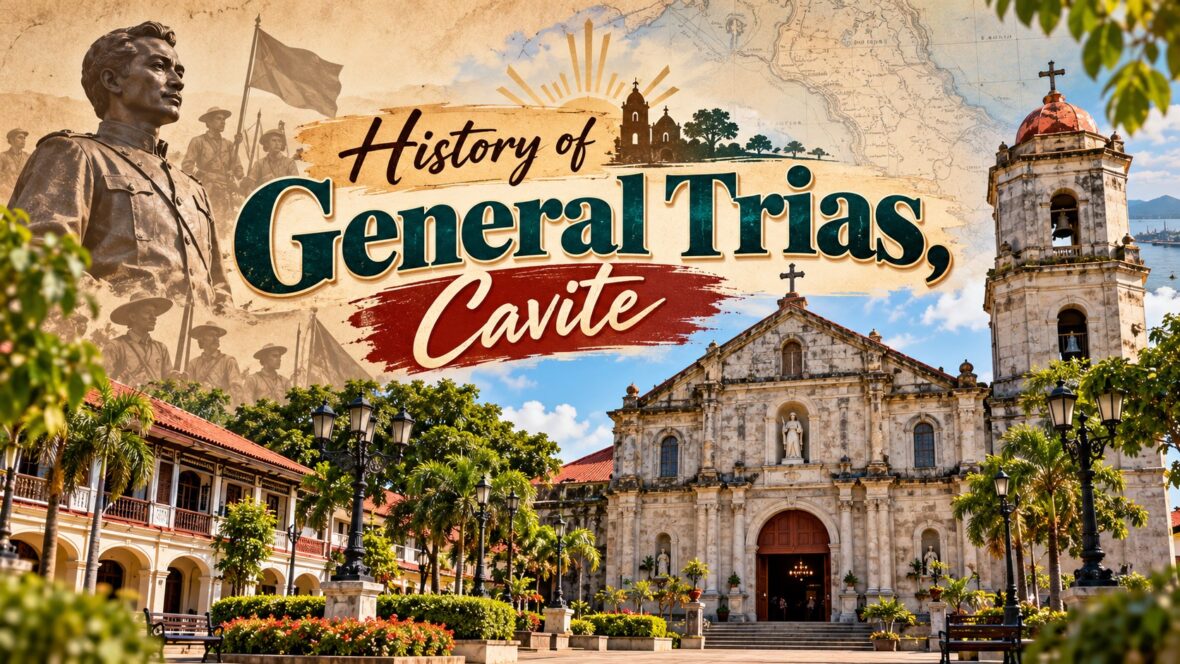
General Trias is one of the fastest-developing cities in Cavite, known today for its growing residential communities, commercial establishments, industrial parks, and modern infrastructure. But long before the city became a thriving urban center, it had already earned an important place in Philippine history.
In fact, General Trias played a significant role in the Philippine Revolution against Spanish colonial rule. It was home to revolutionary leaders, witnessed one of the earliest uprisings in Cavite, and contributed to the country’s declaration of independence in 1898.
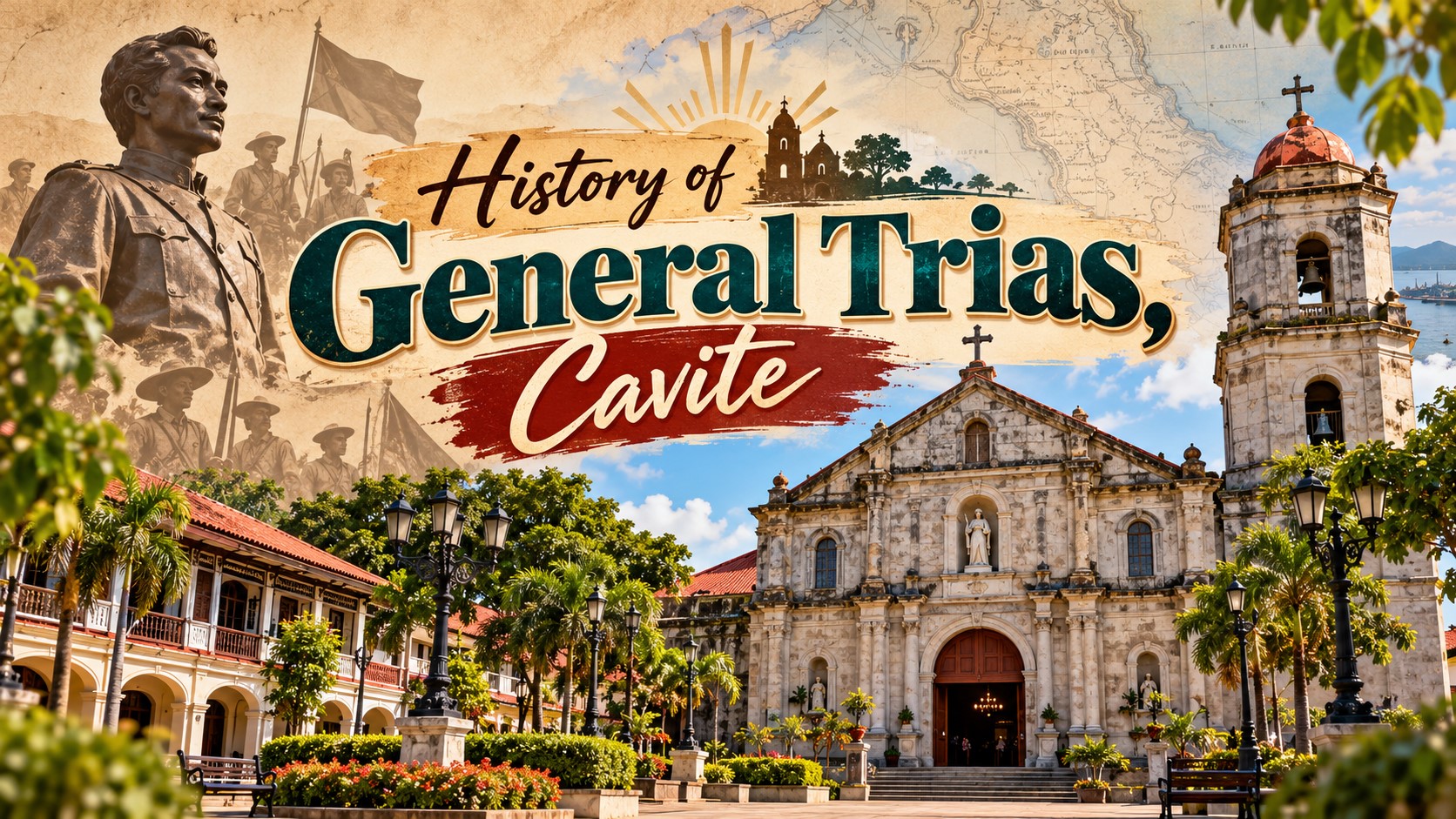
What makes General Trias particularly interesting is how its history remains visible even today. From the centuries-old Saint Francis of Assisi Parish Church to its historic town plaza, the city continues to preserve reminders of its revolutionary past while embracing modernization.
So, how did General Trias begin? Why was it originally called San Francisco de Malabon? And who was the revolutionary general whose name the city carries today?
Let’s explore the fascinating history of General Trias, Cavite, from its colonial beginnings to its transformation into one of the province’s most progressive cities.
Content
The Early History of General Trias
The history of General Trias goes back several centuries, long before the municipality received its present name.
During the Spanish colonial period, the area was part of a larger settlement associated with Cavite Viejo, now known as Kawit. Like many communities in Cavite, its early development was influenced by agriculture, religious missions, and the establishment of Spanish colonial institutions.
The area’s fertile lands and vegetation supported agricultural communities. Over time, settlements expanded, religious structures were established, and the locality gradually developed its own identity.
One of the earliest important developments occurred in 1611, when Franciscan missionaries established a chapel in the area. At that time, the settlement was still a visita, or a smaller religious community administered from another parish.
This early religious presence eventually contributed to the development of the town that would become San Francisco de Malabon.
Why Was General Trias Originally Called San Francisco de Malabon?
Before it became General Trias, the town was known as San Francisco de Malabon.
According to the City Government of General Trias, the municipality was established on December 13, 1748, and named after its patron saint, Saint Francis of Assisi.
The name combined two important elements: the town’s religious patron and the locality’s traditional name, Malabon.
Interestingly, there are different explanations for the origin of the word Malabon.
One theory suggests that it came from the Filipino word labong, meaning bamboo shoot. Bamboo and other vegetation were abundant in the area during its earlier history.
Another explanation connects the name to mayabong, meaning lush or flourishing, possibly referring to the area’s thick vegetation and fertile surroundings.
The labong explanation is often considered more likely in the city’s historical accounts. Interestingly, Mariano Trias himself used Labong as a revolutionary pseudonym.
It is also worth noting that an older historical marker recorded 1720 as the town’s establishment year, while the present city government uses December 13, 1748. For this article, the city’s officially published date is followed.
The Original Territory Was Much Larger
San Francisco de Malabon once covered a considerably larger territory than present-day General Trias.
Its historical area included communities that eventually became separate municipalities, particularly:
- Tanza, formerly known as Santa Cruz de Malabon or Malabon El Chico.
- Rosario, historically associated with Tejeros and Salinas.
These communities were closely connected during the Spanish colonial period and the Philippine Revolution.
The area was also associated with the Hacienda de San Francisco, a large agricultural estate once owned by religious authorities.
Historical accounts record that Doña Isabel Gomez de Cariaga purchased the extensive property on June 14, 1788.
Agriculture and land ownership played major roles in the local economy during this period. Much of the population depended on farming and related activities for their livelihood.
Saint Francis of Assisi Church: A Witness to Centuries of History
One of the most important historical landmarks in General Trias is the Saint Francis of Assisi Parish Church, located near the city plaza.
More than just a place of worship, the church has witnessed some of the most significant events in the town’s history.
Its beginnings can be traced to 1611, when Franciscan missionaries built a modest chapel using lightweight materials.
In 1624, the religious administration of the community was transferred to the Jesuit mission of Cavite Puerto.
The parish eventually became independent on September 9, 1753.
A stone church was constructed beginning in 1769 under the patronage of Doña Maria Josepha de Yrizzari y Ursula, Countess of Lizarraga.
Over the following centuries, the church underwent several repairs and expansions.
It was enlarged in 1834, damaged by an earthquake in 1880, and subsequently renovated. Additional improvements were carried out during the late 19th century, while restoration work was undertaken from 1989 to 1991.
Today, the church remains one of the most recognizable historical and religious landmarks in General Trias.
But what makes this church especially significant is its connection to the Philippine national anthem.
General Trias and the First Performance of the Philippine National Anthem
One of the most fascinating historical facts about General Trias is its connection to the first public performance of the music that would become the Philippine national anthem.
On June 12, 1898, Emilio Aguinaldo proclaimed Philippine independence from Spain at his ancestral home in Kawit, Cavite.
During this historic occasion, a marching band from San Francisco de Malabon performed the composition Marcha Nacional Filipina, written by Filipino composer Julian Felipe.
The musical composition eventually became the melody of Lupang Hinirang, the Philippine national anthem.
Before the independence ceremony, the band rehearsed the composition at Saint Francis of Assisi Parish Church in San Francisco de Malabon.
The band was known as the Banda de San Francisco de Malabon and is associated with what became known as Banda Matanda.
Just imagine that for a moment.
One of the most important musical performances in Philippine history involved musicians from what is now General Trias.
Although the declaration of independence took place in Kawit, the participation of the San Francisco de Malabon band gave General Trias its own special connection to that defining national event.
It is an important part of local history that deserves to be remembered and appreciated.
General Trias During the Philippine Revolution
If there is one historical period that truly shaped the identity of General Trias, it would be the Philippine Revolution of 1896.
Cavite became one of the strongest centers of resistance against Spanish colonial rule, producing revolutionary leaders and hosting major battles and political developments.
San Francisco de Malabon was among the communities that actively participated in the revolutionary movement.
The First Cry of Cavite — August 31, 1896
On August 31, 1896, revolutionaries in San Francisco de Malabon launched an uprising against Spanish colonial authorities.
This event became known as the First Cry of Cavite.
According to the city’s historical account, the uprising took place at approximately 10 o’clock in the morning in Pasong Kalabaw, an area associated with present-day Barangay Santa Clara.
Revolutionary forces attacked and captured the town tribunal, a symbol of Spanish colonial administration.
Among the revolutionary leaders associated with the uprising were:
- Mariano Trias
- Diego Mojica
- Nicolas Portilla
The uprising was followed by revolutionary actions in nearby Noveleta and Cavite Viejo, now Kawit.
These developments demonstrated that the revolutionary movement had gained considerable support in Cavite.
The First Cry of Cavite remains one of the most important events in the history of General Trias because it marked the town’s direct participation in the struggle for Philippine independence.
The Role of the Katipunan
During the revolution, San Francisco de Malabon became involved in the activities of the Katipunan, the secret revolutionary organization that fought for independence from Spain.
The town had a Katipunan branch called Balangay Mapagtiis.
It became associated with the Magdiwang Council, one of the major revolutionary factions operating in Cavite.
The Magdiwang faction was led by Mariano Alvarez, a revolutionary leader from Noveleta.
Another important faction, the Magdalo Council, was associated with revolutionary leaders from Cavite Viejo, including Emilio Aguinaldo.
Although both factions supported independence, political and military disagreements eventually emerged between them.
These disagreements would lead to one of the most famous and controversial events of the Philippine Revolution.
The Tejeros Convention and Its Connection to General Trias
The Tejeros Convention, held on March 22, 1897, is one of the most important political events of the Philippine Revolution.
It took place at the Casa-Hacienda of Tejeros, which was then part of San Francisco de Malabon.
The historical site is now associated with present-day Rosario, Cavite, following changes in municipal boundaries.
This distinction is important because the Tejeros Convention is sometimes described as having taken place in General Trias. Historically, that description refers to the territory of the former San Francisco de Malabon rather than the present boundaries of the city.
What Happened During the Tejeros Convention?
Revolutionary leaders gathered at Tejeros to address problems affecting the revolutionary movement, including disagreements between the Magdiwang and Magdalo factions.
The meeting eventually resulted in an election to establish a central revolutionary government.
The following revolutionary leaders were elected:
- Emilio Aguinaldo — President
- Mariano Trias — Vice President
- Artemio Ricarte — Captain General
- Emiliano Riego de Dios — Director of War
- Andres Bonifacio — Director of the Interior
Aguinaldo was elected president despite being absent from the meeting.
The convention became controversial after questions arose regarding Bonifacio’s qualifications for his elected position.
Bonifacio rejected the proceedings after the dispute, deepening divisions within the revolutionary movement.
Despite the controversy, the convention marked an important attempt to create a central revolutionary government.
For General Trias, the event has particular significance because Mariano Trias, one of the town’s most prominent historical figures, was elected vice president.
Who Was General Mariano Trias?
General Mariano Trias was a Filipino revolutionary leader, soldier, and statesman who played an important role in the struggle for Philippine independence.
He was born in San Francisco de Malabon, Cavite, on October 12, 1869, according to his historical marker issued by the National Historical Commission’s predecessor.
He was the son of Balbino Trias and Gabriela Closas.
As revolutionary movements gained momentum in the Philippines, Mariano Trias became involved in the Katipunan and emerged as one of the leading revolutionary figures in Cavite.
His contributions went beyond military leadership.
He also became involved in the political and administrative organization of the revolutionary government.
Mariano Trias as Vice President
One of Mariano Trias’ most important accomplishments was his election as vice president during the Tejeros Convention in 1897.
He is commonly recognized as the first de facto vice president of the Philippine revolutionary government.
It is important to clarify, however, that this revolutionary position was different from the vice presidency established under the modern Philippine constitutional system.
Nevertheless, his election demonstrated the respect and influence he had earned among revolutionary leaders.
Mariano Trias During the Philippine-American War
Following the Spanish-American War and the proclamation of Philippine independence, the Philippines entered another conflict, this time against the United States.
Mariano Trias continued supporting Emilio Aguinaldo and the revolutionary government.
He served as secretary of finance, also described in historical accounts as secretary of the treasury, and held important military responsibilities.
During the Philippine-American War, Aguinaldo appointed him to a senior civilian and military command in Southern Luzon.
However, as American forces gained control over much of the country, the revolutionary movement faced increasing difficulties.
Mariano Trias eventually surrendered to American authorities in 1901.
Afterward, he pursued political participation under the new colonial administration.
Mariano Trias as Governor of Cavite
Following his revolutionary career, Mariano Trias became the first civil governor of Cavite under American administration.
He served from 1901 to 1905.
This marked another important chapter in his public life, as he moved from revolutionary military leadership into provincial governance.
He also remained involved in politics and helped establish the Nacionalista Party’s organization in Cavite.
Mariano Trias died in 1914.
His contributions to Philippine independence and public service would eventually be honored through the renaming of his hometown.
When Was San Francisco de Malabon Renamed General Trias?
The town officially received the name General Trias in 1920.
On February 24, 1920, Act No. 2889 was approved, changing the name of the municipality from Malabon to General Trias.
The legislation was sponsored by Emilio P. Virata, who served as a representative of Cavite.
The renaming honored Mariano Trias for his contributions to the Philippine Revolution and his service to the province.
By adopting his name, the municipality created a lasting tribute to one of its most important historical figures.
Today, the name General Trias serves as a reminder of the city’s revolutionary heritage.
Interestingly, residents commonly refer to General Trias as GenTri, a shortened name that has become widely used in everyday conversations, business establishments, and local communities.
General Trias During the American Colonial Period
The American colonial period brought important changes to local government and administration throughout the Philippines.
For General Trias, the transition meant becoming part of a reorganized system of municipal governance.
Agriculture remained an important part of the local economy, while communities continued developing around the town center and surrounding rural areas.
Road connections, public administration, education, and transportation gradually became increasingly important to the municipality’s growth.
The period also witnessed changes in municipal boundaries and names as neighboring communities developed their own local governments.
General Trias retained its historical identity as the former San Francisco de Malabon while adjusting to the administrative structure introduced during the American period.
General Trias During World War II
Like other communities in Cavite, General Trias experienced the difficulties brought by World War II and the Japanese occupation of the Philippines.
The Japanese occupation disrupted everyday life, local commerce, farming activities, and transportation throughout the province.
Cavite’s strategic location near Manila and Manila Bay made the province important during wartime operations.
Residents of communities across the province experienced uncertainty, shortages, and the effects of military occupation.
The liberation of the Philippines in 1945 eventually allowed towns such as General Trias to begin rebuilding.
In the decades that followed, the municipality gradually recovered and continued its development as an agricultural and residential community.
From Agricultural Town to an Industrial and Residential Center
For much of its history, General Trias was primarily known as an agricultural municipality.
Its landscape was characterized by farmland, open spaces, rural communities, and traditional residential neighborhoods.
Farming provided livelihoods for many local families, while the town proper served as a center for religious, commercial, and government activities.
However, the character of General Trias began changing considerably during the latter part of the 20th century.
The Growth of Industries
As Cavite became an increasingly important industrial province, General Trias attracted manufacturing companies, industrial developments, and investments.
Industrial estates created employment opportunities and encouraged the growth of nearby commercial and residential areas.
The Gateway Business Park is among the industrial developments associated with the city’s economic expansion.
The presence of industrial facilities also contributed to improvements in road networks, transportation services, and support businesses.
The Expansion of Residential Communities
General Trias also became an attractive location for residential developments.
As land and housing prices increased in parts of Metro Manila, many families began considering Cavite as an alternative place to live.
General Trias benefited from this movement because of its proximity to Metro Manila and other developing cities in Cavite.
Large residential subdivisions and housing developments gradually expanded across the municipality.
Communities such as Lancaster New City, along with developments around Manggahan, Pasong Kawayan, and nearby areas, became part of the city’s changing residential landscape.
The arrival of more residents supported the growth of supermarkets, schools, restaurants, shopping establishments, and other businesses.
Over time, General Trias evolved from a predominantly agricultural community into an important residential and industrial center in Cavite.
General Trias Becomes a City in 2015
Another major milestone in the history of General Trias came in 2015, when the municipality officially became a component city.
Republic Act No. 10675, also known as the Charter of the City of General Trias, was approved on August 19, 2015.
The law provided for the conversion of the Municipality of General Trias into a component city of Cavite.
However, cityhood required approval from local voters through a plebiscite.
On December 12, 2015, residents voted in favor of converting General Trias into a city.
With the successful plebiscite, General Trias became the seventh city in Cavite and the 145th city in the Philippines.
The cityhood milestone reflected the municipality’s population growth, economic expansion, and increasing importance within the province.
It also marked the beginning of another chapter in the development of General Trias.
General Trias Today: A City That Continues to Grow
Today, General Trias is one of Cavite’s major urban centers.
Its development can be seen through expanding residential neighborhoods, industrial parks, commercial establishments, schools, hospitals, and transportation networks.
Areas such as Manggahan, San Francisco, Pasong Kawayan, and the city proper illustrate the different sides of General Trias.
Some communities are increasingly urbanized, while others continue to preserve elements of the city’s traditional provincial character.
Despite the rapid transformation, General Trias has retained several important historical landmarks.
The old town center, Saint Francis of Assisi Parish Church, Plaza Rizal, and places associated with Mariano Trias provide a connection between the city’s present and its revolutionary past.
This combination of history and modernization is one of the things that makes General Trias interesting.
You can experience the atmosphere of an old Cavite town in the city proper, then travel to another part of the city and find modern subdivisions, commercial districts, and industrial developments.
It is a city where different periods of history exist side by side.
Important Historical Landmarks in General Trias
If you want to learn more about the history of General Trias, visiting its historical landmarks is a great place to start.
1. Saint Francis of Assisi Parish Church
Located in the old town center, Saint Francis of Assisi Parish Church is one of the city’s most important landmarks.
Its religious history dates back to 1611, and it is remembered as the place where the San Francisco de Malabon band rehearsed the music that would later become the Philippine national anthem.
The church continues to serve as an important religious and cultural center for local residents.
2. Plaza Rizal and the Old Town Center
Plaza Rizal is part of the historical heart of General Trias.
Like many old Philippine towns established during the Spanish colonial period, the community developed around a central plaza, a church, and government buildings.
The plaza and its surrounding streets offer a glimpse of the traditional town layout that existed long before General Trias became a city.
3. General Mariano Trias Historical Marker
A historical marker commemorating Mariano Trias can be found along Bagumbayan Street in General Trias.
Installed in 1953, the marker recognizes his contributions as a revolutionary leader, statesman, and former governor of Cavite.
It is an important reminder that the man honored by the city’s name was also born in the community.
4. The Historical Town Proper
Walking around the old town proper provides an opportunity to appreciate the more traditional side of General Trias.
The streets surrounding the parish church and plaza form part of the community’s historical center.
While many structures and establishments have changed over the years, the area remains connected to the city’s early development.
5. Tejeros Convention Historical Site in Nearby Rosario
Although it is now located in Rosario, Cavite, the Tejeros Convention site remains closely connected to General Trias’ history.
The convention took place when Tejeros formed part of the old San Francisco de Malabon territory.
For anyone interested in the Philippine Revolution, this site provides additional historical context about the political events that shaped the revolutionary movement.
Important Dates in the History of General Trias
Here is a quick timeline highlighting some of the most significant events in the city’s history.
| Year or Date | Historical Event |
|---|---|
| 1611 | Franciscan missionaries established an early chapel in the area. |
| December 13, 1748 | Official establishment date of San Francisco de Malabon, according to the city government. |
| September 9, 1753 | Saint Francis of Assisi became an independent parish. |
| 1769 | Construction of the stone parish church began. |
| June 14, 1788 | Doña Isabel Gomez de Cariaga purchased the extensive Hacienda de San Francisco property. |
| August 31, 1896 | The First Cry of Cavite took place in San Francisco de Malabon. |
| March 22, 1897 | The Tejeros Convention was held in the former town’s territory. |
| June 12, 1898 | The San Francisco de Malabon band performed the music of the future national anthem during the declaration of Philippine independence. |
| 1901 | Mariano Trias became Cavite’s first civil governor under American administration. |
| 1914 | Mariano Trias died. |
| February 24, 1920 | Act No. 2889 renamed the municipality General Trias. |
| August 19, 2015 | Republic Act No. 10675, the General Trias City Charter, was approved. |
| December 12, 2015 | General Trias became a component city following a successful plebiscite. |
Interesting Historical Facts About General Trias
Here are some interesting things worth knowing about the city.
General Trias Was Once Much Larger
The former San Francisco de Malabon included territories associated with present-day Tanza and Rosario.
This explains why several important revolutionary events connected to General Trias took place in locations that are now outside its boundaries.
The Philippine National Anthem Has a Connection to the City
The band that performed the instrumental anthem during the declaration of independence in Kawit came from San Francisco de Malabon.
Its rehearsal at the local parish church remains one of the city’s proudest historical connections.
General Trias Was a Center of Revolutionary Activity
The First Cry of Cavite on August 31, 1896, placed San Francisco de Malabon among the pioneering communities involved in the province’s uprising against Spanish colonial rule.
The City Was Named After a Revolutionary Vice President
Mariano Trias was elected vice president of the revolutionary government during the Tejeros Convention.
His political and military contributions eventually inspired the renaming of his hometown.
General Trias Became a City More Than 260 Years After Its Official Founding
Based on the city government’s 1748 founding date, General Trias had already existed as a municipality for more than two and a half centuries before achieving cityhood in 2015.
Frequently Asked Questions About the History of General Trias
What is the original name of General Trias, Cavite?
The original name of General Trias was San Francisco de Malabon, named after its patron saint, Saint Francis of Assisi.
The town was later known as Malabon before being renamed General Trias in 1920.
When was General Trias founded?
According to the official City Government of General Trias, the municipality was founded on December 13, 1748.
An older historical marker gives 1720 as its establishment year, reflecting a difference among historical records.
Why is General Trias named General Trias?
The city was named in honor of General Mariano Trias, a revolutionary leader who became vice president of the revolutionary government in 1897 and later served as Cavite’s first civil governor under American administration.
Who was General Mariano Trias?
Mariano Trias was a Filipino revolutionary general and statesman born in San Francisco de Malabon, Cavite.
He participated in the Philippine Revolution, served as vice president of the revolutionary government, held important positions during the struggle for independence, and later became governor of Cavite.
What happened in General Trias on August 31, 1896?
On August 31, 1896, Filipino revolutionaries launched an uprising in San Francisco de Malabon, an event remembered as the First Cry of Cavite.
Revolutionaries associated with Mariano Trias, Diego Mojica, and Nicolas Portilla captured the town tribunal.
Was the Tejeros Convention held in General Trias?
The Tejeros Convention was held in Tejeros on March 22, 1897, when the locality was part of San Francisco de Malabon.
The historical site is now located in Rosario, Cavite.
What is the connection between General Trias and the Philippine national anthem?
The Banda de San Francisco de Malabon rehearsed the composition Marcha Filipina at the local parish church before performing it during the Philippine independence proclamation in Kawit on June 12, 1898.
The composition eventually became the music of Lupang Hinirang.
When did General Trias become a city?
General Trias officially became a component city on December 12, 2015, after voters approved its cityhood in a plebiscite.
It became the seventh city in Cavite.
What is General Trias known for today?
General Trias is known for its historical landmarks, revolutionary heritage, residential communities, industrial estates, and expanding commercial developments.
It has become one of the important residential and economic centers of Cavite.
Final Thoughts: Remembering the Rich History of General Trias
The history of General Trias is much more than the story of how a small municipality became a modern city.
It is also a story of courage, patriotism, transformation, and local identity.
From its beginnings as San Francisco de Malabon to its involvement in the Philippine Revolution, the town played an important role during some of the most defining moments in Philippine history.
It gave the country revolutionary leaders, participated in the First Cry of Cavite, and contributed to the historic declaration of Philippine independence through the musicians of the San Francisco de Malabon band.
The city’s name itself honors Mariano Trias, whose contributions helped shape the revolutionary movement and the political history of Cavite.
Today, General Trias continues to move forward through modernization, industrial growth, and the expansion of residential communities.
But behind the busy roads, shopping establishments, industrial parks, and modern subdivisions lies a community with centuries of history.
And perhaps that’s what makes General Trias special.
It is not simply a growing city in Cavite. It is a place where important chapters of Philippine history unfolded, and where the legacy of those events continues to be remembered by new generations.
Whether you are a longtime resident, someone who recently moved to GenTri, or a traveler interested in discovering more about Cavite, learning the city’s history provides a deeper appreciation of the place it has become.
Because before General Trias became the progressive city we know today, it was already part of the story of Philippine independence.