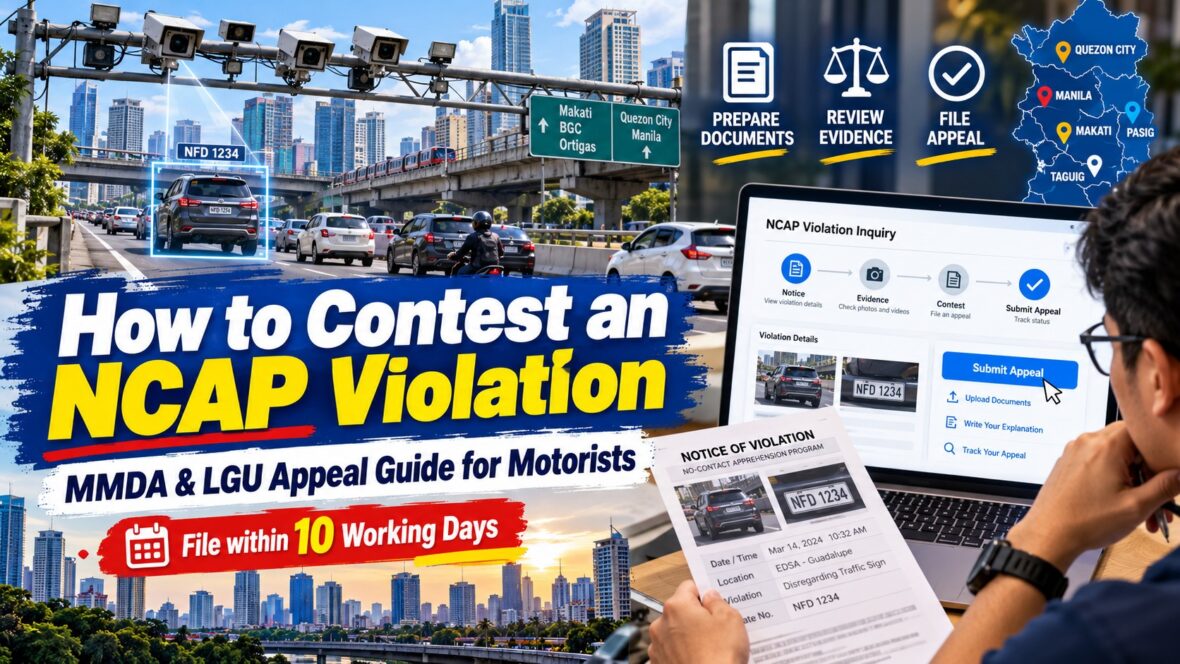
Getting an NCAP Notice of Violation can be frustrating—especially if you look at the photo or video and genuinely believe you didn’t commit the violation.
Maybe the vehicle was misidentified.
Maybe you had already sold the car.
Maybe the traffic sign wasn’t visible.
Or perhaps the images don’t actually show what the citation says happened.
Whatever the reason, receiving an NCAP violation doesn’t mean your only option is to immediately pay the fine.
Motorists have the right to contest a citation through the appropriate traffic adjudication process.
But there’s one thing you should not ignore:
The deadline.
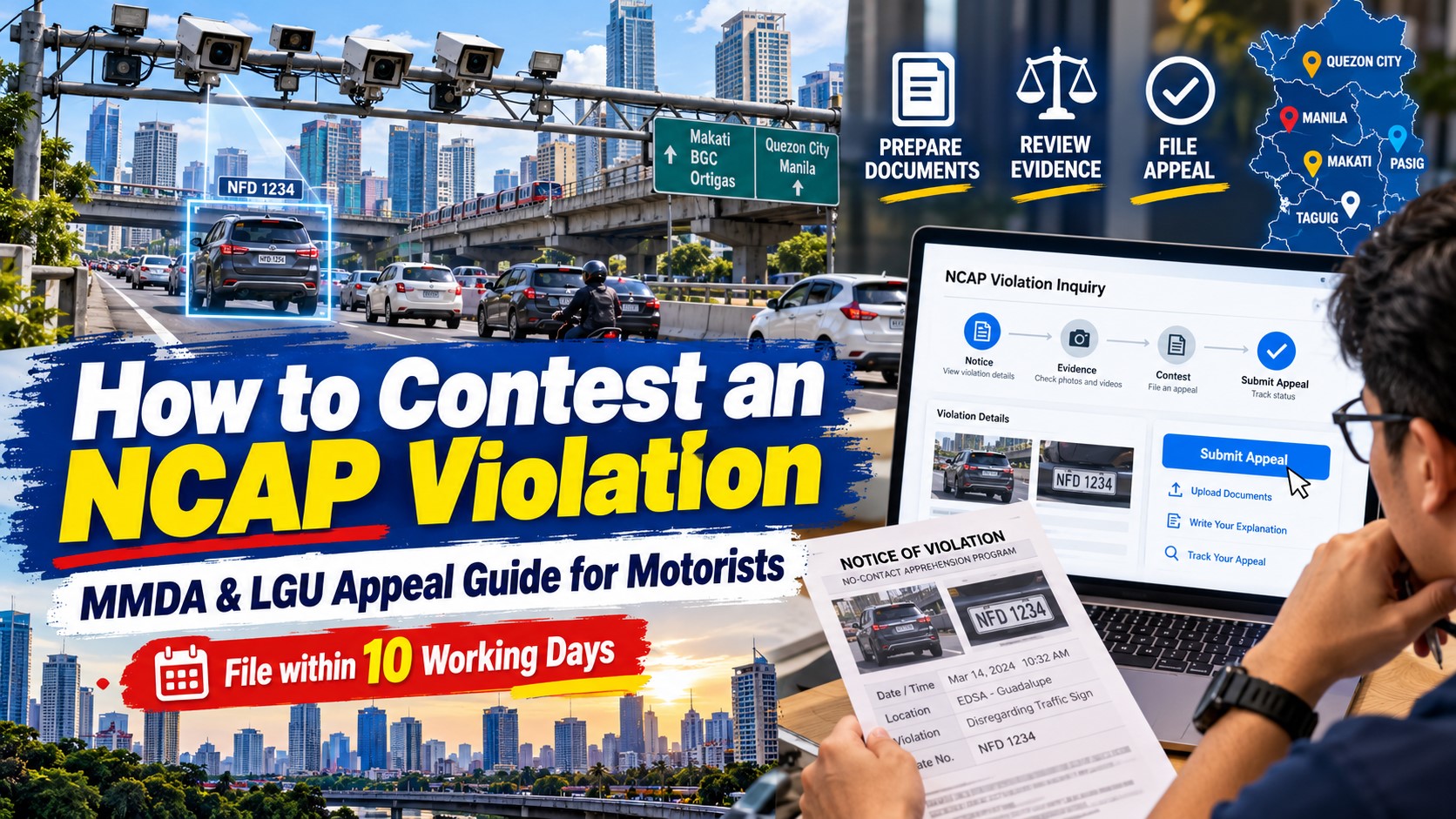
For an MMDA NCAP Notice of Violation, the current May Huli Ka system says you must file your contest with the Traffic Adjudication Division within 10 working days from receiving the notice. The broader Metro Manila Traffic Code also provides a traffic adjudication process for NCAP cases.
So if you believe an NCAP citation is incorrect, don’t leave the notice sitting on your desk for several weeks.
Here’s how the process works.
Content
Can You Contest an NCAP Violation?
Yes.
NCAP does not remove your right to question a traffic citation.
Under the current Metro Manila Traffic Code framework, motorists may file a complaint, contest or protest before the appropriate traffic adjudication body.
The Traffic Adjudication Board or corresponding adjudication office reviews challenges involving traffic violations, including those recorded through non-contact apprehension.
The Metro Manila Traffic Code provides that a violation may generally be contested within 10 working days from the relevant apprehension or knowledge of the traffic citation, while current NCAP implementation rules use receipt of the Notice of Violation as the trigger for the contest period.
For MMDA-issued NCAP cases, MMDA’s May Huli Ka portal specifically says:
You may contest the citation through the Traffic Adjudication Division within 10 working days from receipt of the Notice of Violation.
First: Find Out Who Issued Your NCAP Violation
Before doing anything else, check the Notice of Violation.
Look for the issuing authority.
It may be:
- MMDA
- Quezon City
- Manila
- Muntinlupa
- San Juan
- Another LGU or traffic authority operating an authorized NCAP system
This is important because you need to file your protest with the agency that actually issued the citation.
An MMDA violation should not simply be taken to whatever city hall happens to be closest to you.
Likewise, an NCAP citation issued by an LGU generally has to go through that city’s traffic adjudication procedure.
MMDA NCAP vs. LGU NCAP
The simplest way to understand the system is:
MMDA-issued NCAP
Check and contest through MMDA’s system and Traffic Adjudication Division.
City-issued NCAP
Follow the instructions provided by the city’s official NCAP portal and Traffic Adjudication Board.
The Metro Manila Traffic Code created a more uniform framework, but the actual adjudicating authority still depends on which agency issued the violation.
The Supreme Court noted in its 2026 NCAP decision that the newer system provides uniform procedures involving notices, adjudication, payment, penalties and the tagging of violations in LTO’s Land Transportation Management System.
Step 1: Verify That the NCAP Violation Is Real
Before contesting anything, make sure the violation actually exists.
This is especially important because fake NCAP text messages have circulated.
For an MMDA NCAP record, use the official May Huli Ka system.
You’ll generally need information such as:
- Plate number
- MV File Number
or, if you already have a citation:
- Plate number
- Ticket number
The MV File Number can be found on your LTO Certificate of Registration.
Never rely exclusively on a link sent through an SMS message.
Open the official government portal yourself.
Step 2: Read the Entire Notice of Violation
Don’t just look at the fine.
Read everything.
Under the Metro Manila Traffic Code framework, an NCAP Notice of Violation should provide important details about the alleged offense.
These include information such as:
- Citation number
- Date of the violation
- Time of the violation
- Exact location
- Traffic offense allegedly committed
- Fine or penalty
- Image of the vehicle
- Image showing the alleged violation
- Vehicle plate or other vehicle information
- Process for accessing video evidence, when available
- Instructions for contesting the violation
The notice should also inform the motorist of the period for filing a protest.
Check every detail carefully.
Ask yourself:
Was my vehicle actually there?
Is that my plate?
Does the date make sense?
Does the photograph clearly show the alleged violation?
Does the video tell the same story as the still image?
Don’t assume that because your plate number appears on the notice, everything else on the citation is automatically correct.
Step 3: Review the Photo and Video Evidence
This could be the most important part of your contest.
NCAP violations are based on camera evidence.
So you need to understand exactly what the camera recorded.
Look closely at:
- Vehicle position
- Traffic signal
- Lane markings
- Road signs
- Pedestrian lane
- Intersection
- Surrounding vehicles
- Time sequence
- Vehicle plate
- Direction of travel
A single still image can sometimes look very different from the full sequence of events.
For example, imagine a photo showing your vehicle inside an intersection.
That image alone might suggest that you blocked the intersection.
But a longer video sequence could potentially show that traffic was moving when you entered and stopped unexpectedly after you had already crossed the line.
I’m not saying that automatically makes the violation invalid.
I’m saying the complete evidence matters.
If the notice provides access to video, watch it carefully before deciding whether to contest.
Step 4: Mark Your 10-Working-Day Deadline
This is critical.
For MMDA NCAP, you generally have:
10 working days from receipt of the Notice of Violation
to file your contest.
Under the current Metro Manila framework, failure to file within the applicable period can result in the citation being treated as affirmed or no longer open to the normal contest process.
Don’t confuse working days with calendar days.
Weekends and certain holidays are generally not counted as regular working days.
Still, don’t wait until Day 10.
If you’re going to contest, start preparing immediately.
Step 5: Write Down Exactly Why You’re Contesting
A successful contest should be more than:
“I don’t think I did anything wrong.”
Be specific.
For example:
The vehicle in the evidence is not your vehicle.
The plate was misread.
The cited violation does not match what appears in the video.
The vehicle had already been legally transferred.
The traffic sign cited was not applicable to your lane.
The vehicle information on the notice is incorrect.
There are circumstances visible in the evidence that materially affect whether the cited violation occurred.
The clearer your argument, the easier it is for the adjudicator to understand exactly what you’re disputing.
Step 6: Gather Your Evidence
Your protest becomes much stronger when supported by documents rather than just an explanation.
Depending on the situation, useful evidence may include:
- Notice of Violation
- Screenshots of the NCAP evidence
- Dashcam footage
- Photos
- Videos
- Certificate of Registration
- Official Receipt
- Driver’s license
- Government-issued ID
- Deed of Sale
- Transfer-of-ownership documents
- LTO records
- Documents identifying the driver
- Relevant travel records
- Other documents directly related to the alleged violation
The Metro Manila Traffic Code’s adjudication framework contemplates written protests supported by the documents or evidence relied upon by the motorist.
Don’t submit 50 unrelated screenshots just to make your submission look substantial.
Use evidence that actually proves your argument.
What If You Have Dashcam Footage?
Save it immediately.
Dashcams can be extremely helpful because many devices overwrite old recordings automatically.
If you receive an NCAP notice and still have footage from the date involved:
- Copy the original recording.
- Save a backup.
- Preserve the timestamp if available.
- Don’t heavily edit the original file.
- Make a shorter copy if you need to highlight a particular sequence.
The strongest evidence is generally something that allows the adjudicator to independently understand what happened.
Step 7: Prepare Your Written Contest
The current Metro Manila adjudication framework provides for a written complaint, contest or protest.
The Traffic Code states that protests should be in writing and supported by evidence.
It also contains formal requirements concerning the motorist’s sworn submission.
Your protest should clearly contain:
- Your name
- Your contact information
- Citation or Notice of Violation number
- Plate number
- Vehicle information
- Date and location of the alleged offense
- Violation being contested
- Clear explanation of why you’re contesting it
- Supporting evidence
- Requested action
Keep your explanation factual.
Don’t turn it into a five-page rant about NCAP.
The adjudicator needs to understand why this specific citation should be dismissed or corrected.
Example of a Clear Contest Explanation
A useful explanation might be structured like this:
“I am contesting Notice of Violation No. ______ involving vehicle plate ______. The citation states that the vehicle committed ______ at ______ on ______. However, the attached dashcam recording and photographs show ______. I respectfully request that the cited evidence and my supporting documents be reviewed and that the Notice of Violation be dismissed if the violation is found not to have occurred.”
Short.
Specific.
Easy to understand.
How to Contest an MMDA NCAP Violation
For an MMDA citation, MMDA instructs motorists who disagree with the violation to file with its Traffic Adjudication Division or through the available online process.
The May Huli Ka portal currently states that motorists may proceed to the TAD office at:
MMDA Traffic Adjudication Division
11th Floor, MMDA New Building
or use the available online filing mechanism.
MMDA’s newer May Huli Ka system is also designed to allow motorists to view violation notices and evidence and file a contest with the Traffic Adjudication Division.
If you’re filing online, make sure you receive or save evidence that the submission actually went through.
Take screenshots.
Save confirmation emails.
Record any case or reference number.
How to Contest a Quezon City NCAP Violation
If Quezon City issued the Notice of Violation, the dispute goes through the city’s traffic adjudication system rather than MMDA’s TAD.
Quezon City’s NCAP guidance has provided motorists with 10 days from receipt of the Notice of Violation to appeal to the QC Traffic Adjudication Board.
Quezon City’s Traffic Adjudication Board currently lists supporting requirements for traffic-adjudication transactions including:
- Valid photo ID
- Original copy of the applicable violation receipt
- Assessment information, when applicable
- Other documents relevant to the issue
The city’s published citizen’s charter also provides for an appeal form and evaluation by its Traffic Adjudication Board.
Because procedures and online systems can change, follow the instructions appearing on your current Notice of Violation and the city’s official website.
What If the Violation Came From Another LGU?
The same basic principle applies.
Identify the city that issued your citation.
Then use:
- Its official NCAP portal
- Its Traffic Adjudication Board
- Its traffic management office
- The appeal instructions printed on the Notice of Violation
Do not automatically file everything with MMDA.
The Metro Manila framework says the appropriate LGU Traffic Adjudication Board can hear contests involving notices issued by that LGU.
What Happens During the Adjudication?
The adjudicating authority reviews:
- The Notice of Violation
- Camera evidence
- Your written explanation
- Documents you submitted
- Applicable traffic rules
Depending on the agency and case, additional clarification or proceedings may be required.
The adjudicator can then determine whether the citation should stand or whether your protest has merit.
Don’t assume contesting automatically suspends every consequence forever.
Follow the instructions from the adjudication office while the case is pending.
Can You Appeal if Your Contest Is Denied?
Yes, the current Metro Manila framework provides another administrative level of review.
The implementation arrangement described by the Supreme Court provides that an aggrieved party may appeal an adverse Traffic Adjudication Board resolution within:
15 working days from receipt of the resolution
The appeal goes, as applicable, to either:
- The relevant local chief executive for an LGU case, or
- The Office of the MMDA Chairman for an MMDA case.
The resulting decision at that level is described under the framework as final and executory administratively.
So there are effectively two separate deadlines to remember:
Initial NCAP contest: generally 10 working days.
Appeal from an unfavorable adjudication decision: generally 15 working days under the applicable Metro Manila framework.
Always follow the exact deadline written in the official decision you receive.
What Happens if You Ignore the NCAP Violation?
Ignoring the notice is not the same as contesting it.
Under the Metro Manila Traffic Code system, unresolved violations can eventually be tagged in LTO’s Land Transportation Management System after the applicable procedures and notice requirements have been followed.
A violation that isn’t settled or contested within the prescribed period can result in restrictions affecting vehicle-related transactions until the matter is resolved.
That’s why doing nothing is usually the worst option.
If the citation is correct, settle it properly.
If it’s wrong, contest it within the deadline.
Can You Contest Because Someone Else Was Driving?
Potentially relevant, yes.
Automatically cancelled, no.
NCAP initially identifies a vehicle through its registration record.
The Metro Manila Traffic Code’s NCAP framework specifically requires notices to include instructions relating to identifying the driver at the time of the apprehension.
If another person was driving, follow the process stated on the Notice of Violation and submit the required identification or supporting documents.
Don’t simply write:
“I wasn’t driving.”
and assume the matter is finished.
The vehicle owner may need to establish who was actually driving and comply with the applicable procedures.
What If You Sold the Car Before the Violation?
This is another common problem.
Suppose you sold a car months ago but never completed the LTO transfer of ownership.
If government records still identify you as the registered owner, an NCAP notice may still be sent using your information.
Current rules specifically recognize situations in which the registered owner sold a vehicle but failed to update LTO ownership records as relevant to the service of the Notice of Violation.
If you genuinely sold the vehicle before the violation occurred, gather documents such as:
- Deed of Sale
- Proof of delivery
- Transfer documents
- Communications relating to the sale
- LTO documents
- Other records establishing the timeline
But take this as another reminder:
Always complete the official transfer of ownership after selling a vehicle.
What If the Plate Number Was Read Incorrectly?
Plate misidentification is exactly the type of factual issue worth reviewing.
Compare:
- Your actual vehicle
- Make and model
- Color
- Body type
- Plate
- Other visible characteristics
with the vehicle shown in the NCAP evidence.
If your vehicle is a white sedan and the captured vehicle is clearly a black SUV, that’s obviously relevant.
Include registration documents and photos showing your actual vehicle.
What If Road Signs or Markings Were Unclear?
Photograph the location if you can safely and legally do so.
Useful details could include:
- Missing signs
- Obstructed signs
- Faded markings
- Lane arrows
- Traffic lights
- Construction barriers
- Temporary road changes
However, a confusing road layout does not automatically invalidate a violation.
Your evidence must show why the condition materially affects the specific citation.
Can You Contest Because You Didn’t Know the Traffic Rule?
Usually, saying you were unaware of the rule is not a strong basis by itself.
Traffic rules generally apply whether or not a driver remembers every regulation.
A stronger contest addresses the factual or legal basis for the actual citation.
For example:
The sign did not apply to your lane.
Your vehicle did not enter the prohibited area.
The vehicle was incorrectly identified.
The camera evidence doesn’t establish the offense.
Focus on the violation itself.
Can You Just Ignore the Notice Because You Didn’t Sign Anything?
No.
NCAP is specifically designed as a non-contact system.
There is no roadside encounter where a traffic enforcer asks you to sign a citation.
The Metro Manila framework provides mechanisms for serving the Notice of Violation without physical apprehension.
It also addresses circumstances such as a motorist refusing delivery, outdated LTO addresses and vehicles sold without updated ownership information.
The absence of your signature on the original citation therefore does not automatically invalidate an NCAP case.
What If You Never Received the Notice?
This situation can become more complicated.
The current framework contains detailed rules concerning service of the Notice of Violation.
It also addresses situations where a notice cannot be delivered because:
- The registered owner moved without updating LTO.
- The address in LTO records is incorrect.
- The vehicle was sold without updating ownership.
- Delivery could not be completed.
That’s another reason keeping your LTO registration information current matters.
If you discover an NCAP case only later through an LTO transaction or online check, contact the issuing authority immediately and ask how the contest period applies to your circumstances.
Don’t assume the case is hopeless—but don’t ignore it either.
Should You Pay First and Contest Later?
If you intend to challenge the citation, don’t assume that paying first is the proper strategy.
Payment can have legal or administrative consequences depending on the applicable rules.
The safer approach is:
- Verify the violation.
- Review the evidence.
- Read the Notice of Violation.
- Decide whether you will pay or contest.
- Follow the issuing authority’s official procedure.
If you’re uncertain about whether payment affects your right to contest, ask the adjudication office before paying.
NCAP Scams: Be Careful When Contesting Online
Scammers know motorists are worried about NCAP.
A fake message might say:
“Your NCAP violation is overdue.”
“Pay immediately to avoid LTO suspension.”
“Click here to contest.”
Never blindly click those links.
For MMDA cases, start through the official May Huli Ka service.
For LGU cases, start through the official city website.
Government agencies will not need you to send your appeal fee to a random personal GCash account.
The 2026 Supreme Court Decision and Your Right to Contest
The Supreme Court dismissed the consolidated cases challenging earlier Metro Manila NCAP ordinances in 2026 and lifted the old TRO.
But it’s important to understand what the Court actually said.
The petitions were dismissed largely because the older fragmented system had been replaced by the Metro Manila Traffic Code of 2023 and newer implementing measures.
The Court highlighted that the newer system now includes:
- Uniform traffic adjudication
- Procedures for contesting citations
- Periods for settling notices
- Rules for LTMS tagging
- Data privacy safeguards
- Harmonized fines and penalties
The Court also clarified that its dismissal was not a sweeping declaration that every earlier NCAP issuance was automatically valid.
For motorists today, the practical takeaway is simple:
NCAP is enforceable under the current framework, but due-process mechanisms—including the ability to contest a citation—are part of that framework.
Quick Step-by-Step Guide to Contesting NCAP
Here’s the process in simple terms:
- Verify the Notice of Violation.
- Identify whether MMDA or an LGU issued it.
- Review the photographs and video.
- Note your deadline immediately.
- Gather supporting evidence.
- Prepare a clear written protest.
- File it with the correct adjudication office within the required period.
- Save proof that your protest was submitted.
- Monitor the status of your case.
- Attend or respond to any additional adjudication requirements.
- Review the decision.
- If denied and an appeal is available, file within the applicable appeal period.
NCAP Contest Checklist
Before filing, make sure you have:
- Notice of Violation
- Citation number
- Plate number
- MV File Number when applicable
- Certificate of Registration
- Valid identification
- Written explanation
- Photo or video evidence
- Dashcam recording if available
- Other supporting documents
- Proof of ownership or transfer if relevant
- Contact information
- Copies of everything you submit
Save both digital and printed copies if the matter is important.
Frequently Asked Questions
How many days do I have to contest an NCAP violation?
For an MMDA-issued NCAP Notice of Violation, May Huli Ka currently gives motorists 10 working days from receipt of the notice to file a contest with the Traffic Adjudication Division.
The broader Metro Manila framework likewise provides a 10-working-day contest period for NCAP notices.
Where do I contest an MMDA NCAP violation?
MMDA says you may file with its Traffic Adjudication Division at the MMDA New Building or through the available online process.
Can NCAP be contested online?
Yes.
MMDA’s current digital NCAP system supports filing contests with the Traffic Adjudication Division through its online services.
LGU systems differ, so check the official portal of the city that issued your notice.
Do I need evidence?
You should provide evidence whenever possible.
The Metro Manila adjudication framework provides for written contests supported by documents and evidence relied upon by the motorist.
Can dashcam footage be used?
Dashcam footage can be valuable supporting evidence if it clearly documents the circumstances surrounding the alleged offense.
Preserve the original recording and timestamp whenever possible.
What happens if my appeal is denied?
Under the current Metro Manila framework, an adverse Traffic Adjudication Board resolution can generally be appealed within 15 working days from receipt of the decision to the applicable local chief executive or MMDA Chairman.
Can I contest because another person was driving?
The identity of the actual driver may be relevant.
Current NCAP rules require the Notice of Violation to provide instructions concerning identification of the driver during the contest period.
Follow the specific instructions on your notice and submit the required proof.
Can I contest if I already sold the vehicle?
If the violation happened after you sold the vehicle, documents proving the sale and transfer may be relevant.
However, failing to update ownership information with LTO can complicate the matter because notices are initially based on official registration records.
What if the camera captured the wrong plate?
Gather your Certificate of Registration and photographs showing your actual vehicle and plate.
Compare them with the NCAP evidence and include the discrepancy in your contest.
Can an NCAP violation affect LTO transactions?
Unresolved violations can eventually be tagged in the LTMS under the procedures established by the Metro Manila Traffic Code.
The newer framework specifically contains rules covering when violations may be tagged and how vehicle transactions can be affected.
Does contesting guarantee that the fine will be cancelled?
No.
Filing a protest gives you the opportunity to present your side and evidence.
The adjudicating authority determines whether the citation should be dismissed, modified or upheld.
Final Thoughts
If you receive an NCAP violation that you genuinely believe is wrong, don’t panic—and don’t immediately pay just because a notice landed in your inbox.
First, verify it.
Check who issued the citation.
Review the actual photo and video evidence.
Then compare what the camera shows with what the Notice of Violation says happened.
If there is a legitimate reason to dispute the citation, gather your evidence and file your protest promptly.
For MMDA cases, the most important number to remember is 10 working days from receipt of the Notice of Violation.
And if your first contest is denied, the current Metro Manila framework provides an additional administrative appeal process, generally with a 15-working-day period from receipt of the adjudication resolution.
NCAP may be automated, but traffic adjudication isn’t supposed to be automatic.
You still have the right to see the allegation, review the evidence and explain why you believe the citation is incorrect.
The key is to use that right before the deadline runs out.