Some Philippine festivals celebrate a harvest.
Others honor a patron saint, a historical event or a product that made a town famous.
Sinawug Festival in Asuncion, Davao del Norte begins with something even more basic to everyday life:
Water.
For generations, the rivers running through this part of Davao del Norte were more than scenery. They provided drinking water, supported livelihoods, connected communities and served as transportation routes long before paved roads made travel easier.
That relationship between people and river eventually became the heart of Sinawug Festival.
Traditionally described as an annual thanksgiving celebration associated with Asuncion’s indigenous communities, Sinawug honors the importance of the river to the people who depended on it for transportation, livelihood and water. Over time, that thanksgiving tradition developed into a larger municipal festival filled with cultural performances, street dancing and community activities.
Today, Sinawug is also closely connected with Araw ng Asuncion, the municipality’s founding-anniversary celebration.
But if you only see Sinawug as another colorful street-dancing festival, you’re missing the most interesting part of its story.
This is a festival about the relationship between a community and the river that helped sustain it.
Here’s everything you need to know about Sinawug Festival.
Content
Sinawug Festival at a Glance
| Festival | Sinawug Festival |
|---|---|
| Location | Asuncion, Davao del Norte |
| Region | Davao Region |
| Main theme | Thanksgiving, water, river life and local culture |
| Cultural roots | Indigenous communities of the area |
| Important natural symbol | Saug River and Asuncion’s river system |
| Major modern feature | Festival dance and cultural competitions |
| Connected celebration | Araw ng Asuncion |
| Traditional older date | September 19 |
| Current date | Can vary according to the official Araw ng Asuncion program |
| 2026 celebration | August 1, 2026 |
Older tourism calendars consistently described Sinawug as a river-centered thanksgiving celebration and listed September 19 as its traditional date. More recent official programs, however, show that the celebration is no longer permanently tied to September 19.
That change is important if you’re planning a trip.
Check the current year’s announcement rather than assuming an old festival calendar is still accurate.
Where is Sinawug Festival Celebrated?
Sinawug Festival is celebrated in Asuncion, a municipality in Davao del Norte.
Asuncion sits inland from Tagum City and forms part of the agricultural mainland of the province.
This isn’t the beach-and-resort side of Davao del Norte that many travelers immediately associate with Samal Island.
The landscape here is much more rural.
You’ll encounter agricultural communities, rice fields, rivers and roads leading toward the interior municipalities of Davao del Norte.
The provincial government describes Asuncion as a 30,422-hectare municipality with a mixture of cultures and a history that predates the arrival of large numbers of Visayan settlers in the twentieth century.
The river landscape remains an important part of the town even today.
And that’s exactly why Sinawug makes sense here.
What is Sinawug Festival?
Sinawug Festival is a cultural thanksgiving celebration centered on the importance of the river to the people of Asuncion.
One of the oldest widely circulated tourism descriptions of the festival explains it as an annual thanksgiving of indigenous communities conducted in connection with the river, which historically provided transportation, livelihood and drinking water.
That description is remarkably simple.
But it tells the entire story.
Before roads connected rural Mindanao the way they do today, a river could function almost like a highway.
People traveled along it.
Goods moved along it.
Food came from it.
Water came from it.
Communities grew beside it.
So Sinawug wasn’t created around a random tourism symbol.
The river had already shaped people’s lives long before anyone organized a festival around it.
What Does “Sinawug” Mean?
This is one detail where it’s better to be careful than overly creative.
Public sources consistently connect Sinawug Festival with Asuncion’s river tradition and with the old name Saug.
But I could not find a reliable primary source giving a precise official linguistic translation of the word “Sinawug.”
What we do know is that Saug is deeply embedded in Asuncion’s history.
The area once included the District of Saug, and the municipality itself was officially called Saug before being renamed Asuncion in 1957. The municipal government also continues to identify Ilog Saug as part of the town’s local landscape.
So the association between Sinawug, Saug and the river is clear.
What I wouldn’t do is invent an exact translation simply because it sounds plausible.
Sometimes festival names have local meanings that are obvious to residents but poorly documented online.
Sinawug is one of those cases.
The River is the Real Star of Sinawug
When you understand how important waterways once were to rural communities, the entire festival becomes easier to appreciate.
Imagine living in a time when there wasn’t a concrete road connecting every barangay.
The river wasn’t somewhere you visited on weekends.
It was infrastructure.
A transportation route.
A water source.
A place where food could be gathered.
A connection to nearby communities.
Older Sinawug descriptions emphasize that the river was once the principal means of transporting goods while also supporting people’s livelihoods and supplying drinking water.
That’s why the festival is described as thanksgiving.
The river gave people something to be thankful for.
Asuncion’s River Culture is Still Visible Today
You can still see how important rivers are to the municipality.
Davao del Norte’s provincial tourism office highlights the Madgao River in Asuncion as an emerging tourism area where narrow boats continue moving across the water.
One local boater interviewed by the provincial tourism office described the river as being “like a highway” to residents.
The Madgao River also supports aquatic resources including carp, tilapia and native prawns and has been used as a training area for dragon-boat paddling.
That description sounds remarkably similar to the historical story behind Sinawug.
Different generation.
Different circumstances.
Same idea.
The river connects people.
The Indigenous Roots of Sinawug
Sinawug is frequently described as a thanksgiving celebration of the Lumads.
“Lumad” is a broad term used for various non-Muslim indigenous peoples of Mindanao, so it’s worth being more specific when possible.
According to Asuncion’s municipal historical account, the area’s early inhabitants included Aeta and Mandaya communities. Large numbers of migrants from Leyte, Bohol, Cebu and elsewhere in the Visayas began settling in the area during the 1930s.
That history turned Asuncion into a meeting place of cultures.
Indigenous communities were already there.
Visayan settlers arrived later.
New communities formed.
Livelihoods changed.
Roads developed.
But the river remained part of the story.
Sinawug provides a way of remembering the period when indigenous communities relied heavily on that environment.
A Festival of Thanksgiving
Thanksgiving is one of the easiest ideas to understand across Philippine festivals.
A farmer gives thanks for crops.
A fishing community gives thanks for the sea.
A mountain town gives thanks for fertile land.
In Sinawug, the source of thanksgiving is water.
And not just water in an abstract environmental sense.
Water that people actually drank.
Water that transported their products.
Water that supported their livelihood.
That’s what makes Sinawug meaningful.
The celebration takes something we usually take for granted and reminds people that communities once depended on it for almost everything.
Street Dancing and Cultural Performances
The modern Sinawug Festival has grown far beyond its river thanksgiving roots.
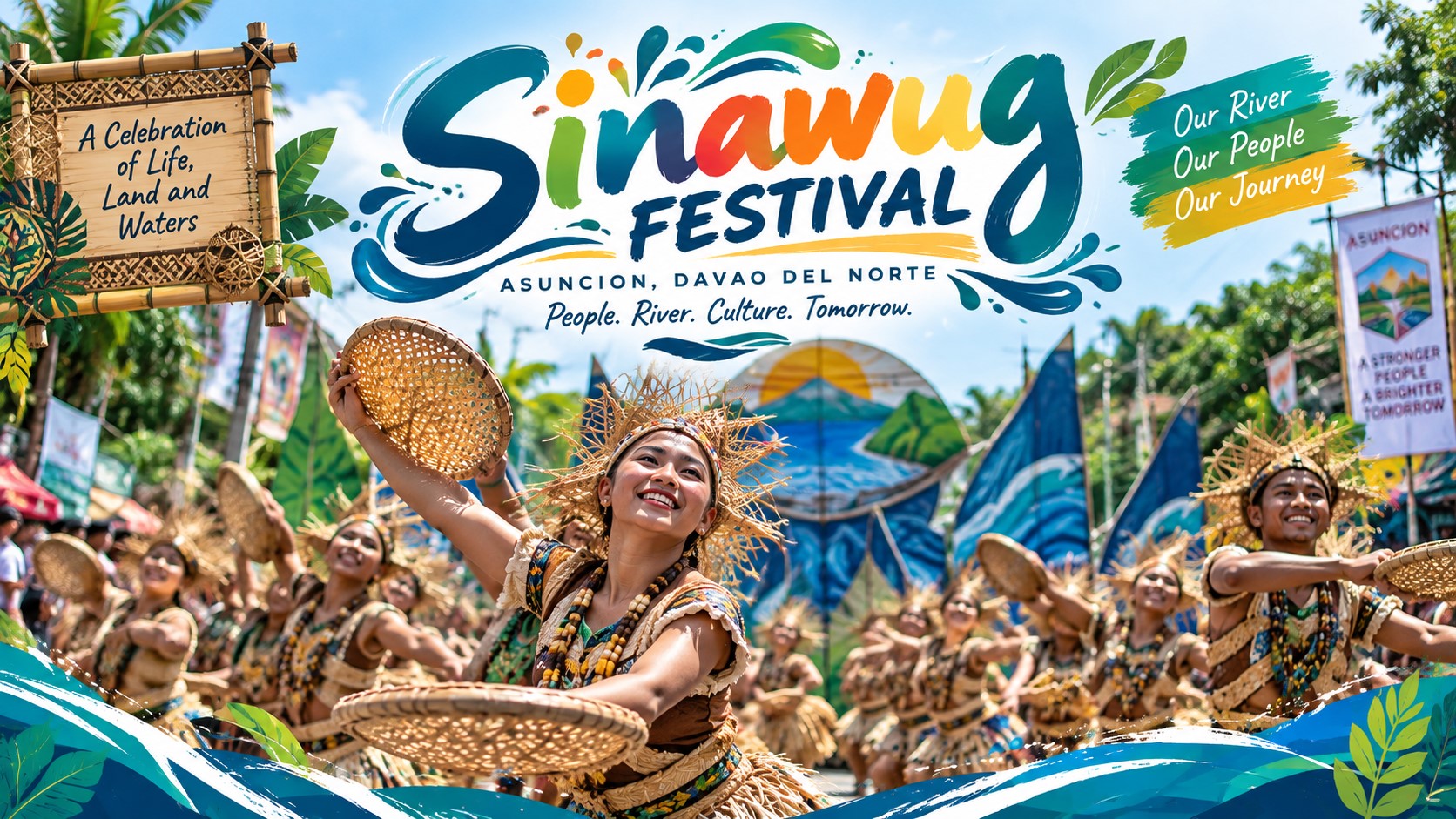
Street dancing and festival dance competitions have become some of the celebration’s most visible activities.
Groups use costumes, music, props and choreography to interpret the culture and history of Asuncion.
Festival performances can depict river life, indigenous traditions, agriculture, community relationships and thanksgiving.
And this isn’t a tiny competition anymore.
Documents from the National Commission for Culture and the Arts show how significant festival dancing has become. A 2025 Sinawug project supported by the NCCA planned participation from 21 schools, with roughly 80 students representing each school.
Think about that for a moment.
Hundreds of young people rehearsing.
Teachers helping organize.
Families working on costumes.
Musicians practicing.
Schools preparing performances.
Suddenly, a festival isn’t merely something you watch.
It’s something an entire community has spent weeks preparing.
Why Schools Matter to Sinawug
School participation is particularly important in cultural festivals.
Young dancers may not have experienced the period when rivers were the primary transportation network of Asuncion.
They grew up with roads.
Motorcycles.
Phones.
Modern transportation.
But when they perform Sinawug, they’re forced to learn the story behind the celebration.
Why was the river important?
Who lived here before?
How did people transport agricultural products?
What did earlier communities depend on?
Dance becomes a form of storytelling.
And even if the choreography is modern, the story being told can be generations old.
Festival Costumes
Sinawug performances can be highly colorful.
You may see dancers in costumes inspired by indigenous patterns, agriculture, vegetation, water and other elements associated with Asuncion.
Props can help turn the performance area into a visual representation of local life.
But there’s an important distinction visitors should remember.
A festival costume inspired by indigenous culture isn’t automatically the same as authentic ceremonial attire used by an indigenous community.
Festival costumes are often theatrical interpretations created for competition.
Traditional clothing and rituals carry their own meanings.
That difference deserves respect.
You can appreciate the creativity of Sinawug street dancing without pretending every design is a literal reconstruction of an ancient tradition.
The Story Told Through Dance
One of the most interesting ways to watch a festival like Sinawug is to stop focusing only on the dancers and start watching the story.
You may notice choreography resembling paddling.
Water movement.
Planting.
Harvesting.
Transporting goods.
Gathering as a community.
Giving thanks.
Festival choreography is essentially visual storytelling.
There might not be a narrator explaining every sequence.
But once you understand Sinawug’s river theme, those movements become easier to read.
You’re no longer just watching people dance.
You’re watching a community recreate its relationship with its environment.
Sinawug and Agriculture
Asuncion is also an agricultural municipality.
The municipal government’s own tourism materials highlight its rice fields, while farming remains part of the wider economy of mainland Davao del Norte.
Rice production continues to matter locally. A 2025 Senate release, for example, documented support for an agrarian-reform cooperative in Asuncion operating rice-milling services for its members.
The connection between agriculture and the Sinawug story is natural.
Crops need water.
Farm products need transportation.
Rural families depend on both land and river.
So while the river sits at the center of the festival, farming is part of the broader livelihood story around it.
The History of Asuncion
The town itself has gone through several names and political changes.
According to the Municipality of Asuncion’s official historical record, the area became a regular municipal district on February 23, 1921.
Two districts existed at the time:
Camansa and Saug.
The District of Saug included Cambanogoy, Limbaan, Canatan, Sagayen and Napungas.
Then came another change.
In early 1948, Executive Order No. 156 made the area a regular municipality under the name New Leyte.
That name didn’t last very long.
In September 1948, Executive Order No. 173 changed the municipality’s name to Saug.
Finally, Republic Act No. 1675, enacted on June 20, 1957, renamed Saug as Asuncion in honor of Nuestra Señora de la Asuncion, the municipality’s patron saint.
So even before Sinawug Festival existed, “Saug” was already deeply connected with the identity of the town.
From Saug to Asuncion
I find this part of the story particularly interesting.
Places change names.
Governments change boundaries.
Roads change transportation.
New people arrive.
But old names survive.
You still encounter Saug in Asuncion’s historical identity.
And a festival called Sinawug keeps that connection visible.
That’s one reason local festivals matter.
They can preserve pieces of history that might otherwise disappear from everyday conversation.
Ask a young resident today about “Saug” and the answer may lead you back through decades of Asuncion history.
That’s cultural memory doing its job.
Araw ng Asuncion and Sinawug Festival
Sinawug is now closely tied to Araw ng Asuncion.
The two celebrations are often mentioned together in official announcements.
Araw ng Asuncion commemorates the municipality’s establishment, while Sinawug provides the cultural festival component.
This pairing is common around the Philippines.
One occasion remembers civic history.
The other expresses local identity through dance, culture, food, competitions and entertainment.
Together, they create something much larger than a simple anniversary ceremony.
When is Sinawug Festival Celebrated?
Here’s where travelers need to be careful.
For many years, widely circulated Philippine tourism calendars listed Sinawug Festival on September 19.
Those older references remain online today.
And Sinawug activities were still being programmed in September in recent years. For example, an NCCA document placed the 2025 festival project in September.
However, the official date can change.
In 2026, Sinawug and Araw ng Asuncion were celebrated on August 1.
So I wouldn’t describe September 19 as the permanent festival date anymore.
A better rule is:
Sinawug is celebrated in connection with Araw ng Asuncion, and visitors should check the municipality’s official calendar for the current year’s dates.
That will save you from arriving in September only to discover the biggest celebration already happened weeks earlier.
Sinawug Festival Isn’t Only About Street Dancing
Street dancing gets the photos.
But it shouldn’t become the entire definition of the festival.
Sinawug is really built on several layers.
There’s the river.
There’s indigenous history.
There’s the story of early communities.
There’s agriculture.
There’s municipal history.
There’s thanksgiving.
And then there’s modern festival culture.
Street dancing is the most visible expression of those themes.
It isn’t the reason they exist.
A Celebration of Water
Most of us don’t think much about water until there isn’t any.
Turn the faucet.
Water comes out.
That’s normal.
But communities historically located around rivers understood water differently.
Where you lived mattered.
Where you could travel mattered.
Where animals drank mattered.
Where you obtained water mattered.
Where goods could be carried mattered.
Sinawug preserves some of that relationship.
It reminds people that rivers were not simply natural attractions.
They were essential infrastructure long before anyone used that term.
Sinawug and Environmental Awareness
This also gives Sinawug a very modern relevance.
If the river is the reason behind the festival, protecting waterways becomes part of protecting the festival’s story.
Polluted rivers don’t support communities the same way healthy rivers do.
Damaged watersheds affect agriculture.
Trash affects aquatic life.
Poor water quality affects everyone downstream.
Sinawug’s traditional thanksgiving message therefore fits naturally with environmental responsibility.
You can’t celebrate what the river gave earlier generations while ignoring what happens to that river today.
That’s a message worth carrying forward.
What to Expect When Visiting Sinawug
Don’t expect a festival identical to Kadayawan in Davao City.
Sinawug is a municipal celebration.
That’s part of its appeal.
You may find yourself watching local school contingents rather than nationally famous dance companies.
The people lining the streets may be parents, classmates and relatives of the performers.
Community officials know many participants personally.
Agricultural areas are only a short distance from the festival center.
The celebration feels local because it is local.
And when you’re traveling specifically to understand Philippine festivals, that can be far more interesting than something designed mainly for tourists.
How to Get to Asuncion
Tagum City is the easiest major gateway for many travelers heading to Asuncion.
Asuncion lies inland northwest of Tagum and is connected by road to the provincial capital and neighboring municipalities.
Geographic databases place Asuncion’s town center roughly 12 kilometers in straight-line distance from Tagum, while road journeys are longer depending on the exact starting point and route.
If you’re coming from Davao City, travel north toward Tagum first, then continue inland toward Asuncion.
Public transportation options can change, so check current van, bus or jeepney routes when you arrive in Tagum.
During festival events, expect heavier local traffic and possible road closures around parade and performance areas.
If one particular competition is the reason you’re traveling, arrive early.
Madgao River: Seeing the River Story Beyond the Festival
If you want to understand Sinawug beyond the costumes, Asuncion’s river landscapes are worth paying attention to.
The provincial tourism office specifically highlights Madgao River as an emerging local destination.
Boats travel across its calm waters, aquatic resources support local life and the river has even provided a training area for paddlers.
That experience can help connect the festival story to something real.
You watch dancers portray river life.
Then you see people actually using the river.
Suddenly, Sinawug stops feeling like an abstract cultural theme.
What to Bring
Festival travel in Davao del Norte is mostly about staying comfortable.
Light clothing works well for the warm and humid weather.
Bring water, sun protection and something for sudden rain.
Wear shoes you’re comfortable walking in because road closures can mean more walking than expected.
Carry some cash.
Small vendors and temporary food stalls may not always accept digital payments.
And if you’re taking photos, remember to enjoy at least part of the festival without the camera.
You’ll hear things a photo can’t capture.
Drums.
Crowd reactions.
Music.
Students cheering for their schools.
Those sounds are part of Sinawug too.
Respecting Indigenous Culture
Because Sinawug draws from indigenous history, visitors should approach that aspect with respect.
Don’t treat indigenous-inspired performances as exotic entertainment.
And don’t assume every festival portrayal is an exact representation of traditional culture.
The better approach is curiosity.
Ask what the dance represents.
Learn which communities historically lived in Asuncion.
Understand why the river mattered.
Recognize that the people being referenced in the festival aren’t characters from the distant past.
Indigenous communities remain part of Mindanao today.
Respect makes the experience richer.
Why Sinawug Festival Matters
Sinawug is one of those festivals that becomes more interesting the longer you think about it.
On the surface:
Colorful costumes.
Music.
Street dancing.
Competition.
Celebration.
Underneath:
A river.
People carrying goods.
Families depending on water.
Indigenous communities living along the landscape.
Migrants arriving.
A town changing names.
Roads replacing waterways.
Agriculture expanding.
And generations trying not to forget what came before them.
That’s a lot of history hidden inside a dance festival.
Sinawug Festival 2026
For 2026, there was a major change from the September dates still found on many older festival calendars.
The 27th Sinawug Festival and Araw ng Asuncion were officially celebrated on Saturday, August 1, 2026.
Malacañang issued Proclamation No. 1354 declaring August 1 a special non-working day in Asuncion specifically to give residents the opportunity to participate in the Araw ng Asuncion and Sinawug Festival celebrations.
Because today is already September 2026, that celebration has passed.
This is also a good example of why travelers shouldn’t rely exclusively on older pages that continue listing Sinawug on September 19.
The festival’s core tradition is timeless.
Its exact calendar date isn’t.
For future editions, check the Municipal Government of Asuncion’s announcements before booking transportation or accommodation.
A Note About Sinawug’s Festival Numbering
There’s also a small inconsistency in publicly available documents worth mentioning.
An NCCA document referred to a 2025 project as the “25th Sinawug Festival,” while the official 2026 presidential proclamation called the following celebration the “27th Sinawug Festival.”
Rather than guessing why the numbering differs, it’s safest to use the official designation issued for the specific year you’re writing about.
For a timeless article like this, the exact edition number isn’t necessary.
The festival story matters more.
Final Thoughts
Sinawug Festival is easy to appreciate for its street dancing.
But that’s only the beginning.
To understand Sinawug, picture Asuncion before highways.
Picture communities beside a river.
Goods being carried by boat.
Families drawing water.
People fishing.
Farmers depending on the same water system that connected one settlement to another.
Then imagine those communities stopping to give thanks.
That’s the foundation of Sinawug.
The festival has changed since then.
It has become bigger.
Schools compete.
Costumes have become more elaborate.
Municipal celebrations have expanded.
Dates have moved.
Modern Asuncion is obviously no longer the community it was generations ago.
But the river remains in the story.
And every time dancers recreate that relationship through movement, music and color, they’re doing something more than competing for a trophy.
They’re reminding Asuncion where part of its life came from.
That’s what makes Sinawug Festival worth remembering.
It’s a celebration of water.
Of livelihood.
Of culture.
Of history.
And of a community saying thank you to the river that once served as its road, its workplace and one of its most important sources of life.