There are festivals in the Philippines known for giant masks, colorful flowers, elaborate costumes or energetic street dancing.
Then there is the Angel Festival of San Rafael, Bulacan.
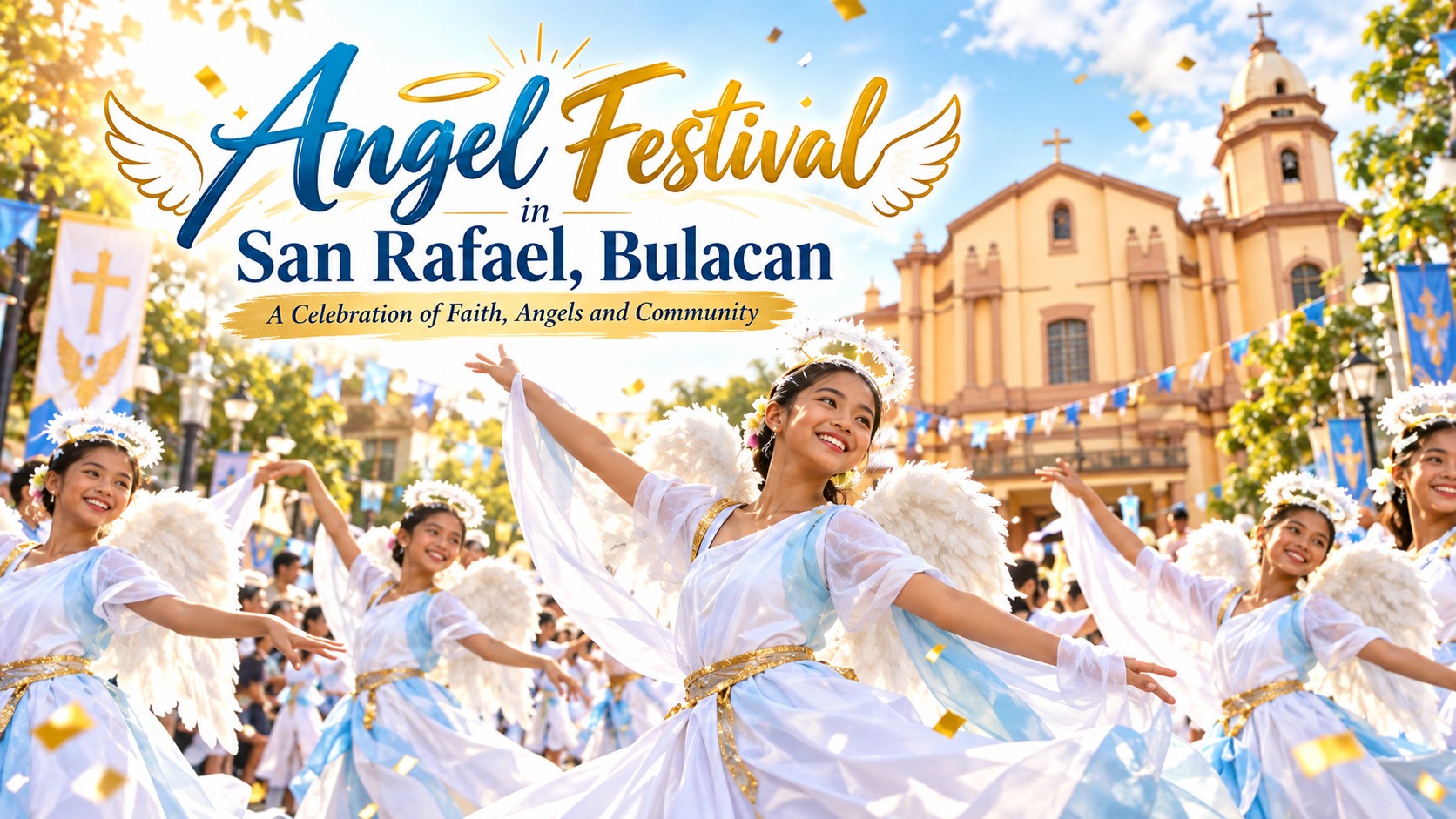
Imagine an entire street filled with children dressed in white, complete with wings, halos and flowing costumes, dancing their way through town as spectators line the roadside.
For a moment, it really can look like hundreds—or even thousands—of angels have descended on San Rafael.
But behind the beautiful costumes and festive atmosphere is something much deeper.
The Angel Festival is rooted in San Rafael’s devotion to St. Raphael the Archangel. It combines Catholic tradition, local culture, school participation and community celebration into one of Bulacan’s more distinctive festivals.
Held in connection with the feast of St. Raphael every September 29, the festival has grown from a local religious celebration into an event closely associated with the identity of San Rafael itself.
If you’re curious about the Angel Festival—when it happens, why people dress like angels, how it started and what you can expect when visiting—here’s a complete guide.
Content
What Is the Angel Festival?
The Angel Festival is the annual festival of San Rafael, Bulacan honoring St. Raphael the Archangel.
Its most recognizable feature is the gathering of young participants dressed as angels.
Students from public and private schools traditionally join a street parade or street-dancing competition wearing angel-inspired costumes. After the parade, participating groups may perform choreographed routines or interpretative dances during the festival showdown.
That’s the part of the celebration most visitors see in photographs.
White wings everywhere.
Halos.
Colorful accents.
Music.
Students dancing through the streets.
Crowds gathering around the poblacion.
But the Angel Festival isn’t simply a street-dancing event.
Its foundation is religious.
The celebration revolves around St. Raphael the Archangel and usually includes Masses, novena prayers, processions and other parish activities alongside the cultural festivities.
In some years, the program has also included a fluvial procession along the river.
So when you visit the Angel Festival, you’re really experiencing two celebrations happening together: the festive side of a Philippine town fiesta and the devotional traditions surrounding the feast of St. Raphael.
When Is the Angel Festival Celebrated?
The main feast is traditionally celebrated every:
September 29
This is the feast associated locally with St. Raphael the Archangel, and the Municipality of San Rafael identifies September 29 as the traditional date of the Angel Festival.
However, here’s something important if you’re planning to visit.
The biggest festival activities aren’t always held exactly on September 29.
Street dancing, competitions, concerts, processions and other activities may be scheduled several days before the actual feast day.
For example, in 2023, the Indakan sa Kalye or street dance was held on September 23, while September 29 remained the feast day.
In 2024, the street dancing was held on September 27, followed by a fluvial procession on September 28 and the feast celebration on September 29.
So if your main goal is to photograph the angel costumes and watch the street dancing, don’t simply arrive in San Rafael on September 29 without checking that year’s official program.
The festival season usually builds toward September 29, but individual events can fall on different dates.
Why Is It Called the Angel Festival?
The name comes directly from the festival’s devotion to St. Raphael the Archangel.
St. Raphael is traditionally associated with healing and guidance, and the San Rafael municipal government describes him as the “Divine Healer” and a patron associated with people who are ill and those caring for them.
That makes the imagery of angels more than just decoration.
The wings, halos and white costumes represent the religious character of the celebration.
And when hundreds of students move together through the streets dressed as angels, the effect is quite different from the usual Philippine festival costume.
Many Philippine festivals use bright tribal costumes, flowers, indigenous patterns or agricultural products as their visual identity.
San Rafael went in another direction.
Angels became its signature.
And that visual identity has helped make the festival immediately recognizable.
How Did the Angel Festival Start?
The Angel Festival began on September 29, 2002.
According to the Municipality of San Rafael, the festival was initiated through the efforts of the San Juan de Dios Parish and the San Rafael Tourism Council.
That origin explains why religion and tourism have remained closely connected throughout the festival’s development.
The celebration wasn’t created only as entertainment.
It was designed around devotion to St. Raphael while also giving the town a cultural event that could involve schools, residents and visitors.
Over the years, the sight of children dressed as angels became the festival’s defining image.
By 2023, San Rafael was celebrating the 22nd Angel Festival.
What started in 2002 has now become a long-running September tradition in Bulacan.
St. Raphael and San Rafael, Bulacan
To understand the festival better, it helps to understand the religious history of the town.
One interesting detail is that San Rafael’s historic church is officially known as San Juan de Dios Parish Church.
St. John of God is the church’s titular patron, while St. Raphael the Archangel is identified as its secondary patron.
Yet devotion to St. Raphael became deeply connected with the municipality and eventually with the Angel Festival.
The historic San Juan de Dios Parish Church is located in Barangay Poblacion and dates to the Spanish colonial period.
It also occupies an important place in Philippine history.
The church became the site of the Battle of San Rafael during the Philippine Revolution in 1896. According to the municipal historical account, retreating Filipino revolutionaries and civilians sought refuge in the church during fighting with Spanish forces, and hundreds were killed.
So visiting the festival also gives travelers an opportunity to see one of Bulacan’s historic churches.
It’s a place connected not only to religion, but also to the country’s revolutionary past.
The Angel Street Dancing
For most first-time visitors, this is probably the main attraction.
The streets fill with young performers dressed in angel costumes.
Traditionally, students representing different public and private schools around San Rafael participate.
The municipal government says that more than a thousand children have taken part in the festival, transforming the streets into a large procession of angel-costumed dancers.
And the costumes aren’t necessarily identical.
White is naturally dominant, but groups can add gold, blue, silver and other colors.
Some costumes are simple.
Others can be elaborate, with large feathered wings, glittering halos and detailed accessories.
Then come the performances.
Groups dance along the festival route before participating in a larger showdown or interpretative dance competition.
You’ll hear festival music.
You’ll see parents following their children.
You’ll see photographers positioning themselves along the road.
And you’ll probably notice spectators waiting in shaded areas long before the dancers arrive.
It has the familiar energy of a Philippine street-dancing festival, but the angel theme gives San Rafael its own identity.
The Festival Showdown
After the street parade, participating groups traditionally gather for a competition.
This is where they perform longer choreographed pieces.
The Municipality of San Rafael describes it as an interpretative dancing competition involving participating schools.
The themes and format can change from year to year.
Sometimes organizers introduce particular concepts or styles. In other years, the celebration shifts back toward more traditional and religious imagery.
For example, San Rafael’s municipal government described the 2023 celebration under the theme “Balik Tradisyon sa Makabagong Ngayon,” emphasizing a return to more traditional religious elements.
That’s why older photos from the Angel Festival may look slightly different from more recent editions.
The basic identity remains—the angels and devotion to St. Raphael—but the presentation evolves.
Religious Activities During the Festival
This is something worth remembering, especially if you’re visiting primarily to take photos.
The Angel Festival is still connected to a Catholic feast.
In the days leading to September 29, San Juan de Dios Parish traditionally holds novena Masses and other devotional activities.
The feast day itself includes major Mass celebrations.
Religious processions may also take place.
In 2024, for example, the feast included a Mass followed by a procession featuring images of the Three Archangels together with St. John of God and Our Lady of the Rosary.
So even if the street dance gets most of the attention online, it isn’t the entire festival.
For many residents, these religious activities are the heart of the celebration.
The Fluvial Procession
One of the more interesting traditions incorporated into recent editions of the celebration is the fluvial procession.
Instead of everything happening on land, an image of St. Raphael is carried along the river on a decorated pagoda or boat.
In 2023, festival activities included a motorcade to San Rafael River Adventure, followed by Mass and a fluvial procession downstream toward the Poblacion area.
The tradition was also held in 2024.
The Diocese of Malolos reported that after Mass at San Rafael River Adventure, an image of St. Raphael was placed aboard the pagoda for the procession along the river. The activity included prayers connected with the livelihoods of fishermen and St. Raphael’s guidance.
This part of the festival has a quieter and more devotional atmosphere compared with the street dancing.
And visually, it’s another beautiful part of San Rafael’s fiesta tradition.
San Rafael’s Guinness World Record
Here’s one detail that makes the festival even more interesting.
San Rafael now holds a Guinness World Record related to its angel tradition.
On December 14, 2024, the Municipality of San Rafael gathered 2,000 people dressed as angels at Victory Coliseum.
Guinness World Records officially recognized it as the world’s largest gathering of people dressed as angels.
Participants wore white robes, halos and wings, along with candle accessories.
The record attempt wasn’t held on the traditional September 29 feast itself, but Guinness specifically connected the gathering with San Rafael’s annual Angel Festival tradition.
That’s a pretty fitting record for a town whose signature festival has been filling its streets with angels since 2002.
What to Expect When Visiting Angel Festival
If you’re coming specifically for the street dancing, arrive early.
Very early.
The main roads around the event area can become crowded once spectators begin gathering.
You’ll also want time to find a good position before the dancers arrive.
Shade can be limited along some parts of the route, so bring an umbrella, cap or anything that can protect you from the sun.
September is also within the rainy season, so an umbrella is useful either way.
Bring water.
Wear comfortable shoes.
And if you’re carrying a camera, expect to move around quite a bit.
For photography, the angel costumes look particularly good when dancers are approaching rather than when you’re standing directly beside them. Finding an open section of road where you can photograph the entire formation can give you much better shots than squeezing into the busiest parts of the crowd.
But remember that many of the participants are children.
Give them space.
Don’t block their route just to get a photo.
And during Masses or religious processions, treat the event as a religious observance rather than purely as a tourist attraction.
Don’t Skip San Juan de Dios Parish Church
If you’re already in San Rafael for the festival, make time for the church.
San Juan de Dios Parish Church isn’t simply the religious center of the celebration.
It’s also one of San Rafael’s most important historical landmarks.
The present church has roots going back to the Spanish colonial period, and the Battle of San Rafael in 1896 took place at the site. A historical marker was later installed to commemorate those who died.
During fiesta season, the church naturally becomes one of the busiest places in town.
But even outside September, it’s worth visiting if you’re exploring historical Bulacan.
Where Is the Angel Festival Held?
The festival is held in the municipality of San Rafael in Bulacan province.
Many of the traditional religious activities center around San Juan de Dios Parish in the Poblacion area.
Street-dancing routes and competition venues may change depending on the year’s program.
The municipal complex and Victory Coliseum have also been used for major festival activities, while the river area has hosted the fluvial component of the celebration.
This is another reason to check the official schedule before traveling.
Don’t assume every activity happens in front of the church.
Is the Angel Festival Worth Visiting?
For travelers who enjoy Philippine fiestas, this is one of the more unusual festivals you can experience in Central Luzon.
Its appeal isn’t necessarily about having the biggest floats or the loudest street party.
It’s the visual concept.
Seeing such a large number of participants dressed as angels is something you don’t encounter at most festivals.
Then you add the old church, religious processions, school competitions and local community atmosphere.
It creates something distinctly San Rafael.
And because Bulacan is relatively accessible from Metro Manila and neighboring Central Luzon provinces, you don’t necessarily need a long vacation to experience it.
It can work as a day trip, although staying longer gives you time to experience both the cultural and religious parts of the celebration.
Angel Festival vs. the San Rafael Town Fiesta
These terms can sometimes be used interchangeably by visitors, but there is a useful distinction.
The town’s September celebration centers on the feast of St. Raphael the Archangel.
The Angel Festival is the cultural festival developed around that religious celebration.
So the September 29 feast is the traditional anchor date.
Meanwhile, activities branded under the Angel Festival—including street dancing, competitions and entertainment—may take place before or around the feast.
Think of it the same way many Philippine towns celebrate fiestas.
There is a religious feast.
And then there is a larger community festival that grows around it.
In San Rafael, the angel theme ties the two together.
Why the Angel Festival Matters to San Rafael
A good local festival isn’t simply something created for visitors.
Eventually, it becomes part of how residents identify their town.
That’s what seems to have happened with the Angel Festival.
It started through cooperation between the parish and the local tourism council in 2002.
Schools became involved.
Children became the festival’s most recognizable participants.
Local residents supported the celebration.
The imagery of angels became associated with San Rafael.
And more than two decades later, the town even managed to turn that tradition into a Guinness World Record.
That’s a pretty impressive journey for a municipal festival.
Angel Festival 2026 Schedule
The Angel Festival traditionally revolves around the September 29 feast of St. Raphael the Archangel.
So for 2026, the main feast day falls on:
September 29, 2026
As of September 18, the Municipality of San Rafael’s website does not appear to have published a complete 2026 Angel Festival program containing the confirmed dates and times for street dancing, the showdown, fluvial procession and other major activities. The municipality continues to identify September 29 as the festival’s traditional annual date.
If you’re planning to attend specifically for the Indakan sa Kalye, don’t rely only on September 29.
Based on previous editions, the street-dancing competition may take place a few days before the feast.
It’s best to check announcements from the Municipality of San Rafael and San Juan de Dios Parish once the detailed program is released.
Final Thoughts
There are plenty of colorful festivals around Bulacan and Central Luzon, but San Rafael’s Angel Festival has something that makes it immediately recognizable.
The angels.
Hundreds of wings moving through the streets.
Children dressed in white.
Halos catching the sunlight.
Music playing as school groups perform.
Then, beyond all of that, you have the church, the novena, Masses, processions and the devotion to St. Raphael that started the celebration in the first place.
That’s really what makes the Angel Festival interesting.
It can be colorful without losing its religious character.
It can attract tourists while still feeling like a genuine hometown fiesta.
And after more than two decades, it has developed into one of the traditions San Rafael can genuinely call its own.
So if you find yourself looking for a September festival near Metro Manila or somewhere around Central Luzon, keep San Rafael, Bulacan on your list.
Just make sure you check the schedule first.
Because while September 29 is the heart of the celebration, some of the most beautiful moments—especially the sight of hundreds of angels dancing through the streets—may happen a few days earlier.