When we think about Baguio City, the first things that usually come to mind are its cool weather, pine trees, strawberry taho, Burnham Park, and the colorful Panagbenga Festival.
But there’s another side of Baguio that deserves just as much attention.
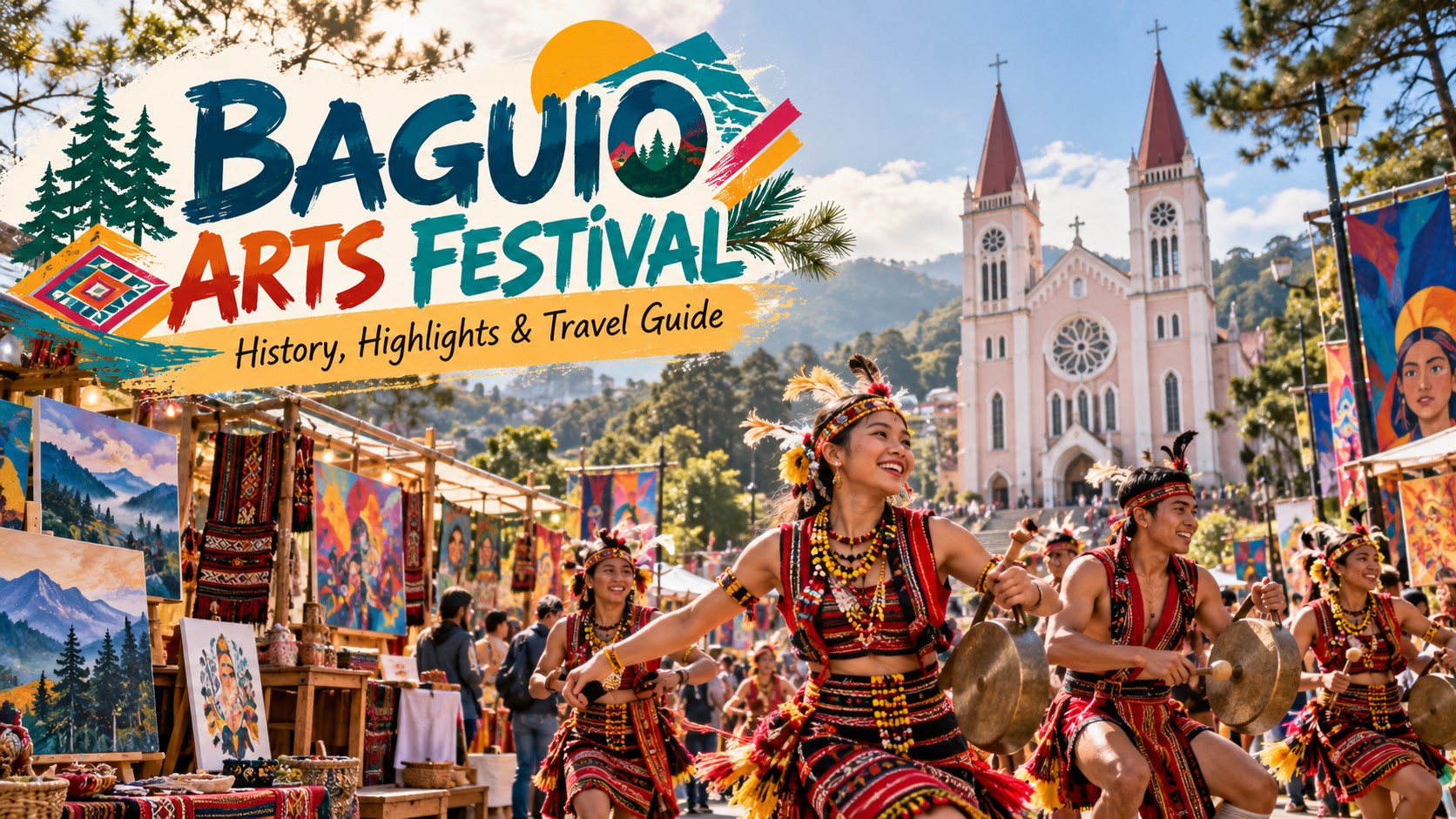
Beyond its famous tourist attractions, the City of Pines has a rich artistic heritage that has helped shape Philippine contemporary art for decades. From traditional Cordillera weaving and woodcarving to experimental films, installations, paintings, and live performances, Baguio has long been a place where artists gather to create and share their work.
And one of the most important celebrations in this history is the Baguio Arts Festival.
Organized by the pioneering Baguio Arts Guild beginning in the late 1980s, the festival brought together Filipino and international artists in a celebration of creativity, cultural identity, and artistic freedom.
Unlike the usual Philippine festivals centered on street dancing competitions or religious processions, the Baguio Arts Festival focused on artistic expression in many different forms.
It wasn’t just about looking at paintings inside a gallery. Art could appear along the streets, inside unconventional spaces, through live performances, or in installations that encouraged people to think differently about culture and society.
Although the original festival is no longer held as a continuous annual event under the same name, its legacy remains an important part of Baguio’s creative identity. That spirit continues today through celebrations such as the Ibagiw Creative Festival and other cultural initiatives.
So, what exactly is the Baguio Arts Festival? How did it begin, what made it different, and how can travelers experience Baguio’s artistic culture today?
Here’s everything you need to know.
Content
What Is the Baguio Arts Festival?
The Baguio Arts Festival is a historic cultural and artistic celebration organized by the Baguio Arts Guild, a collective of artists established in the late 1980s.
The festival was created to promote Baguio as a center for artistic exchange and to provide a platform for artists working across different disciplines.
Its programs included visual arts, contemporary installations, photography, filmmaking, music, dance, theater, poetry, and cultural expressions connected to the Cordillera region.
One of the festival’s defining characteristics was its experimental approach.
Rather than limiting artistic presentations to conventional galleries or theaters, the organizers explored different ways of bringing art into public spaces and community settings.
Artists were encouraged to collaborate, experiment with materials, and explore subjects connected to Philippine culture, history, identity, and the environment.
The festival also helped connect Baguio’s artistic community with other creative groups in the Philippines and abroad.
Over time, it became an important part of the development of contemporary art in the country.
While some older tourism calendars continue to describe the Baguio Arts Festival as an annual November-to-December celebration, the original festival eventually ceased regular operations. Visitors today should distinguish it from the newer Ibagiw Creative Festival.
Baguio Arts Festival Quick Facts
- Festival name: Baguio Arts Festival
- Location: Baguio City, Benguet, Philippines
- Original organizer: Baguio Arts Guild
- Guild established: 1987
- Festival beginnings: Late 1980s, with 1989 widely cited as its early major festival year
- Historical festival season: November to December
- Festival type: Cultural, contemporary arts, visual arts, and performing arts
- Main highlights: Art exhibitions, installations, film, photography, music, theater, poetry, and Cordillera-inspired artistic expressions
- Cultural significance: Helped establish Baguio as a major center for contemporary art and artistic collaboration
- Present-day legacy: Reflected in Baguio’s continuing arts scene and celebrations such as the Ibagiw Creative Festival
The original Baguio Arts Festival and the present-day Ibagiw Creative Festival are historically connected, but they are not simply two names for the same uninterrupted annual event.
History and Origin of the Baguio Arts Festival
To understand the Baguio Arts Festival, we need to go back to the 1980s.
This was an important period in Philippine history.
The country was undergoing major political and social changes following the 1986 People Power Revolution, and many artists were exploring new ways of expressing their ideas about Philippine society and identity.
Baguio became one of the places where these creative discussions developed.
The Formation of the Baguio Arts Guild
In 1987, a group of artists established the Baguio Arts Guild, an organization that would eventually become one of the most influential artist collectives in the Philippines.
Among the personalities associated with its founding were Santiago Bose, Benedicto Cabrera or BenCab, filmmaker Kidlat Tahimik, and artist Roberto Villanueva.
These artists came from different creative backgrounds, but they shared an interest in building a stronger artistic community.
They believed art could exist beyond conventional exhibitions and commercial galleries.
It could become a way of connecting with communities, preserving cultural knowledge, questioning established ideas, and exploring the relationship between people and their environment.
Baguio provided an interesting setting for this vision.
The city had long attracted artists because of its mountain surroundings, multicultural communities, and connections to the traditions of the Cordillera.
Its location also created opportunities for artists to engage with the crafts, stories, and cultural practices of Indigenous communities in Northern Luzon.
Through the Baguio Arts Guild, these creative interests gradually developed into a larger movement.
The First Baguio Arts Festival
The beginnings of the festival can be traced to artistic gatherings and smaller celebrations in the late 1980s.
Historical research documents a mini-Baguio Arts Festival in December 1988, while 1989 is widely cited in tourism histories as the beginning of the major festival tradition.
The idea was to bring artists together in Baguio for a celebration that would go beyond conventional exhibitions.
The festival became a meeting place for painters, sculptors, photographers, filmmakers, musicians, writers, performance artists, and cultural practitioners.
Rather than presenting only finished artworks, some participants developed projects that involved collaboration, experimentation, and public participation.
Certain works used natural materials, found objects, or references to Indigenous cultural practices.
Others explored social and political questions.
What made the festival significant was the freedom it gave artists to present work outside the usual boundaries of Philippine art institutions.
For a period, Baguio became an important meeting place for artists from different regions and countries.
A Festival That Attracted International Attention
As the festival developed, it began attracting participants and attention beyond the Philippines.
International artists became part of its creative exchanges, while the Baguio Arts Guild built connections with broader contemporary art movements.
The event helped strengthen Baguio’s reputation as a place where experimental and community-based art could flourish.
Its importance was recognized by artists, cultural institutions, and observers who followed the development of Philippine contemporary art.
The festival also demonstrated that major artistic gatherings did not need to take place exclusively in Metro Manila.
Baguio showed that a provincial city could become an internationally recognized center for cultural exchange.
Why Did the Original Baguio Arts Festival Stop?
Despite its artistic achievements, sustaining the original festival became increasingly difficult.
Organizing an international arts festival required substantial funding, coordination, institutional support, and administrative work.
Many of the participating artists were also involved in planning the events, finding resources, coordinating international guests, and producing their own artworks.
These responsibilities placed considerable pressure on the organizers.
Over time, financial and organizational challenges made it difficult to continue the festival regularly.
The original Baguio Arts Festival eventually came to an end as a sustained annual event, with historical accounts documenting its activity into the early 2000s.
However, this did not mean Baguio’s artistic community disappeared.
The people, ideas, and creative networks that developed around the festival continued influencing art in the city.
In many ways, the festival’s legacy became part of the foundation for Baguio’s present-day creative identity.
What Made the Baguio Arts Festival Unique?
The Baguio Arts Festival was different from many other Philippine celebrations because it did not revolve around a single performance, dance tradition, or religious occasion.
Its focus was the arts themselves.
The festival embraced different forms of creativity, allowing artists to explore both traditional and contemporary approaches.
Here are some of the artistic expressions that became associated with its programs and legacy.
1. Visual Arts and Painting Exhibitions
Visual arts played an important role in the festival.
Artists presented paintings, drawings, prints, mixed-media pieces, and other creative works.
These exhibitions gave visitors opportunities to encounter different artistic styles and perspectives.
Some works explored Philippine history and identity, while others drew inspiration from landscapes, communities, and cultural traditions.
The festival also encouraged approaches that moved away from conventional representations.
Instead of simply reproducing familiar subjects, artists experimented with materials, textures, symbols, and combinations of different media.
This openness helped establish Baguio as an important environment for contemporary visual art.
2. Sculpture and Art Installations
Another defining feature of the Baguio Arts Festival was its emphasis on installations and experimental art.
Unlike paintings displayed on walls, installations often transform an entire space into an artistic experience.
Artists might use natural materials, recycled objects, bamboo, wood, stone, or other materials to create works connected to particular locations.
One important example from the festival’s early years was Roberto Villanueva’s exploration of environmental and community-based installations.
His work drew from concepts of nature, communal participation, and cultural traditions.
Installations like these demonstrated that art could be something visitors experienced physically rather than simply observed from a distance.
They also encouraged conversations about humanity’s relationship with the environment.
3. Photography, Film, and Video Art
Film and photography were also part of the festival’s artistic scope.
These media allowed participants to document communities, explore cultural issues, and tell stories through images.
For some artists, filmmaking became a way of questioning conventional storytelling and examining the relationship between Philippine culture and outside influences.
The presence of filmmaker Kidlat Tahimik within the Baguio Arts Guild helped connect the city’s artistic movement with experimental Philippine cinema.
His work is particularly associated with independent filmmaking, Indigenous knowledge, cultural identity, and criticism of colonial perspectives.
Film and video also expanded the festival’s reach beyond traditional visual art audiences.
4. Music and Performing Arts
The Baguio Arts Festival also included different forms of performance.
Programs featured artistic expressions involving music, theater, dance, and experimental performances.
Unlike events built around a single choreographed street dancing competition, these presentations could vary widely in format.
Some involved conventional musical or theatrical performances.
Others combined sound, movement, visual elements, and interaction with audiences.
This variety reflected the festival’s broader emphasis on collaboration.
Artists from different disciplines could work together to create experiences that were difficult to classify under just one category.
5. Poetry, Literature, and Creative Expression
The festival also provided space for literary and spoken-word forms of art.
Poetry readings and other literary presentations formed part of its multidisciplinary character.
This made the celebration especially interesting because it recognized that artistic expression wasn’t limited to objects or performances.
Stories, language, and spoken words could also play important roles in exploring identity and culture.
The participation of writers and other creative practitioners contributed to the festival’s reputation as a meeting place for different artistic communities.
6. Cordillera Arts and Cultural Traditions
One of the most important characteristics of Baguio’s art movement was its connection with the cultural heritage of the Cordillera.
The region is home to diverse Indigenous communities with distinct languages, customs, and artistic traditions.
These include the Ibaloi, Kankanaey, Ifugao, Kalinga, Bontok, and other ethnolinguistic groups.
Traditional weaving, woodcarving, basketry, metalwork, and other forms of craftsmanship became important sources of inspiration and subjects of cultural discussion.
For some participating artists, traditional materials and cultural symbols became part of contemporary installations and visual works.
The relationship between contemporary art and Indigenous culture remains an important subject in Baguio’s creative community today.
It also highlights the importance of recognizing the communities, knowledge holders, and cultural contexts behind these traditions.
The Cultural Significance of the Baguio Arts Festival
The Baguio Arts Festival was more than an event where artists displayed their work.
Its importance can be understood through the lasting effects it had on the city’s artistic community.
Helping Establish Baguio as an Arts Center
Long before Baguio received international recognition as a creative city, local artists were already developing a distinct artistic identity.
The Baguio Arts Festival helped bring this community into the national and international spotlight.
Through exhibitions, performances, and exchanges, the city became associated with experimental art and creative collaboration.
This helped strengthen Baguio’s position as one of the country’s important cultural destinations.
Encouraging Artistic Freedom
The festival developed during a period when many Filipino artists were examining political changes, cultural identity, and social issues.
Its experimental character offered opportunities to explore subjects that did not always fit conventional expectations of art.
Artists could combine traditional practices with contemporary ideas or use unconventional materials and locations.
This spirit of experimentation became an important part of the Baguio Arts Guild’s legacy.
Promoting Collaboration Across Communities
Another important contribution was the festival’s emphasis on bringing different people together.
Visual artists, filmmakers, performers, writers, and cultural practitioners could exchange ideas and collaborate.
The festival also created opportunities for interactions between artists from different regions and countries.
These exchanges helped expand artistic conversations beyond individual studios and institutions.
Recognizing Local Culture and Indigenous Knowledge
The festival encouraged attention to the cultural identity of Northern Luzon.
For Baguio’s artistic community, the surrounding Cordillera was not simply a scenic backdrop.
Its landscapes, histories, materials, and living cultural traditions became important subjects of artistic exploration.
This helped strengthen wider interest in the relationship between contemporary Philippine art and local cultural heritage.
From Baguio Arts Festival to Ibagiw Creative Festival
One of the most important things to understand about the Baguio Arts Festival is its relationship with the city’s modern creative celebrations.
The original festival eventually ended, but the idea of celebrating Baguio’s artistic identity continued.
A major development came in 2017.
That year, Baguio City became the first Philippine city admitted to the UNESCO Creative Cities Network, receiving recognition as a Creative City of Crafts and Folk Art.
This designation recognized the importance of Baguio’s traditional crafts, cultural heritage, and creative industries.
It also created opportunities for the city to strengthen its programs supporting artists and craftspeople.
The Beginning of the Baguio Creative Festival
Following Baguio’s UNESCO designation, local cultural advocates and creative organizations helped develop a new citywide arts celebration.
In November 2018, the city launched the ENTACool Baguio Creative Festival.
The event brought together artists, craftspeople, cultural organizations, and other creative sectors.
Its purpose was to celebrate Baguio’s artistic heritage while supporting the development of its contemporary creative economy.
The festival drew inspiration from the city’s earlier art movement, including the legacy of the Baguio Arts Guild.
In 2019, the celebration adopted the name Ibagiw Creative Festival.
The name is connected to the Ibaloi word “bagiw,” referring to moss, a reference associated with Baguio’s historical landscape.
Is Ibagiw the Same as the Baguio Arts Festival?
Not exactly.
The two celebrations are historically connected, but they are different events.
The original Baguio Arts Festival was organized by the Baguio Arts Guild beginning in the late 1980s and became known for experimental and contemporary art.
The Ibagiw Creative Festival began in 2018 as a newer celebration promoting Baguio’s arts, crafts, folk traditions, and creative industries.
Both reflect the city’s artistic identity, but they belong to different periods of Baguio’s cultural history.
For visitors looking for a present-day creative festival in Baguio, Ibagiw is one of the most relevant events to follow.
What Can You Experience During Baguio’s Modern Arts Celebrations?
Although individual programs change, Baguio’s contemporary creative festivals continue showcasing many of the artistic disciplines associated with the city’s history.
Here are some common experiences.
Art Exhibitions
Art exhibitions remain central to Baguio’s creative culture.
Visitors can encounter paintings, sculptures, installations, photography, and works by both established and emerging artists.
Some exhibitions explore contemporary themes, while others highlight cultural heritage, regional identity, or environmental issues.
Weaving and Traditional Crafts
Craftsmanship is particularly important because of Baguio’s UNESCO designation.
Traditional weaving, woodcarving, basketry, and other crafts represent valuable cultural knowledge and creative livelihoods.
Modern festivals provide opportunities for artisans to demonstrate their skills and introduce visitors to the processes behind their work.
Creative Workshops
Workshops allow visitors to become participants rather than simply spectators.
Depending on the festival program, activities may include drawing, painting, crafts, design, or other hands-on creative experiences.
These events can be especially enjoyable for students, families, and visitors interested in learning something new.
Cultural Performances
Musical performances, theater, dance, and other cultural presentations can also form part of Baguio’s arts celebrations.
Some events highlight contemporary performing arts, while others feature traditions associated with the Cordillera.
Art Markets and Local Products
Modern creative festivals also support artists and craftspeople by providing opportunities to showcase and sell their work.
Visitors may find locally made textiles, prints, handmade accessories, ceramics, and other creative products.
Purchasing directly from artists and artisans is one way to support the local creative community.
Where to Experience Baguio’s Arts and Culture
Even when there is no festival taking place, Baguio remains an excellent destination for travelers interested in art.
The city and its surrounding areas have several museums, galleries, and creative spaces worth exploring.
These are not necessarily venues of the original Baguio Arts Festival, but they offer ways to appreciate the artistic culture that the festival helped promote.
1. BenCab Museum
One of the most recognizable art destinations near Baguio is the BenCab Museum.
Located along Asin Road in Tuba, Benguet, just outside Baguio City, the museum showcases the works and collections of National Artist Benedicto Cabrera.
Visitors can explore galleries featuring contemporary Philippine art, sculptures, and works connected to Cordillera culture.
The museum also has landscaped grounds surrounded by mountain scenery.
It’s an excellent destination for anyone who wants to learn more about one of the influential artists associated with the Baguio Arts Guild.
2. Tam-awan Village
Tam-awan Village is another well-known cultural destination in Baguio.
Located in Pinsao Proper, it combines traditional Cordillera-inspired architecture with galleries, creative workshops, and cultural activities.
The setting features traditional houses and hillside pathways surrounded by greenery.
Visitors can explore art exhibitions and learn about artistic traditions associated with the region.
Tam-awan is particularly interesting because it brings together architecture, visual arts, and cultural education in one place.
3. Ili-Likha Artists Village
For something a little different, visit Ili-Likha Artists Village along Assumption Road.
This creative space is closely associated with filmmaker and National Artist Kidlat Tahimik.
Rather than looking like a conventional museum, Ili-Likha features an imaginative architectural design incorporating trees, recycled materials, mosaics, and handcrafted details.
The complex also includes food stalls and spaces where visitors can appreciate local creativity.
Even the architecture itself feels like a work of art.
It’s one of those places where you can enjoy a meal while discovering Baguio’s artistic personality.
4. Museo Kordilyera
Located inside the University of the Philippines Baguio campus, Museo Kordilyera is dedicated to the cultures and heritage of the Cordillera region.
The museum features exhibitions and educational materials related to Indigenous communities, traditional objects, and regional history.
Its collections help visitors understand the cultural context behind many of the artistic traditions associated with Northern Luzon.
For travelers interested in the relationship between art, history, and Indigenous culture, this is an especially meaningful destination.
Make sure to confirm the museum’s visitor schedule before going.
When Is the Baguio Arts Festival Celebrated?
Historical tourism references commonly list the Baguio Arts Festival during November and December.
However, this refers to the original festival tradition rather than a guaranteed present-day annual schedule.
The Baguio Arts Guild’s original festival is no longer regularly staged under the same name.
Today, arts-related celebrations in Baguio follow their own schedules.
The Ibagiw Creative Festival, for example, has generally been associated with activities during the latter part of the year, particularly October and November, although specific programs can extend into other dates.
Other independent arts festivals and exhibitions are also held at different times.
If you’re planning a trip, the best approach is to check the official Baguio City Government, City Tourism Office, and festival organizers’ announcements.
This will help you identify the exact event you want to attend instead of relying on outdated festival calendars.
How to Get to Baguio City
Baguio City is located in the Cordillera Administrative Region in Northern Luzon.
It is accessible by road from Metro Manila and nearby provinces.
From Manila to Baguio
The most convenient option for many travelers is to take a bus bound for Baguio.
Several provincial bus companies operate services from terminals in Metro Manila.
Depending on your departure point, route, and traffic conditions, the trip commonly takes approximately five to seven hours.
Some express services may complete the journey faster when road conditions are favorable.
Most major bus services arrive at designated terminals in Baguio City.
From there, you can take a taxi or local public transportation to your accommodation.
Traveling by Private Vehicle
Travelers using a private vehicle can reach Baguio through major expressways and connecting highways in Northern Luzon.
Kennon Road and Marcos Highway, also known as Aspiras-Palispis Highway, are among the routes associated with access to the city.
However, road conditions and restrictions can change, especially during periods of heavy rain.
It’s important to check the latest traffic and road advisories before traveling.
Getting Around Baguio
Baguio has taxis, jeepneys, and other local transportation services.
Many establishments around Session Road and the central business district are accessible on foot.
However, some cultural attractions are located farther from the city center.
If you’re planning to visit several museums and galleries, group nearby destinations together to avoid spending too much time traveling between locations.
Tips for Exploring Baguio’s Arts Scene
Whether you’re visiting during a creative festival or simply exploring the city, here are some practical tips.
Check Event Announcements
Unlike festivals built around a single annual parade, Baguio’s arts celebrations may involve multiple activities spread across different venues.
Exhibitions, workshops, and performances can have separate schedules.
Check the organizers’ announcements so you know which activities are open to the public.
Allow Time for Museums and Galleries
Art destinations are often better enjoyed without rushing.
Instead of trying to visit every gallery in one afternoon, choose a few places that interest you.
This gives you more time to appreciate the artwork and understand the stories behind the exhibitions.
Support Local Artists
Baguio has many independent artists and craftspeople.
If you find something you like, consider purchasing directly from the artist or an authorized seller.
Handmade products, prints, textiles, and other locally created pieces can make meaningful souvenirs.
Respect Cultural Traditions
Some artworks and performances draw from the heritage of Indigenous communities.
Remember that these traditions are part of living cultures rather than simply tourist attractions.
Follow photography restrictions, ask permission where appropriate, and respect the guidance of cultural practitioners.
Prepare for Baguio’s Weather
Baguio’s cooler climate is one of its biggest attractions.
However, the weather can change quickly, and rain or fog may affect outdoor activities.
Bring a light jacket, comfortable walking shoes, and an umbrella.
These are especially useful when visiting museums or cultural spaces located along hilly paths.
Baguio Arts Festival vs. Panagbenga Festival
It’s easy to confuse Baguio’s different cultural celebrations, especially because they all highlight the city’s identity.
However, the Baguio Arts Festival and Panagbenga Festival are quite different.
The Baguio Arts Festival was historically an artist-led celebration focused on visual arts, performing arts, experimental installations, and cultural exchange.
Panagbenga, meanwhile, is Baguio’s famous flower festival held in February, known for its grand float parade, street dancing, floral displays, and other community activities.
While both involve creativity, their main purposes and formats are different.
Panagbenga celebrates Baguio through flowers, community performances, and tourism activities.
The historic Baguio Arts Festival focused on artistic experimentation, collaboration, and cultural expression.
Both have contributed to the city’s identity in different ways.
Frequently Asked Questions About the Baguio Arts Festival
What is the Baguio Arts Festival?
The Baguio Arts Festival was a cultural celebration organized by the Baguio Arts Guild beginning in the late 1980s. It featured exhibitions, installations, photography, filmmaking, music, theater, poetry, and other forms of artistic expression.
Where was the Baguio Arts Festival held?
The festival took place in Baguio City, Benguet, Philippines, with activities held in different artistic and public spaces.
When did the Baguio Arts Festival start?
The Baguio Arts Guild was formally established in 1987. Smaller festival activities were documented in 1988, while 1989 is widely cited as the beginning of the major Baguio Arts Festival tradition.
Who organized the Baguio Arts Festival?
The festival was organized by the Baguio Arts Guild, a pioneering collective associated with artists including Santiago Bose, BenCab, Kidlat Tahimik, and Roberto Villanueva.
What is the main purpose of the Baguio Arts Festival?
Its main purpose was to promote artistic expression, encourage collaboration, strengthen cultural exchange, and establish Baguio as an important center for the arts.
What month was the Baguio Arts Festival celebrated?
Historical festival calendars commonly placed the celebration between November and December. However, the original festival is no longer a regularly scheduled annual event.
Is the Baguio Arts Festival still celebrated today?
The original Baguio Arts Festival is no longer held regularly under its historic format. However, its artistic legacy continues through Baguio’s creative community, including newer celebrations such as the Ibagiw Creative Festival.
What is the difference between the Baguio Arts Festival and Ibagiw?
The original Baguio Arts Festival was organized by the Baguio Arts Guild beginning in the late 1980s.
Ibagiw is a newer citywide creative festival launched in 2018 under the Baguio Creative Festival initiative and renamed in 2019.
Both promote artistic expression, but they are separate celebrations from different periods.
Why is Baguio considered a creative city?
Baguio became the Philippines’ first member of the UNESCO Creative Cities Network in 2017, receiving recognition as a Creative City of Crafts and Folk Art.
The designation highlights the city’s artistic heritage, traditional craftsmanship, and creative industries.
Can tourists visit Baguio’s art galleries throughout the year?
Yes. Baguio and nearby Benguet have museums, galleries, and cultural spaces that operate outside festival periods.
However, opening schedules, admission fees, and exhibitions vary by establishment.
Baguio Arts Festival 2026: Are There Scheduled Events?
For travelers researching Baguio’s arts activities in 2026, it’s important to distinguish the original Baguio Arts Festival from the city’s current creative celebrations.
As of October 26, 2026, there is no verified official schedule for a revival of the original Baguio Arts Festival under its historic name.
However, Baguio has continued celebrating its artistic heritage through other programs.
The city’s 2026 Ibagiw Festival activities included RIKUS: The Flow of Life, a cultural and creative fellowship event held on October 14, 2026, at Venus Parkview Hotel.
The program featured Cordillera-inspired music, cultural heritage, and discussions connected to environmental awareness and sustainability.
Baguio also hosted the 16th Tam-awan International Arts Festival from October 9 to 11, 2026, at Tam-awan Village, featuring exhibitions, cultural activities, workshops, and artistic discussions.
These events reflect Baguio’s continuing creative culture, but they should not be confused with the original Baguio Arts Festival.
Travelers interested in upcoming Ibagiw activities should check the city’s official tourism and cultural announcements for the latest confirmed program and venues.
Final Thoughts
The Baguio Arts Festival is an important chapter in the cultural history of the City of Pines.
Long before Baguio became internationally recognized as a UNESCO Creative City, a community of artists had already established the city as a place for artistic experimentation, collaboration, and cultural exchange.
Through the Baguio Arts Guild and its pioneering festival, artists found opportunities to connect with one another and explore new ways of presenting their work.
Some created installations inspired by nature. Others experimented with film, painting, performance, and traditional materials.
Together, they helped build a creative movement that left a lasting impression on Philippine contemporary art.
Although the original festival eventually ended, its influence did not disappear.
You can still find that artistic spirit in Baguio’s museums, galleries, workshops, creative spaces, and modern cultural celebrations.
And perhaps that’s what makes Baguio such an interesting destination.
It’s a place where art isn’t limited to museums or special occasions. It’s part of the city’s history, its communities, and the way people continue to express themselves.
So the next time you visit Baguio, consider exploring beyond the usual tourist attractions.
Visit an art gallery, discover the works of local artists, learn about Cordillera craftsmanship, or take part in a creative workshop.
Because beyond the pine trees, cool weather, and beautiful mountain scenery, there’s an entire artistic side of Baguio waiting to be discovered.